






The Most Transformative Women Leaders Making an Impact in 2026
The Most Transformative Women Leaders Making an Impact in 2026 Highlighting influential women leaders who are driving transformation through innovation, strategic leadership, and impactful decisions. This edition showcases the influence, achievements, and contributions shaping businesses, communities, and the future of global leadership in 2026. Digital Link Quick highlights Quick reads
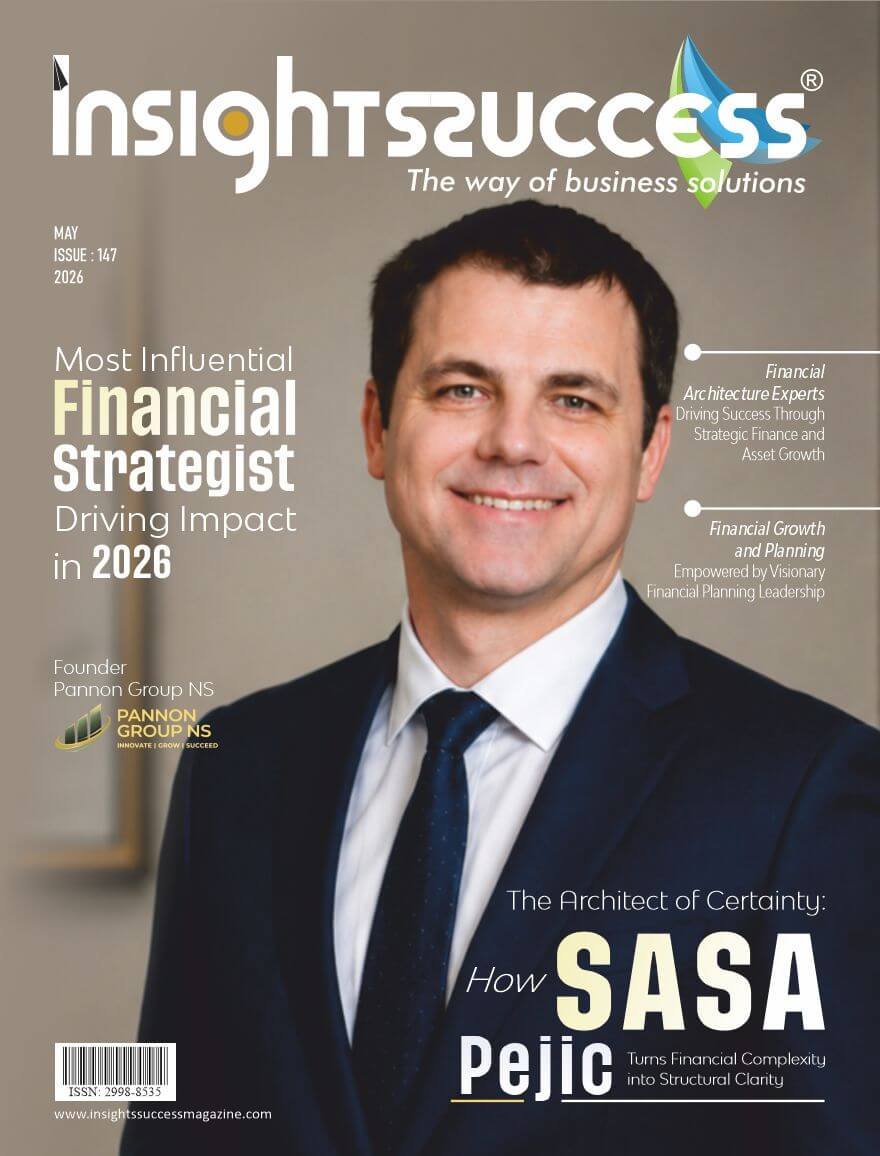
Most Influential Financial Strategist Driving Impact in 2026
Most Influential Financial Strategist Driving Impact in 2026 Honoring an exceptional financial strategist whose visionary leadership, innovative financial expertise, and strategic decision-making are driving business growth, economic resilience, and transformative industry impact while setting new benchmarks for excellence in 2026. Digital Link Quick highlights Quick reads

The Architect of Certainty: How Sasa Pejic Turns Financial Complexity into Structural Clarity
Most people learn about financial risk from textbooks. A few learn it from markets. And then there are those who learn it from life itself, from watching currencies collapse. Institutions fail, and carefully built wealth disappear not because someone made a bad investment, but because no one had built the right structure to protect it. That kind of education does not come with a certificate. It comes with a perspective that no classroom can manufacture, and no bull market can replicate. Sasa Pejic carries that perspective into every conversation, every client engagement, and every financial structure he builds. As the driving force behind Pannon Group NS, he has spent over a decade applying a philosophy of financial architecture that prioritizes stability, structure, and long-term clarity over the seductive promise of short-term performance. His reputation as an influential financial strategist today does not rest on a single spectacular call or a lucky market cycle. It rests on something far more durable: a consistent ability to build systems that hold when conditions deteriorate and perform with discipline when they recover. Impact Is Not a Number. It Is a Structure. Ask Sasa how he defines impact in today’s financial environment and he does not reach for the obvious answers. He does not talk about returns, rankings, or revenue. He talks about pressure. “Impact is not measured by short-term returns or isolated successes, but by how well a financial structure performs under pressure.” In his view, a strategy that only works when conditions are favorable is not a strategy at all. It is timing. And timing, as he puts it plainly, is not a reliable foundation for long-term decisions. This framing shapes everything about how Sasa approaches his work. True impact, in his definition, means building systems that remain stable across different market conditions: protecting capital, maintaining liquidity, and enabling controlled growth even as volatility increases. The bar he holds himself to is not whether a portfolio gained during a good quarter. It is whether the structure was held during a bad year. He also draws a dimension of impact that most purely quantitative strategists overlook: the relational one. Financial structure, he argues, is not only numerical. Access to the right information, perspectives, and opportunities through networks and collaboration with experts in key financial hubs often determines how well a structure adapts over time. What used to be considered advanced portfolio thinking, currency diversification, geographic risk allocation, multiple income streams, has become a baseline requirement for anyone serious about capital preservation. Three Thousand Reports and One Defining Childhood Two formative experiences shaped the strategist Sasa. One was professional. One was personal. Together they created a thinker who does not separate financial theory from human reality. The professional shaping came through the discipline of financial reporting. Working across more than 3,000 financial reports fundamentally changed how he processes information. In that environment, assumptions do not survive. They get tested, exposed, and either validated or discarded. He learned quickly that precision matters, but structure matters even more. Numbers without architecture are just noise dressed up in columns. Combined with his experience in banking and corporate finance, that discipline pushed him toward a philosophy where decisions are driven not by optimism but by a clear understanding of risk. He learned to recognize market trends and business patterns with the same fluency that others read balance sheets, because in his experience, those patterns often contain more relevant information than the numbers themselves. Personal shaping came from growing in Southeast Europe during the 1990s, a period of profound political and economic instability that left a permanent mark on an entire generation. Sasa watched firsthand what happens when structures fail and diversification is absent. That experience did not make him pessimistic. It made him precise. “Diversification of risk and understanding the broader context are essential for protecting and preserving capital over the long term.” For him, that is not a theoretical principle drawn from a finance textbook. It is a live truth. Risk Management Is Not the Enemy of Growth One of the most persistent misconceptions in finance is the idea that risk management and growth exist in tension, that protecting capital means forfeiting opportunity. Sasa dismantles that assumption with a clarity that reflects years of practical experience on both sides of the equation. “Risk management is not the opposite of growth. It is a condition that makes growth sustainable.” He structures that belief into a layered architecture. At the core sits stability: liquidity, capital protection, and predictable income streams. Around that core, he builds outward toward growth, innovation, and opportunity. The sequence matters. You cannot build durably on an unstable foundation, and capital allocated toward aggressive strategies without a protected core is not investing. It is speculation. He pays particular attention to inflation, which he identifies as one of the most underestimated risks in today’s financial environment. It does not create immediate pressure. It works slowly and silently, often reducing real purchasing power by 2–5% annually without triggering immediate concern. Protecting the core, in Sasa’s framework, is not simply about avoiding losses. It is about maintaining real value against an adversary that most clients do not even recognise they are fighting. When Structure Changes Everything Sasa is not a strategist who speaks abstractly. He grounds his philosophy in outcomes, in the moments where the right structure made a measurable difference to a real person’s financial life and emotional wellbeing. One case that stands out involves a client approaching retirement with a significant portfolio of real estate and cash, but no coherent architecture binding those assets together. On paper, the numbers looked strong. In practice, there was no clear integration of income, inflation, and longevity planning, which meant the apparent strength concealed real uncertainty about whether the portfolio could sustain the life the client had planned. Through scenario-based planning that aligned rental income, dividend flows, liquidity, and currency exposure, Sasa moved the client from uncertainty to clarity. The numbers did not change dramatically. The structure did. And with that

Empowered by Visionary Financial Planning Leadership
Financial Growth and Planning Every organization reaches a point where good intentions are no longer enough. Budgets get tighter, markets move, and the distance between where a company is right now and where it wants to reach becomes hard to ignore. What separates companies that push through from those that stagnate is rarely luck. It is the quality of their financial planning leadership and how seriously they treat it as a strategic function. The businesses that grow with consistency are those that treat finance not just as a back-office function, but as a core driver of decisions at every level. When the right people are leading financial conversations, the whole organization moves with greater clarity and purpose. This is what genuine financial growth and planning look like in practice. Strategy Before the Numbers Most financial problems in organizations are not really number problems. They are thinking problems. Leaders who approach finance reactively, responding to crises rather than anticipating them, tend to find themselves in the same difficult positions repeatedly. Strong financial planning leadership begins with a shift in mindset. This means that the plan is being created with future months and years in mind, and not just the present month or quarter. When strategizing happens before counting, then counting becomes easier. It enables leaders to develop financial strategies based on sound objectives that make it easier for them to plan, foresee potential risks, and make well-calculated decisions. Such an attitude makes all the difference between a reactive financial function and a proactive one, and it is the foundation of sustainable financial growth and planning. Aligning People With Financial Goals One of the often neglected areas of financial planning leadership is its human component. No matter how good your financial plan may be, the execution of the plan will mean nothing if you do not have people on your side who know what they must do to make the plan work. Leaders who effectively communicate their goals to their teams usually enjoy much more success than those who keep such things private. Financial development and planning become much easier when made everyone’s problem, not just the finance department’s. When sales, operations, and product teams understand how their work connects to financial outcomes, they make smarter decisions day to day. Alignment between people and financial goals is not a soft concept. It is among a company’s most useful tools for enhancing performance. Adapting to Market Realities Markets do not stay still, and neither should financial plans. What makes financial planning leadership great is the ability to be flexible but not directionless. Financial planning leaders ensure that their plans remain flexible enough to incorporate changes while remaining detailed enough to provide guidance. Failure to embrace changes will result in the failure of these plans since circumstances might abruptly change. Adaptability brings real benefits for organizations. They create review cycles, track leading indicators, and maintain clear decision-making protocols for when assumptions no longer hold. Financial growth and planning done well is not a fixed document produced once a year. It is a living process that evolves alongside the business and the environment it operates in. Measuring What Actually Matters Many organizations collect a great deal of financial data but struggle to act on it. The issue is often not a lack of information but a lack of focus on the right metrics. Instead of generating large amounts of data that no one uses to make choices, effective leadership is about determining which figures actually represent the health of the company and developing reporting around those. With clear insight into what is being measured and for what purpose by the leaders, financial growth and planning become a far more exacting process. Organizations no longer chase irrelevant measures, but concentrate on those that can have a direct impact on profitability and sustainability. The discipline of measuring what matters is what turns financial planning from an administrative exercise into a competitive strength. Conclusion: Building a Stronger Financial Future Sound financial planning leadership does not happen by accident. The outcome comes from deliberate choices and the ability to keep the organization accountable to itself and to its goals. Businesses that choose to develop such skills on the executive level usually perform better compared to companies that do not prioritize finances. Financial growth and planning are only part of the story. They represent much more than mere figures and arithmetic. They represent the capability of growth and change, and the creation of something enduring. When these elements become priorities for the business leaders, success is guaranteed. Read Also : Strengthening Financial Security Through Transaction Monitoring Solutions

Driving Success Through Strategic Finance and Asset Growth
Financial Architecture Experts Scaling takes work, not fortune. The businesses that grow year over year are built on leadership that makes sound capital decisions, maintains tight financial systems, and keeps the focus firmly on what drives the business forward. For B2B enterprises, the difference between compounding growth and a frustrating plateau rarely comes down to the product or the market. It comes down to how seriously the business treats strategic finance and asset growth as a non-negotiable operational priority. This is not a conversation about accounting. It is a conversation about how financial structure drives operational performance, influences market positioning, and determines whether a business has the capacity to pursue opportunity when it appears. Why Financial Architecture Defines Enterprise Trajectory B2B enterprises face a specific set of financial pressures. Long sales cycles, complex client relationships, multi-layered procurement processes, and high-value contracts all demand a financial infrastructure that is responsive, transparent, and built for sustained performance. Financial architecture experts work at this level. They assess how capital moves through the business, where structure is creating friction, and where better design would unlock performance. The deliverable is not a report. It is a functional financial framework that leadership can operate from with clarity and confidence. Without that framework, businesses make reactive decisions. Urgency drives most capital decisions in businesses that lack financial structure. Money goes where the loudest problem is, assets pile up without purpose, and the areas that would actually move the business forward never get the investment they need. Every financial decision gets made with a reason and measured against a result. That is what strategic finance and asset growth build into a business. Building Assets That Generate Enterprise Value In B2B markets, asset strength is a credibility signal. Before a long-term contract gets signed, clients want to know the business they are committing to can actually deliver at scale. Investors want proof that what a business owns is being managed well before they commit any capital. Partners need to see a stable financial foundation before they are willing to put anything in writing. Financial architecture experts help enterprises build asset portfolios that communicate competence, not just size. The focus is on ensuring that every significant asset on the balance sheet is earning its place, contributing to revenue generation, competitive positioning, or operational efficiency. This is what separates asset accumulation from asset strategy. Businesses that approach strategic finance and asset growth with this level of rigor build balance sheets that work in their favor, in conversations with investors, in negotiations with clients, and in decisions made at the leadership table. Aligning Financial Structure With Business Strategy The most common financial challenge facing B2B enterprises is not a lack of revenue. It is a misalignment between financial structure and strategic direction. Businesses grow and strategies evolve, but the financial architecture underneath often does not keep pace. The result is a structure that was built for a version of the business that no longer exists, now being asked to carry a business it was never designed for. Financial architecture experts identify and resolve this misalignment. They review capital structure, assess how investment decisions are being made, evaluate debt and equity positioning, and build the frameworks that allow leadership to put resources where the strategy actually demands them. Once that alignment is in place, the business stops second-guessing itself. Priorities become clearer, capital stops chasing noise, and growth has a structure underneath it that can hold the weight. For any B2B enterprise serious about scaling, strategic finance and asset growth are not functions to revisit once a year. It is something leadership stays close to every quarter. Looking Ahead Enterprises that treat strategic finance and asset growth as a permanent operational priority build a financial profile that holds up under scrutiny from every direction. Lenders see a well-managed structure and offer better terms. Partners see financial discipline and move with more confidence. Clients see a business built to deliver and sign with fewer reservations. The contribution of financial architecture experts to this outcome is direct. By designing financial systems built specifically for the demands of B2B enterprise growth, they stop being advisors who show up when something breaks and become partners embedded in how the business thinks, plans, and performs. Businesses that have not yet engaged financial architecture experts at a strategic level are likely leaving both performance and capital on the table. The businesses making this investment now are the ones that will be setting the terms in their markets five years from now. For B2B leadership serious about building something that lasts, the starting point is always the same. Get the financial structure right. Everything that follows becomes significantly easier. Read Also : Empowered by Visionary Financial Planning Leadership

Goldman Sachs Raises S&P 500 Target on Strong Earnings Outlook
Prime Highlights- Goldman Sachs raised its 2026 S&P 500 target to 8,000 on expectations of strong corporate earnings growth. AI infrastructure and semiconductor companies are expected to drive a large share of market earnings growth. Key Facts- Goldman Sachs increased its 2026 earnings-per-share forecast for the S&P 500 to $340. The S&P 500 is a major U.S. stock market index that tracks leading publicly traded companies. Background- Goldman Sachs has raised its 2026 year-end target for the S&P 500 to 8,000 from 7,600, reflecting growing confidence in corporate earnings and continued strength in the U.S. stock market. The revised target is higher than the index’s recent closing level and signals optimism about business performance in the coming months. The investment bank said higher company profits have helped push the S&P 500 upward this year and are expected to keep supporting market performance ahead. Goldman Sachs also increased its earnings-per-share forecast for 2026 to $340, representing strong annual growth. It further raised its 2027 estimate to $385, pointing to continued momentum in corporate profits. The firm highlighted that companies linked to AI infrastructure are expected to contribute nearly half of the index’s earnings growth this year. It said rising investments in artificial intelligence are helping offset challenges such as inflation pressures, higher costs, and weak consumer spending. Semiconductor companies connected to AI infrastructure were also identified as key contributors to market growth. The latest revision adds to a series of positive market outlooks from major brokerages, with several firms citing strong AI-driven earnings and steady investment activity. Analysts said earnings forecasts for S&P 500 companies have continued to increase, especially for semiconductor firms benefiting from strong AI demand. The outlook reflects growing confidence that technology investments and strong corporate performance will continue supporting market growth despite global economic uncertainties and cost-related pressures across industries worldwide. Read Also : PingPong and Visa Launch B2B Card Payment Tool for Global Supplier Transactions

Forklift Collision Avoidance Systems are a MUST for Real Time Safety and Risk Reduction
If you walk through a high-velocity plant today, you see the same thing everywhere. Yellow floor tape. Drivers honking at blind corners. It’s a safety strategy built on hope. But hope doesn’t stop a multi-ton vehicle when an operator is tired or a pedestrian is distracted by a handheld scanner. Narrow margins in these aisles mean one second of lost focus leads to a life-changing accident. You need more than just “awareness training” or signs that everyone ignores. You need an active forklift collision avoidance system that acts as a digital shield. It’s about technology that sees what a human driver physically cannot, reacting instantly to keep the floor moving without a constant threat of disaster. Financial Loss Due to A Near-Miss Forklift Accident Accidents aren’t just tragic. They are expensive disruptions that kill your momentum. Every time a truck clips a rack or nudges a worker, the entire facility stops. Investigations start. Insurance premiums spike. The legal liability alone can swallow a year’s worth of profit. Moving Beyond Defensive Safety with Real-Time Forklift Monitoring These incidents force you into a defensive, reactive posture. Instead of scaling your output, you are stuck managing a crisis. An active safety layer stops this cycle before the first report is ever filed. Your team is the engine of the facility. They should focus on their tasks without worrying about a vehicle coming around a blind corner. Optimizing Flow Through Engineered Forklift Safety True operational efficiency is impossible if your workforce is constantly operating in fear. When you integrate high-level safety logic into your daily flow, you do more than just prevent injuries. You streamline the movement of goods. This is a critical component of manufacturing process automation because it removes the unpredictable human variables that cause bottlenecks. You shift from a culture of blame to a culture of engineering. Identifying Hidden Risks in Heavy-Industry Environments Data-driven safety gives you a window into the near misses that nobody reports. If one specific intersection sees ten near-collisions a day, you fix the layout now. This level of visibility turns safety from a cost center into a strategic advantage for your production line. Solving the Alarm Fatigue Issue with Real-Time Data Standard safety gear is loud. It beeps for everything. Eventually, the human brain just tunes it out. If a buzzer sounds every time a forklift passes a static pole, it becomes background noise. Filtering Out the Noise That sensory overload is dangerous. It masks the one alert that actually matters. Modern tracking changes by differentiating between a trash can and a human being. The alerts become rare and relevant. Targeted Real-Time Forklift Proximity and Impact Alerts When that alarm triggers, the driver knows it is a real threat. That is how you get an actual response instead of just more noise. You create a workspace where confidence replaces constant looking over the shoulder. This allows for a much higher velocity of work across every shift. Agnostic Safety: No More OEM Vendor Lock-In Trouble Many plants have a patchwork of different truck brands. Usually, their built-in safety features do not talk to each other. This leaves huge gaps in your protection. You end up with one brand of truck that cannot “see” a worker wearing a different brand’s tag. Breaking Data Silos The future of the industrial floor is agnostic. You need a unified safety layer that works across every piece of equipment you own. No matter the manufacturer. This open architecture protects your budget and ensures your safety standards are the same across the site. Unified Standards with LocaXion’s Tailored Approach You should not be forced to buy specific trucks just to keep your people safe. A vendor-neutral approach ensures that the receiving dock follows the same high-level safety protocols as the final assembly line. It’s about protecting the business, not the vendor’s sales quota. Engineering an Accident-Free Factory Floor True control means having a digital twin that mirrors what is actually happening on the concrete. You stop hoping for a safe shift and start engineering one. By mapping how people and machines interact, you kill the blind spots that threaten your ROI. This isn’t about just tracking. It’s about dominating your physical space so your production stays on schedule and your people go home safe. LocaXion is the world’s first pure-play RTLS and Digital Twin systems integrator. We engineer systems for your business outcomes, not just tracking. That means less risk, less integration of guesswork, and faster time-to-value. Because we are not locked to one technology stack, you get the freedom to scale with the right technology, not the technology we happen to sell. RTLS tracks your assets. LocaXion transforms how your operation runs. That is the difference. And it is not a small one. Stop hidden safety risks and wasted margins and engineer your outcomes today at https://locaxion.com/ Read Also : 7 Signs a School Placement Process Needs Updating

Modesto Gutiérrez Losada: Engineering Mexico’s Patrimonial Revolution
From Rent to Wealth: Generational Wealth Through Homeownership Forged in Failure Among the leaders recognized in this year’s “Top 10 Most Influential Leaders in the Finance Industry”, few embody the transformative power of purpose-driven finance as completely as Modesto Gutiérrez Losada. For three decades, the founder and CEO of Tu Casa Express has waged a quiet revolution—building Mexico’s most innovative self-financing company and proving that homeownership and generational wealth are not privileges reserved for the affluent, but achievable goals for millions of families that the traditional banking system deliberately chose to ignore. His path was anything but conventional. Before Tu Casa Express, there was failure—the kind that strips away illusions and reveals what a person is truly made of. Newly married, carrying debt, and facing the wreckage of a collapsed business venture, the young entrepreneur from Mexico City didn’t retreat into self-pity or blame. He absorbed the blow, extracted every lesson it had to offer, and began rebuilding with a clarity that only adversity can sharpen. “Failure taught me humility,” he says with the steady conviction of someone who has lived every word. “You have to work hard; you have to have great ideas. But the most important part is the execution and your team.” Drawing on his formative years as an amateur soccer goalkeeper—playing with fierce intensity on the fields of Colegio Vista Hermosa and ITAM in Mexico City—Modesto internalized a lesson that would define his entire career: the best players are not necessarily born with the most talent. They are the ones who “practice and learn more things with humility to be the best.” That philosophy—equal parts discipline, relentless hunger, and genuine humility—became the operational DNA of every company he built. The Birth of the Financial Bridge: Tu Casa Express and the Crisis of 1995 The Mexican financial landscape in 1995 was a brutal fortress—especially for the millions of hardworking citizens who constituted the country’s aspirational “missing middle.” As interest rates skyrocketed past 100% annually during the Tequila Crisis, traditional banks retreated into safe, commission-based models, slamming the door on aspirational families, first-time homeowners, single mothers, young professionals, and small business entrepreneurs. The mortgage market collapsed for ordinary Mexicans. Modesto, fresh from a stinging business failure, didn’t see ruin. He saw an ocean of underserved potential and recognized a truth the entire banking establishment had chosen to ignore: “Somebody has to take the risk, and somebody has to trust in the people.” His solution was a financial masterstroke imported from Brazil: Autofinanciamiento—a transparent, collective self-financing model that allowed everyday people who couldn’t qualify for bank loans to affordably purchase a home. With nothing to lose and everything to win, he launched Tu Casa Express in 1995 and became the pioneer of real estate self-financing in Mexico. The model was not naïve trust—it was engineered trust. Client resources were protected through bank-administered trusts. Adjudications were contractually guaranteed. More than 30 tailored financing plans accommodated every family situation. Governance structures met the standards expected of the most regulated financial institutions in the country. “We trust them,” Modesto says simply. “We know that they are able to pay, they want to pay, and they need the credit.” For these families, Tu Casa Express was not merely a financial provider—it was a partner in life planning, a bridge between where they were and where they deserved to be. Tu Casa Express didn’t just offer financing. It offered a lifeline—a way for hardworking Mexicans to stop paying rent that built someone else’s wealth and start building their own. The company’s DNA—Highly Productive, Deeply Human, Socially Responsible—was not a marketing slogan. It was, and remains, a daily operational commitment that governs every decision, every product, and every interaction with the families it serves. Expanding the Ecosystem: Financiera Mexicana Finamigo, OpenPay, and the Architecture of Inclusion Modesto’s commitment to financial inclusion didn’t stop at housing. He understood that for millions of Mexicans, the struggle begins far below the dream of homeownership—at the level of day-to-day survival. That conviction led him to co-found Financiera Mexicana Finamigo, a fully regulated SOFIPO (Sociedad Financiera Popular) that has been a leader in Mexico for 25 years, providing comprehensive financial services to the base of the pyramid—the most forgotten and underserved population that banks have systematically ignored. With more than 60 branches embedded in rural communities across the country, Financiera Mexicana Finamigo’s principal product is productive credit for micro-entrepreneurs: artisans, mechanics, farmers, small-scale merchants, and families running businesses from their living rooms. These borrowers, dismissed by major banks as too small to be profitable and too informal to be trusted, proved to be among the most reliable and highly motivated in the country. This dual strategic focus—securing the home through Tu Casa Express and funding the livelihood through Financiera Mexicana Finamigo—is what truly defines the architecture of Modesto Gutiérrez Losada’s human-centered financial ecosystem. His entrepreneurial instincts also drove him into fintech territory. Modesto co-founded OpenPay, one of Mexico’s most advanced digital payment platforms, which was acquired by BBVA Spain in 2016—marking the first major fintech exit from a Mexican startup to a global bank. The experience reinforced his conviction that technology, when aligned with human purpose, can dramatically expand access and efficiency across entire industries. Future-Proofing Finance: From Bitcoin to Artificial Intelligence From executive programs at Harvard, the London Business School, and IPADE to surrounding himself with young, disruptive entrepreneurs, Modesto’s relentless intellectual thirst ensures he is perpetually operating in the future tense. “We have a culture of always be learning, improving, implementing new things,” he says—a philosophy that has made Tu Casa Express not just a housing company, but a fintech innovator in its own right. That same year OpenPay was acquired, the company made a decisive and surprising move: it became the first self-financing institution in the world to accept Bitcoin payments. While the global financial establishment was still debating the legitimacy of cryptocurrency, Modesto made the executive decision to integrate it—demonstrating a forward-thinking agility that few in the established housing finance sector possess. The company also

The 10 Most Influential Leaders in Finance Industry
The 10 Most Influential Leaders in Finance Industry Showcasing visionaries who are redefining the financial landscape through innovation, resilience, and strategic leadership, The 10 Most Influential Leaders in Finance Industry highlights trailblazers driving growth, trust, and transformation. This edition celebrates leaders whose expertise, foresight, and commitment to excellence continue to shape the future of global finance and business success. Digital Link Quick highlights Quick reads

Small Business Finance Experts Answer Your Most Pressing Questions About Business Loans
Financing Simplified Running a small business, you kind of know, it almost always takes more than just passion and hard work. At some point, every entrepreneur runs into the same sort of problem, like trying to grab the right funding to grow, or just make it through those tough weeks, or even jump on fresh openings. Whether it’s expanding operations, getting better equipment, bringing in employees, or simply keeping the cash flow steady, business loans can become a real crucial piece of the whole journey. Still, dealing with business financing can feel overwhelming. Interest rates, repayment terms, credit requirements, and all the different lender options usually leave business owners feeling a bit unsure, like they’re staring at a map without labels. And honestly, it’s easy to feel tangled up when you’re trying to compare everything all at once. This is exactly where small business finance experts come in. Their experience, plus their everyday direction, helps entrepreneurs make sharper financial choices that actually support lasting progress, not only short-term comfort. In this article, small business finance experts answer a few of the most common and pressing questions business owners ask about business loans. Why Do Small Business Finance Experts Recommend Business Loans? A lot of entrepreneur’s kind of pause before taking a loan because they connect debt with financial risk, and honestly, that feeling is not weird. Still, even small business finance experts say that if the loan is chosen well, it can end up strengthening the business instead of becoming this extra weight that drags everything down. With the right loan, a business can get the capital to fund growth opportunities without draining personal savings or messing with day-to-day work. People in this field often point to using business financing for expanding into a new place, buying inventory or machinery, handling seasonal cash flow dips, recruiting and coaching staff, backing marketing efforts, and improving systems or infrastructure. Basically, it’s less about “spending money now” and more about giving the company room to move. And the main idea, according to small business finance experts, is to borrow in a strategic way. The loan ought to drive income or make operations smoother, not just cover needless costs that could have been avoided in the first place. How Can Small Business Finance Experts Help You Choose the Right Loan? One of the biggest headaches business owners face is going for the first loan they spot. like, just because it’s sitting there doesn’t mean it actually fits or will fit well. Different companies have different financial needs, and honestly, there isn’t one single loan that works like a universal solution for everybody. Most small business finance experts don’t just grab the option that comes up fastest. They usually look at a bunch of things first, before suggesting any type of financing. They check the business size and industry, annual revenue, credit score, current debt commitments, the purpose behind the loan, and also whether the business can handle repayments in a steady way, not in some panicky, stretched-out way. For example, a short-term loan can be a decent match for quick cash flow bumps, while a long-term loan can make more sense for growth plans. And in a similar vein, equipment financing can end up being way more favorable when a business is buying machinery or vehicles, instead of using those funds for general operating expenses. What Do Small Business Finance Experts Say About Credit Scores? Credit scores, honestly, one of those big things lenders keep staring at during loan approval. Still, a bunch of entrepreneurs feel that if their score is low, then it basically means no funding at all. Like instantly, right away, no wiggle room. But small business finance experts say it’s not quite that straightforward. Sure, strong credit can raise your approval chances a lot, and it usually brings better loan terms, but there are still routes available when credit history is thin or not so great. To improve your odds, specialists recommend some basic financial habits: pay bills and any current loans on time. Also, reduce your outstanding debt, and check your credit reports regularly. They even advise keeping your personal cash situation separate from business finances and staying steady with bookkeeping and revenue records. Over time, those kinds of steps show reliability, and they can support a healthier overall financial standing. Why Small Business Finance Experts Stress the Importance of Loan Preparation Getting ready for a loan can really boost the odds of approval. A lot of business owners jump straight into the application, like right away, and then they don’t bother arranging financial records properly, or even fail to spell out their funding aims in a clear way. It’s kind of common, but it usually causes problems later. Small business finance advisors often tell entrepreneurs to gather the key paperwork first. For example, a thorough business plan, profit and loss records, tax returns, bank statements, cash flow forecasts, and the relevant legal business documents, all of which should be in place before approaching any lender. When things are prepared the right way, lenders can evaluate the company more precisely, and it also leaves a better vibe during the decision process. It feels more organized, more credible, less improvised. Lenders also look for signals that the applicant genuinely understands the business, not just the idea of it financially. They want to see a sensible repayment route, something realistic. Good preparation shows professionalism, and that helps build trust quickly. Another thing experts emphasize is figuring out the right funding amount. If someone asks for too little, the business might still be stuck. If they request too much, it can add extra repayment pressure, almost like an unnecessary weight. What Are the Most Common Loan Mistakes According to Small Business Finance Experts? Even successful entrepreneurs can mess up when it comes to financing, and it can quietly hurt the business later, more than people expect. Small business finance experts keep saying that there are a few common slip-ups that create