





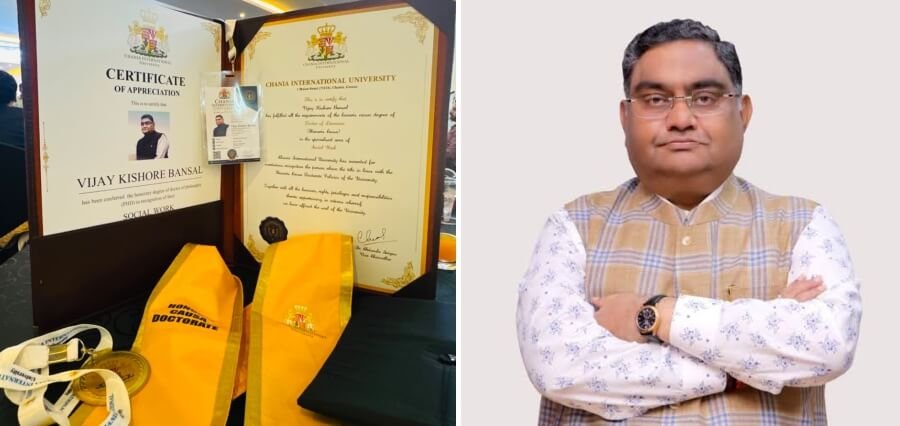
INDIAN HUMANITARIAN DR. VIJAY KISHORE BANSAL HONOURED WITH HONORARY DOCTORATE AT INTERNATIONAL CONVOCATION IN DUBAI
From Agra to Global Recognition — An Unsung Business Leader’s Extraordinary Journey of Service Dubai, United Arab Emirates | 28 June 2026 Indian entrepreneur, printing industry leader, philanthropist, and humanitarian Dr. Vijay Kishore Bansal was conferred the prestigious Honorary Degree of Doctor of Literature Honoris Causa in Social Work by Chania International University, Greece, during its International Convocation held at the Seven Seas Hotel, Dubai, on 28 June 2026. The honorary doctorate was awarded under the authority of the University’s Vice Chancellor, Dr. Chrisoula Sirigou, in recognition of Dr. Bansal’s decades-long contribution to humanitarian service, education, healthcare, tribal welfare, elderly care, disaster relief, and sustainable community development. The international ceremony was attended by distinguished dignitaries including Mr. Haanif Shaikh, Chairman, Emirates Holding Group; Mr. Ahmed Al Mahmoo, Board Member, Dubai Quality Group and Strategic Planning Advisor to the Government of Sharjah; Mr. Abdullah Aljaffali, VIP Guest; Dr. Amb. Isha Farha Quraishy, Associate Vice President – Cloud Infrastructure & AI, Public Sector MEA, Coforge; and Dr. Priti Tagde, President, PRISAL Foundation India, who attended the ceremony as Guest of Honour. Rooted in Agra, Dr. Bansal built his journey through discipline, enterprise, social responsibility, and deep compassion for people in need. His life reflects a rare balance of business leadership and humanitarian commitment, where success was never seen only as personal progress but as a responsibility toward society. For him, entrepreneurship has always carried a larger meaning. Business was not merely a way to create financial growth, but a platform to create opportunities, support families, strengthen communities, and serve those who had no one to stand beside them. This vision gradually shaped his identity as a leader whose work connects enterprise with empathy. Over the years, he has remained committed to serving people quietly and consistently, without seeking publicity. Those who know him describe him as an unsung hero who believes that genuine charity should remain silent and that true leadership is measured not by applause, but by the number of lives transformed. According to information presented during the convocation, his initiatives have supported more than 25,000 students through educational assistance, scholarships, books, uniforms, food support, and residential help. His commitment to education reflects his belief that a single educated child can uplift an entire family and change the direction of future generations. His healthcare initiatives have benefited more than 150,000 patients through medical consultations, medicines, diagnostic services, surgeries, and treatment support. For economically weaker families, such support has often meant timely treatment, restored dignity, and renewed hope during moments of deep difficulty. Dr. Bansal has also supported the dignified marriages of more than 4,000 tribal daughters, helping families overcome financial hardship while preserving cultural values and dignity. His work further extends to old-age homes, orphanages, shelter homes, and community welfare institutions, providing food, healthcare, clothing, accommodation, and emotional support to vulnerable individuals. During the COVID-19 pandemic, Dr. Bansal led large-scale humanitarian relief initiatives that facilitated the distribution of more than 2.5 million food and relief packets to migrant workers, daily wage earners, and vulnerable families. His relief work also received international acknowledgement, including recognition by the World Book of Records. Today, his humanitarian initiatives extend across more than 150 cities throughout India, reaching communities through education, healthcare, tribal welfare, elderly care, disaster response, and social development. Dr. Bansal’s humanitarian journey has received honours and recognition from more than 40 countries, reflecting the global respect earned through his decades of selfless service. These international awards and acknowledgements stand as a testament to his lifelong commitment to humanity, compassion, and social upliftment. Accepting the honorary doctorate in Dubai, Dr. Vijay Kishore Bansal dedicated the recognition to every volunteer, educator, healthcare professional, social worker, supporter, and beneficiary who has been part of his lifelong mission. He described the honour as a renewed responsibility to continue serving humanity with greater dedication. The recognition by Chania International University is not only an academic honour, but also a global acknowledgement of a life devoted to meaningful impact. It celebrates a man who has consistently chosen humanity over headlines and service over self-promotion. From a respected entrepreneur rooted in Agra to a humanitarian honoured across more than 40 countries, Dr. Vijay Kishore Bansal’s journey stands as a powerful reminder that the greatest legacy is not built through fame or fortune, but through the countless lives uplifted by compassion, purpose, and selfless service. About Dr. Vijay Kishore Bansal Dr. Vijay Kishore Bansal is an Indian entrepreneur and humanitarian based in Agra, India. A leader in the printing and publishing industry, he has directed large-scale philanthropic initiatives across education, healthcare, tribal welfare, elderly care, and disaster response in more than 150 cities across India. His work has been recognised by institutions in more than 40 countries, including the World Book of Records. He is the recipient of the Honorary Degree of Doctor of Literature Honoris Causa in Social Work, conferred by Chania International University, Greece, in 2026. Disclaimer: This press release has been prepared for public relations and informational purposes only and may be distributed across digital media platforms with the full knowledge and consent of the subject. All referenced names, organisations, and associated marks remain the property of their respective owners. Unauthorised reproduction or modification without prior written permission is strictly prohibited. Read Also: UDAAN: How Dharmendra Sharma Is Building India’s Next Great Movement in Motivational Leadership

Can You Recover Compensation After a Distracted Driving Accident in Florida?
Yes, you may be able to recover compensation after a distracted driving accident in Florida if another driver’s negligence caused your injuries. Depending on the circumstances, compensation may be available for medical expenses, lost income, property damage, and other accident-related losses. Distracted driving remains one of the most common causes of traffic collisions across the state. A quick glance at a phone, adjusting a navigation system, or even eating behind the wheel can take a driver’s attention away from the road at a critical moment. These seemingly small actions can have serious consequences for other motorists, passengers, cyclists, and pedestrians. As a result, distracted driving accidents continue to generate thousands of injury claims each year. What Is Considered Distracted Driving? Distracted driving occurs whenever a driver’s attention shifts away from operating the vehicle safely. Distractions generally fall into three categories: Visual distractions, such as looking at a phone Manual distractions, such as removing hands from the wheel Cognitive distractions, such as focusing on something other than driving Texting while driving is particularly dangerous because it often involves all three types of distraction at the same time. Florida’s No-Fault Insurance System Florida operates under a no-fault insurance system. After an accident, injured parties typically turn to their own Personal Injury Protection (PIP) coverage for initial medical expenses and certain lost wages. However, PIP benefits are limited and may not fully cover serious injuries. When injuries meet Florida’s serious injury threshold, an injured person may be able to pursue additional compensation from the at-fault driver. Proving the Other Driver Was Distracted To recover compensation beyond available no-fault benefits, it is often necessary to establish that another driver’s negligence contributed to the crash. Evidence may include: Police reports Witness statements Traffic camera footage Cell phone records Vehicle data recordings Accident reconstruction findings The stronger the evidence, the easier it may be to demonstrate how distraction contributed to the collision. Types of Compensation Available The compensation available after a distracted driving accident depends on the specific circumstances and severity of the injuries. Potential damages may include: Medical bills Future medical treatment costs Lost wages Reduced earning capacity Property damage Pain and suffering Each case is unique, and the value of a claim often depends on the extent of the injuries and their impact on daily life. What if You Were Partially at Fault? Some accident victims worry that they may not qualify for compensation if they contributed to the crash in some way. Florida follows a modified comparative negligence system. This means compensation may be reduced based on a person’s percentage of fault. If another driver was primarily responsible because they were distracted, compensation may still be available even if multiple factors contributed to the accident. Why Acting Quickly Matters Evidence can disappear quickly after a distracted driving accident. Witness memories may fade, surveillance footage may be overwritten, and important records may become more difficult to obtain. Taking prompt action can help preserve evidence and strengthen a potential claim. Seeking medical attention quickly is also important because medical records often play a significant role in documenting injuries. Key Takeaways Compensation may be available after a distracted driving accident in Florida. Distracted driving includes visual, manual, and cognitive distractions. Florida’s no-fault insurance system provides initial coverage through PIP benefits. Serious injuries may allow victims to pursue claims against the at-fault driver. Evidence such as phone records and witness statements can help prove distraction. Compensation may cover medical expenses, lost income, and pain and suffering. Acting quickly helps preserve important evidence and strengthen a claim.

Visionary CEO in African Travel and Tourism Development -2026
Visionary CEO in African Travel and Tourism Development -2026 This edition celebrates leaders transforming Africa’s tourism landscape through innovation, sustainability, and community-driven growth. Featuring Dancan Kiiza, this edition explores visionary leadership, strategic investments, and groundbreaking initiatives that elevate African destinations, empower local communities, and position the continent as a globally competitive and sustainable travel destination. Digital Link Quick highlights Quick reads

Tourism Industry Innovation in the Age of AI
Digital Disruption There are many industries being transformed using Artificial Intelligence (AI) like never before, and the one that has undergone drastic changes due to AI is the tourism industry. By offering personalized vacation recommendations, advanced customer service, and using predictive analysis, AI is changing the way people travel in a whole new way. Since travelers are focusing more on convenience and efficiency, the businesses in the travel industry have no choice but to embrace technology. The future of travel is all about crafting experiences through innovation. Tourism Industry Innovation Is Reshaping the Traveler’s Journey Expectations of today’s travelers are quite distinct from those of their predecessors. The present-day tourist needs an individualized vacation plan based on his own preferences and budget. Analyzing the preferences of the client, his past behavior, AI technology makes it possible to create individual travel plans for clients. It may range from suggesting hidden pearls of the destination or booking hotels according to the dietary habits of the tourist, to changing the travel route according to the weather forecast. Not only is it helpful in increasing customer satisfaction but also builds loyalty toward the brand. In addition, the role of AI assistants became critical for the trip as they offer immediate responses to the tourists’ questions. Tourism Industry Innovation Through Smarter Business Operations Behind each successful trip is an intricate web of operations including airlines, hotels, tour operators, and destination managers. The role of AI is to help enterprises become efficient in performing such operations through automation of redundant tasks and data analysis. AI is already assisting hotels to predict their occupancy rates, optimize pricing of rooms, and manage resources. Predictive analytics are being used by airlines to optimize scheduling, decrease flight delays, and plan maintenance processes. The use of intelligent technologies allows travel agencies to recognize trends in the travel market and customer preferences, which will help them come up with more appealing travel packages. Also, it allows staff members not to perform administrative tasks and concentrate on developing customer relations. In other words, the purpose of AI is not to substitute for professionals, but to assist them. Tourism Industry Innovation Enhancing Sustainable Travel Sustainability is an important issue in the world of tourism. With growing environmental concerns among tourists, AI provides several ways to ensure sustainable growth of the industry. With the help of smart technologies, the number of tourists visiting famous places could be monitored by authorities so as to avoid overpopulation and conserve the environment there. The transportation could be made efficient with the help of artificial intelligence and intelligent energy management would ensure reduction in the use of electricity and water in the hotels. The data analysis through AI would help the tourism departments find out travel trends during different seasons and promote visits to the less explored locations, thus promoting local community and conserving the environment and culture for posterity. Tourism Industry Innovation Improving Safety and Risk Management Sustainability is an important issue in the world of tourism. With growing environmental concerns among tourists, AI provides several ways to ensure sustainable growth of the industry. With the help of smart technologies, the number of tourists visiting famous places could be monitored by authorities so as to avoid overpopulation and conserve the environment there. The transportation could be made efficient with the help of artificial intelligence and intelligent energy management would ensure reduction in the use of electricity and water in the hotels. The data analysis through AI would help the tourism departments find out travel trends during different seasons and promote visits to the less explored locations, thus promoting local community and conserving the environment and culture for posterity. Tourism Industry Innovation Creating Immersive Digital Experiences Among the most promising advancements in the tourism industry is the emergence of immersive digital experiences through artificial intelligence (AI). Virtual visits, augmented reality, and intelligent recommendations change the way tourists learn about destinations before they visit them. Museums provide interactive tours through AI that adjust the narrative according to the interests of tourists. History sites employ augmented reality technology to create an experience of ancient civilizations for tourists. Destination marketing organizations use AI to develop customized promotional material and encourage tourists to visit different places. Not only do these technologies attract tourists, but they also provide them with more knowledge and information about destinations, thus helping them to make better decisions. The Human Element Behind Tourism Industry Innovation Although the development of artificial intelligence is rapid, tourism is still a human-based business. It is because technology helps to manage data and perform routine work and make suggestions, but hospitality and empathy and culture can only be performed by humans. Effective touristic companies understand that artificial intelligence is there to improve human experience, not to substitute it. Staff with intelligent tools can save time on routine tasks and use the time on providing unforgettable experiences for their customers. It may be pleasant for travelers to have effective booking services and online customer support; however, they will always be keen on having real communication with locals, service at hotels, and meaningful interaction with the community. Looking Ahead: The Future of AI in Tourism The future of tourism will be formed by organizations that manage to combine innovation and consumer orientation. AI will develop further and give rise to smart transport systems, predictive travel planning, self-service and more personalized travel experiences. Nonetheless, the future of tourism will not depend on technological innovation alone. Trust, transparency, ethical AI applications and sustainable development will also be critical factors of success in the future of the industry. Companies that develop responsible innovations and preserve at the same time the emotional aspect of traveling are going to be the winners. As AI evolves continuously, there is a unique chance for the tourism industry to reinvent itself for a new generation of travelers, making travel experiences sustainable, efficient, accessible and more meaningful than ever before. Innovation in the tourism industry is not just the adoption of advanced technologies anymore;

Investment Opportunities in African Tourism Development
A New Frontier for Global Capital There are some of the greatest places to visit on earth, and such places are found in Africa. The continent has wildlife reserves and beautiful beaches, modern cities and ancient history. There are countless opportunities here that may appeal to diverse tourists. In line with the current developments in the tourism sector around the world, Africa stands out in terms of possibilities. Today, the development of tourism in Africa has not only involved the promotion of destinations but extends to infrastructure, technology, sustainability, hospitality, and much more. Why African Tourism Development Is Attracting Global Investors? Despite the significance of the tourism industry in different African economies, the share of the continent in terms of world travelers is relatively low. But, at the same time, this situation provides a tremendous chance for investment in the industry, which can grow further. There are several factors accounting for the growing popularity of the development of the tourism industry in Africa. The first one is the constantly rising global demand for the genuine travel experience, along with the development of infrastructure and political stability in some parts of the continent, and favorable policies of the states. The second one is the presence of the young labor force. Infrastructure: The Foundation of African Tourism Development There has been evidence showing that investments in infrastructures represent the biggest investment sector for the development of tourism in Africa. Infrastructure is composed of the means of access to tourist attractions using airports, roads, railways, ports, and transport system. Quite a lot of money has been invested in infrastructure in terms of transport, hence making it possible for the two to work together. Investors will be able to benefit from investments in connections between cities and tourist sites. The other area of investment is that of accommodation. The demand for luxuries, eco-lodges, serviced apartments, and hotels is on the rise. Sustainable African Tourism Development Creates Long-Term Value In today’s time, travelers are becoming increasingly environmentally conscious and culturally aware. As a result, the concept of sustainability has become important in the evolution of African tourism. Eco-tourism ventures offer investors an opportunity to gain profits while making an effort to conserve the environment. Wildlife parks, eco-safaris, marine conservation tourism and community-based tourism ventures have proven that profits can be made through sustainable means. Use of renewable energy sources, waste management systems, water conservation projects, and eco-friendly architecture would not only help in improving costs but also save money in the future. Hospitality and Digital Innovation in African Tourism Development Technology is revolutionizing all the processes involved in travel, providing new possibilities for African tourism development. Booking systems, mobile payments, virtual tours, customer relationship management systems, and artificial intelligence assist businesses in enhancing their productivity and customer satisfaction. Entrepreneurial ventures in the hotel industry provide unique services, connecting travelers to accommodation, tour guides, transportation, and culture through digital platforms. This makes travel more accessible while assisting local business owners. The combination of hospitality and technology makes investors ideally placed to benefit from Africa’s fast-growing digital economy. Community Empowerment Through African Tourism Development One of the most positive factors about tourism development in Africa is the potential of generating an inclusive economy. While many sectors tend to favor large cities, tourism tends to generate money in rural areas where the attractions are situated. Community-run lodges, local tour operators, handicraft ventures, cultural centers, and agritourism initiatives provide residents with opportunities to participate actively in the tourism industry chain. By working together with the local community, investors are able not only to enrich their experience and build stronger ties with the stakeholders but also to improve the overall sustainability of their businesses. Emerging Investment Segments in African Tourism Development While the Safari tourism sector continues to attract tourists from overseas, other sectors have evolved that affect the development of tourism in Africa. There has been an increasing trend of medical tourism in some countries in Africa owing to improved medical facilities in those countries. Other sectors of tourism, including wellness tourism, conferences tourism, sports tourism, educational tourism, film tourism, and luxury experiential tourism have grown rapidly too. Adventure tourism, which entails activities like mountain climbing, scuba diving, desert tourism, bicycling, and hiking has gained popularity among young tourists seeking adventure experiences. Tourism at cultural festivals and culinary tourism has also increased in popularity. Challenges That Investors Should Consider Investments in the tourism industry in Africa encounter the same challenges that can be encountered anywhere in an emerging economy. The issues of varying regulations, lack of infrastructure in some regions within the country, environmental risks, and funding constraints have to be taken into consideration. For successful investments, cooperation with the locals, proper market research, understanding of the government regulations, and long-term business approach are important. The key elements for success in tourism investments are risk management and sustainability Conclusion There are new developments that promise to transform the African tourism industry. With more improvement being made to enhance accessibility and diversity in the experiences offered, the investment environment has become increasingly favorable. Given the array of possibilities within different industries, together with the possibility of making a positive difference socially and economically, there is an excellent chance of creating value through sustainable approaches, building local partnerships, and making the most of what is possible. For success in the investment in the tourism industry of Africa, one has to go beyond simply attracting tourists but creating sustainable destinations. Read Also : Tourism Industry Innovation in the Age of AI

Africa Is Not a Destination. It Is a Story: The Leadership Vision of Dancan Kiiza
Most people who enter the travel and tourism industry do so because they love to travel. The ones who build meaningful careers in it stay because they discover something more durable than personal enthusiasm: the understanding that tourism, done with genuine intention, can change lives, protect ecosystems, and preserve cultures that would otherwise disappear without the economic rationale to sustain them. Dancan Kiiza arrived at that understanding early and has never left it. As CEO of Liberty Uganda and Liberty Rwanda, and Founder of Signature Africa, he leads with a clarity of purpose that transforms what could simply be a commercial operation into something that matters to the destinations it serves as much as to the travelers it brings there. Liberty Uganda and Liberty Rwanda, operate within the Liberty International network across two of East Africa’s most compelling and distinctive markets. Kiiza’s leadership of both entities gives him a front-row perspective on how responsible tourism, pursued with genuine commitment and operational excellence, changes both the quality of a traveler’s experience and the trajectory of the communities that host it. The philosophy he has built around both organizations is not a marketing position. It is the organizing principle of every product designed, every partnership forged, and every traveler experience curated under his leadership. He mentions, “What motivates me most is the opportunity to position Africa not simply as a destination, but as a collection of extraordinary experiences that inspire, educate, and connect people from around the world.” East Africa: A Region Unlike Any Other Ask Dancan Kiiza what makes East Africa genuinely special as a tourism destination and his answer is both precise and expansive, the response of someone who has spent years thinking carefully about a subject he cares about deeply. The region offers a combination that exists nowhere else on earth. Kenya’s Maasai Mara, home to the Great Wildebeest Migration and considered one of the Seven Natural Wonders of the World, sits within a country that also offers pristine coastal destinations, vibrant urban tourism in Nairobi, and cultural experiences of extraordinary depth. Tanzania provides Serengeti National Park, Ngorongoro Conservation Area, Mount Kilimanjaro, and the tropical paradise of Zanzibar within a single itinerary. Uganda, the Pearl of Africa, offers mountain gorilla trekking in Bwindi Impenetrable National Park, chimpanzee encounters in Kibale Forest, and the source of the River Nile in Jinja. Rwanda has emerged as one of the continent’s premier high-end destinations, anchored by Volcanoes National Park’s gorilla encounters and infrastructure defined by safety, cleanliness, and genuine investment in sustainable tourism. Burundi and South Sudan add further dimensions: authentic undiscovered experiences, vast wilderness areas, and the remarkable Boma-Bandingilo ecosystem, which hosts one of the world’s largest wildlife migrations and is drawing growing interest from conservation and adventure travelers globally. He highlights, “East Africa offers travelers the opportunity to experience wildlife safaris, mountain adventures, cultural immersion, beach holidays, conservation tourism, and luxury travel within a single multi-country itinerary.” This breadth, combined with improving infrastructure, growing air connectivity, and stronger regional cooperation, positions East Africa as not simply one of the world’s most attractive current destinations but one of its most promising for the decade ahead. Creating Experiences That Stay The difference between a tourism product and a genuinely memorable travel experience is not a matter of budget or luxury. It is a matter of intention, and Dancan Kiiza has built his entire operational philosophy around that distinction. Creating memorable experiences begins with understanding that today’s travelers seek emotional connection rather than a checklist of sites visited. The experiences that Liberty Uganda and Liberty Rwanda design prioritize authentic cultural immersion, genuine community engagement, and the kind of storytelling that gives each destination a voice rather than simply a visual backdrop. Community visits, culinary experiences, cultural performances, and interactions with local artisans are not bolt-on additions to an itinerary. They are the center of gravity. Every destination has a narrative, and his role is to bring that narrative to life in ways that create emotional resonance and produce lasting impressions that turn first-time visitors into advocates who return and bring others. Sustainability and responsible tourism sit alongside this experiential philosophy as operational commitments that shape every product decision. Travelers increasingly want to know their journeys contribute positively to conservation and to the communities they pass through. Integrating social and environmental impact into the tourism product is how you create experiences that are both meaningful and genuinely worth recommending. He states, “Memorable tourism experiences result from authenticity, attention to detail, cultural respect, and a genuine commitment to exceeding expectations.” The Challenges That Leaders Must Face Dancan Kiiza does not talk about African tourism’s challenges from a distance. He navigates them daily with the clarity of someone who understands that acknowledging difficulty honestly is the precondition for addressing it effectively. Connectivity remains one of the most significant structural barriers. Limited direct flight routes, high travel costs, and complex visa processes reduce accessibility for international visitors in ways that require sustained collaboration between governments, airlines, and tourism stakeholders to meaningfully resolve. Perception is another persistent challenge. Outdated global narratives continue to overshadow Africa’s remarkable diversity, requiring strategic destination marketing, digital storytelling, and consistent positive brand positioning to reshape over time. Infrastructure development, climate change, and talent development complete his list of priority concerns. The future growth of African tourism depends on building a workforce capable of delivering world-class experiences across every touchpoint of the visitor journey, and that requires continuous investment in training, mentorship, and leadership development across the sector. He asserts, “The future of tourism will belong to organizations that create value not only for travelers and shareholders but also for communities and the environment.” Technology in Service of Human Connection Digital transformation has restructured how travelers discover, evaluate, book, and experience destinations. Dancan’s response to that shift is characteristically nuanced. He embraces technology as both a strategic necessity and an opportunity for innovation while holding firmly to the conviction that the human element of hospitality is never replaceable by any platform or application.

Leadership Beyond Authority: The Power of Understanding Before Being Understood
In today’s organizations, leadership is often measured by titles, reporting structures, targets achieved, and decisions made. Yet, some of the most effective leaders are not necessarily those with the highest authority; they are those who have mastered the art of building relationships. Whether one is leading a team, influencing peers, managing stakeholders, or working with senior leadership, success is ultimately rooted in the quality of human connections. Strong relationships are built not on winning arguments, proving points, or exercising authority, but on understanding people, their motivations, their concerns, and their aspirations. Many leaders assume that their primary responsibility is to direct, monitor, and evaluate their teams. However, leadership is fundamentally an exercise in influence. Influence cannot be commanded; it must be earned. Teams willingly follow leaders who listen, understand, and create an environment of trust. Employees may comply with authority, but they commit themselves to leaders who genuinely care about their growth and success. When leaders spend time understanding what drives their people, what challenges they face, and what support they need, they create a culture where individuals feel valued rather than managed. One of the greatest challenges in leadership is the tendency to focus on being understood rather than understanding others. Leaders often communicate expectations, strategies, and goals, but may not invest enough effort in understanding how those messages are being received. Misalignment, frustration, and disengagement frequently arise not because people are unwilling to contribute, but because expectations remain unspoken or perspectives remain unheard. Effective leaders recognize that every conversation has two dimensions: the spoken words and the emotions behind them. When a team member appears defensive, there may be a fear of failure. When someone is silent, there may be uncertainty or a lack of psychological safety. When frustration surfaces, it may indicate unmet expectations. Understanding these underlying messages enables leaders to address the real issue rather than merely reacting to visible behavior. This principle finds a powerful reflection in the Bhagavad Gita. Lord Krishna advises Arjuna: “योगस्थः कुरु कर्माणि सङ्गं त्यक्त्वम धनञ्जय। णसद्ध्यणसद्ध्योः सर्ो भूत्वम सर्त्वं योग उच्यते॥” (Bhagavad Gita 2.48) “Perform your duties with a balanced mind, abandoning attachment to success or failure. Such equanimity is called Yoga.” For leaders, this verse offers a timeless lesson. Leadership requires emotional balance, self-awareness, and the ability to remain composed amidst differing opinions, conflicts, and pressures. When leaders become attached to being right, they risk damaging relationships. When they remain balanced and focused on understanding, they create conditions for collaboration and trust. Equanimity allows leaders to listen without becoming defensive, to receive feedback without feeling threatened, and to make decisions that serve the larger purpose rather than personal ego. The relevance of this principle extends across industries. In manufacturing, healthcare, technology, education, financial services, and family businesses alike, leaders deal with people who have different experiences, expectations, and priorities. Teams today seek more than instructions; they seek clarity, respect, inclusion, and purpose. Leaders who understand this shift are able to build high-performing teams because they recognize that engagement begins with empathy. A leader who understands the aspirations of a young employee, the concerns of a customer, or the pressures faced by a colleague is far more likely to inspire commitment than one who relies solely on authority. This article draws inspiration from a mindfulness session conducted by Prof. Vishal Gupta. Ultimately, leadership is not about controlling outcomes through authority. It is about creating alignment through understanding. Titles may establish hierarchy, but relationships create influence. In every team, every organization, and every industry, the leaders who leave the deepest impact are those who recognize a simple truth: people may forget instructions, they may forget presentations, and they may even forget decisions, but they rarely forget how a leader made them feel. Understanding, therefore, is not merely a soft skill—it is one of the most powerful leadership capabilities of our time. Written By- Monalisa Banerjee

China’s economy gains momentum as US exports rebound
Prime Highlights China’s economy showed signs of improvement in June as manufacturing, retail sales and exports to the US recovered. Businesses increased shipments to the US ahead of possible tariff changes, boosting factory activity and export growth. Key Facts The China Beige Book is an independent survey that tracks business conditions across China using company responses from multiple industries. China is expected to release official June trade, retail sales, industrial output and second-quarter GDP data in the second week of July. Background China’s economy showed signs of improvement in June, supported by stronger manufacturing activity, recovering retail sales and a rebound in exports to the United States, according to an independent business survey. The China Beige Book, based on responses from 1,321 businesses during June, reported that factory activity accelerated while retail spending improved. Luxury goods sales increased, although tourism-related spending remained weak. The report said the positive trend would need to continue through July and August before confirming a sustained economic recovery Manufacturing gained momentum as shipments to the US increased sharply. China’s exports to the US rose in April and May after declining for much of the previous year, as businesses accelerated deliveries ahead of the possibility of higher US tariffs. Freight rates on shipping routes between Asia and the US also climbed to their highest level in nearly two years due to increased demand. Economists said the improvement was largely driven by stronger external demand. They added that rising demand for artificial intelligence-related products and lower oil prices could help reduce pressure on the Chinese economy in the coming months. While exports to the US strengthened, growth in export orders from other Asian and developing markets slowed in June, while demand from Europe remained stable. China is expected to release official trade figures in the second week of July, followed by retail sales, industrial production and second-quarter gross domestic product data. Analysts also expect the official manufacturing purchasing managers’ index to return to expansion territory, reflecting improving business activity. Despite the recent gains, economists said the durability of the recovery will depend on continued export demand and stronger domestic consumption. Read Also : Ipsen to Acquire Kartos Therapeutics in $450 Million Oncology Deal

What to Look for When Choosing Financial Advisors in Yorkshire
Selecting a financial advisor can be a daunting task, especially in a region as vast as Yorkshire. Whether you’re looking for someone to assist with investments, retirement planning, or general financial advice, it’s crucial to pick the right fit for your needs. Finding the most suitable financial advisors in Yorkshire involves considering various factors that go beyond credentials and fees. Here are some aspects to focus on to ensure your financial future is in capable hands. Understand Your Financial Needs Before you begin your search for a financial advisor, take some time to introspect about your financial goals and needs. Are you looking for someone to manage your investments, help you with tax planning, or guide you through estate planning? Understanding this will help you in finding an advisor with the right expertise and focus to meet your specific requirements. Check Qualifications and Credentials Credentials matter when it comes to financial advisors. Look for qualifications such as Chartered Financial Planner (CFP) or Chartered Financial Analyst (CFA), which indicate a higher level of professional competence and ethical practice. Additionally, check whether they are registered with the Financial Conduct Authority (FCA) in the UK, as this ensures they adhere to industry regulations and standards. Consider Experience and Specialisation It’s beneficial to choose a financial advisor who not only has ample experience in the industry but also specialises in the area you need assistance with. An advisor with a history of working with clients in similar financial situations or life stages can provide tailored and effective advice. Ask prospective advisors about their past experiences and the types of clients they typically work with. Evaluate Reputation and References Reputation is a key factor to consider when choosing a financial advisor. Doing your homework by checking online reviews and asking for references can provide valuable insights into an advisor’s working style and reliability. Speaking with current or former clients can help you gauge their satisfaction level and the results they’ve achieved with the advisor’s help. Assess the Cost Structure Financial advice comes at a cost, and understanding an advisor’s fee structure is essential to ensure there are no surprises later on. Advisors may charge hourly rates, fixed fees, or a percentage of assets under management. Transparency in fees and a clear explanation of what services are included in the cost will help you make an informed decision. In conclusion, choosing the right financial advisor requires due diligence and careful consideration of several factors. By understanding your financial needs, checking their qualifications and experience, and evaluating reputation and cost structures, you can find a professional who will help you achieve your financial goals. Take the time to meet and interview several advisors before making your decision, as this relationship can have a profound impact on your financial well-being. Read Also : TakeMe2Space and QOSMIC Partner to Develop India’s First Sovereign Laser-Based Satellite Data Relay Network

TakeMe2Space and QOSMIC Partner to Develop India’s First Sovereign Laser-Based Satellite Data Relay Network
TakeMe2Space, an Indian space infrastructure company focused on orbital computing and in-space data processing, has announced a strategic partnership with QOSMIC to develop India’s first sovereign Optical Inter-Satellite Link (OISL) network. The initiative is designed to establish an indigenous laser-based satellite communication backbone capable of delivering near-real-time satellite intelligence without relying on foreign relay infrastructure. The collaboration represents a significant step toward strengthening India’s space capabilities by enabling satellites to exchange data directly in orbit through high-speed laser communications. The proposed network is expected to reduce the latency associated with conventional satellite communications, where Earth observation data often remains onboard until a satellite passes over a ground station before it can be transmitted for analysis. Advancing India’s Sovereign Space Infrastructure The proposed laser-based relay network seeks to transform how satellite data is collected, processed, and delivered. Instead of depending solely on geographically distributed ground stations, the Optical Inter-Satellite Link network will allow satellites to communicate directly with one another through high-speed laser links. Information captured by one satellite can be transmitted across the constellation and downlinked through the nearest available radio frequency gateway or optical ground station, significantly reducing data delivery times. The architecture is intended to create a secure, independent, and continuously available space-based communications backbone capable of supporting government agencies, defence organisations, commercial satellite operators, and enterprise customers. By enabling critical information to move across orbit before being transmitted to Earth, the system is expected to improve the speed and availability of time-sensitive intelligence. Enabling Near-Real-Time Decision Making The ability to rapidly transfer and process satellite data in orbit has the potential to enhance decision-making across several sectors where timely information is critical. Applications include precision agriculture, where crop health monitoring can support faster interventions; disaster management, where emergency responders require rapid situational awareness during floods, wildfires, or other natural disasters; environmental monitoring; and national security operations that depend on timely intelligence. The collaboration also aligns with India’s broader objective of strengthening indigenous space technologies while reducing dependence on overseas communications infrastructure for strategically important data. Combining Complementary Space Technologies Under the partnership, QOSMIC will lead the development of the core optical communication terminal that enables high-speed laser communication between satellites. TakeMe2Space will be responsible for designing and developing several critical components required for stable optical communication, including the high-precision Optical Inter-Satellite Link gimbal system, satellite bus interconnects, and the Attitude Determination and Control System (ADCS) hardware and firmware responsible for precision pointing and maintaining stable laser links in orbit. The joint development programme will span system architecture, engineering, testing, space qualification, and on-orbit validation. The companies expect the first optical communication terminal to be launched during the second quarter of 2027. Supporting the Future of Orbital Computing The partnership forms part of TakeMe2Space’s broader vision of building next-generation orbital infrastructure capable of processing, storing, and distributing data directly in space. Commenting on the announcement, Ronak Kumar Samantray, Founder and Chief Executive Officer of TakeMe2Space, said: “Optical inter-satellite communication is an essential component of the next generation of orbital infrastructure. As we continue developing large-scale orbital computing and data centre capabilities, intelligent networking between satellites becomes as important as onboard computing itself. Our collaboration with QOSMIC represents an important step towards establishing an indigenous communications backbone capable of supporting future space-based applications and services.” The integration of laser communication technology with orbital computing platforms is expected to support the company’s long-term ambition of establishing gigawatt-scale orbital data centre capacity and creating an interconnected ecosystem capable of processing and distributing information directly in space. Technical Configurations The Optical Inter-Satellite Link platform will be developed in two configurations to address different mission requirements. Variant A is a compact, energy-efficient optical communication system designed for operational ranges of up to 2,500 kilometres, making it suitable for low Earth orbit satellite constellations. Variant B is engineered for extended-range operations of up to 8,000 kilometers, enabling deep-meshed orbital communication networks that support larger and more distributed satellite constellations. Strengthening India’s Space Technology Ecosystem As satellite constellations continue to grow in size and complexity, optical inter-satellite communication is increasingly viewed as a critical enabling technology for next-generation space infrastructure. By combining indigenous laser communication technology with in-orbit computing capabilities, TakeMe2Space and QOSMIC aim to contribute to the development of a more resilient and self-reliant space ecosystem capable of supporting India’s future scientific, commercial, and strategic space missions. About TakeMe2Space TakeMe2Space is an Indian space infrastructure company developing next-generation orbital computing platforms, in-space data processing capabilities, and orbital data center technologies. Through its MOI constellation and space-based computing architecture, the company is focused on enabling data to be processed, analyzed, and distributed directly in orbit, supporting future applications across commercial, scientific, and government sectors. About QOSMIC QOSMIC is a space technology company specializing in advanced optical communication systems for satellite networks. The company develops high-speed laser communication technologies designed to enable secure, efficient, and scalable space-based connectivity for next-generation orbital communication infrastructure. Media Contacts Harsha VK Phone: +91 8123567214 Email: harsha@moatglobal.com Priya M Phone: +91 6363620273 Email: priya@moatglobal.com Read Also : Transforming Operations Through Advanced Logistics Management Systems