






Developing Future-Ready Fleet Leaders: Coaching, Culture, and Capability
Fleet management is not just about control of operations anymore—it’s about visionary leadership that can drive an ever more dynamic world. With fleets growing in complexity as digital technologies intersect with sustainability objectives and regulatory mandates, fleet leaders’ roles are shifting from asset managers to strategic value architects. Future-proofed fleet leaders are no longer just car managers; they need to motivate teams, innovate, and instill a culture of ongoing improvement. To create such leaders, there is a conscious emphasis on coaching, establishing the correct culture, and developing capabilities to address emerging industry challenges. Coaching: Unleashing Leadership Potential Coaching is a key lever in influencing the future generation of fleet leaders. Compared to more conventional top-down command and control, coaching focuses on empowerment, self-awareness, and building competencies. Coaching establishes a space where leaders do not mind questioning themselves, trying new things, and improving decision-making. By integrating coaching into leadership development programs, organizations create adaptable, emotionally intelligent leaders who can manage complexity. Coaching equips fleet managers to be effective problem solvers and communicators who can inspire teams during change and uncertainty. In addition, coaching provides for customized development trajectories. It acknowledges that leadership growth is not a one-size-fits-all process but necessitates tailored feedback and focused skill building through the individual’s strengths and organizational objectives. Building A Culture of Innovation and Accountability Culture and leadership are inseparable. The next-generation of fleet leaders will need to build cultures that integrate accountability with innovation in order to survive in a dynamic and competitive world. This entails building environments where experimentation is supported, mistakes are viewed as the path to learning, and change becomes part of the habit. An open communication culture enables employees to voice their concerns, contribute their ideas, and collaborate across silos. It results in greater employee engagement and retention—dynamics driving an industry typically accompanied by labor shortages and turnover. Successful fleet leaders are also champions of safety and compliance, and no new concept ever takes a priority over operational integrity or regulatory compliance. Leaders define values by setting an example that will guide ethical decision-making and operational excellence. Establishing Core Capabilities for Future Challenges The sophistication of contemporary fleet operations demands that leaders excel in a wide range of skills. Technical skills are still relevant—ranging from telematics and data analysis to vehicle maintenance and regulatory frameworks. Strategic and interpersonal skills, however, are no less vital. The future fleet leaders should be able to read data in order to make data-driven decisions in a bid to increase efficiency and decrease costs. They have the capacity of change management to effectively implement digital changes and sustainability strategies. They are good at effective stakeholder management to facilitate collaborations with suppliers, regulators, and internal stakeholders. In addition to that, the capacity to build and grow talent is most crucial. People investment provides a robust pipeline of talented operators and leaders, building strength in an organization. Leadership Development through Adoption of Technology Technology adoption is the essence of fleet modernization, but leadership preparedness is the success factor. The organizations that combine leadership development with technology upskilling produce improved, more confident leaders better capable of using digital tools. Simulations, workshops, and in-workplace training on telematics platforms, AI-powered route optimization, and predictive maintenance systems speed up leader competency. Such blending overcomes the resistance to change and promotes a culture of continuous learning and innovation. The Executive Sponsorship and Organizational Support Role Creating the fleet leaders of tomorrow is not a standalone HR program—it needs organizational commitment and executive sponsorship. Visible commitments from senior leadership to cultural change and coaching activity are required in order to ensure that leadership development is properly funded and prioritized. Cross-functional collaboration among HR, operations, IT, and compliance functions ensures enterprise-based approach. Unambiguous leadership competencies, career progression, and performance metrics communicated keeps the momentum going and holds them accountable. Conclusion: Leaders Ready to Shape the Future of Fleet Management The future of fleet management is in leaders who can reconcile operational excellence with strategic direction. To build such leaders, technical training is not enough—what they need is a commitment to coaching, building culture, and developing capability. Organizations that invest in developing future-ready fleet leaders won’t just better navigate today’s challenges but will be ready to capitalize on new ones. By developing leaders who are able to inspire teams, drive innovation, and grow long-term, organizations gain a competitive advantage in a rapidly more complicated industry. The path to future-readiness starts with leadership development—and culture, capability, and coaching are its foundations. Read More: Smart Fleet Management: Strategies to Drive Efficiency and Cut Costs
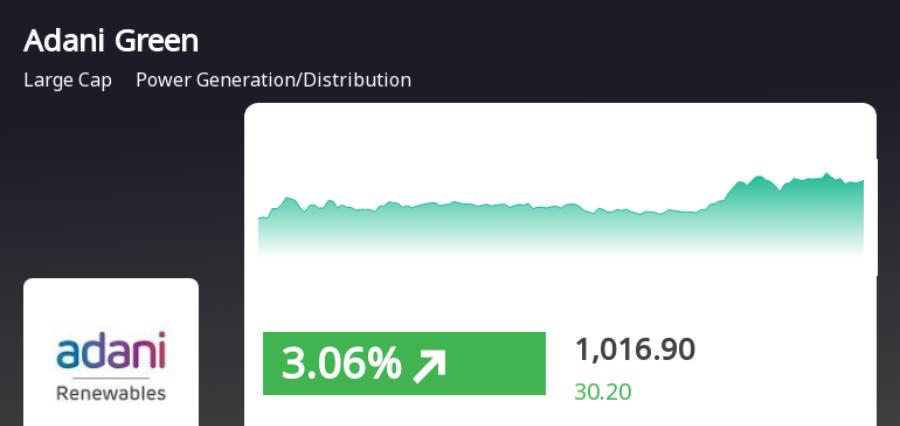
Adani Green Energy Rises 3.16%, Outpacing Sector In Conjunction With Market Sentiment Optimism
Prime Highlights: Adani Green Energy rose 3.16% on May 27, surpassing its sector in conjunction with widespread market appreciation. The stock ended a two-day losing streak, hitting an intraday high of ₹1,020. Key Facts: One-month return of the stock increased to 11.46%, outperforming the Sensex’s 3.82% return. Year-on-year, the stock has fallen 47.18%, lagging behind the Sensex’s 9.06% appreciation. Technically sound in the near term, the stock is above its 100-day but below its 200-day average. Key Background : Adani Green Energy Ltd. (AGEL) saw a strong rally in trading on May 27, recording a 3.16% spike in share price. This is a sharp turnabout from its two-day loss and indicates one of revival of investor interest. The share beat its sector by 2.37%, indicating enhanced sentiment in the backdrop of a largescale bullish market scenario. The intraday peak touched ₹1,020 before closing a little below, reflecting robust buying strength during the day. This upmove also drove one-month return of AGEL to a remarkable 11.46%, much higher than the benchmark Sensex, which gained 3.82% over the same interval. Although these are short-term positives, the stock is still way below where it was on a year-on-year basis. Adani Green shares have lost 47.18% in the last 12 months, a far cry from Sensex’s 9.06% appreciation. This decoupling is indicative of the volatility and investor fear factor in Adani Group stocks, which have been at the receiving end of regulatory action and market skepticism in recent months. Technically speaking, the stock does seem to have picked up steam in the near term. It is trading over its 5-day, 20-day, 50-day, and 100-day moving averages. But it is still below its 200-day moving average, a longer-term measure that implies caution is still in order for long-horizon investors. The overall market context has also supported the rally. The Sensex is still within 5% of its 52-week high, which indicates overall market strength and has lifted underperforming stocks like Adani Green. Sectoral optimism towards renewable energy and continuous government support for green infrastructure have also provided a degree of optimism. Going forward, investors will be keeping a close eye on steady earnings performance, regulatory updates, and news on the firm’s project pipeline to ascertain whether this rebound has staying power. While short-term momentum is undeniably bullish, long-term recovery will depend on sustained operational and financial gains. Read More: Developing Future-Ready Fleet Leaders: Coaching, Culture, and Capability

Top 7 Side Hustles to Boost Your Income in 2025
Side Hustles are becoming the pathway to economic independence, individual improvement, and career diversification. In 2025, through a combination of AI-assisted tools, remote work jobs, and changing digital platforms, starting a successful side business has never been simpler. No matter if your goal is creating wealth on weekends, establishing a sideline creative venture, or jumping into a full-fledged independent business, Side Hustles provide the scalability and adaptability to achieve all your personal objectives. With this year’s shift towards tech-enabled streams of income, there is no better time to get started. The Era of Flexible Side Hustles in a Digital-First World The beauty of today’s Side Hustles is that they can be done in a variety of ways. While telecommuting is becoming the new normal all over the world and with AI, efficiency is enhanced, you are able to capitalize on your talents with less time invested. The right side hustle can enhance your primary career, enhance your skills, and turn into something much larger. From AI-supported freelancing to producing perpetual digital products, the scope for 2025 is enormous. Let us briefly discuss seven of the most promising avenues that are revolutionizing how individuals live and earn. 1) AI-Powered Freelancing: A Wiser Side Hustle The most groundbreaking Side Hustle for 2025 is certainly AI-powered freelancing. With the help of tools such as ChatGPT for content writing or Midjourney for visual design, freelancers can produce more, faster, with better quality. Writers, marketers, designers, and even developers are utilizing AI to accelerate their activity. Freelancers can gain a robust web presence, obtain repeat business, and make between $500 and more than $5,000 per month through sites such as Upwork and Fiverr. AI is not only an assistant, it’s a changer. 2) Selling Digital Products: Let Creativity Pay For anyone wanting to earn passive income, selling digital products is still among the most sought-after Side Hustles for 2025. From productivity templates, online courses, eBooks, or even AI created art, there’s a hungry world market ready for useful, well-packaged digital content. Platform platforms such as Gumroad, Etsy, or Payhip enable creators to start with little setup and get their message in front of masses. High-demand niches are business tools, wellness guides, and digital planners, all of which enable you to scale without ever handling stock. 3) Short-Form Video Editing: Catch the Reels Revolution Short video editing is a premium creative Side Hustle. With the viral popularity of apps such as TikTok, Instagram Reels, and YouTube Shorts, brands and creators are constantly seeking editors who know how to make it pop. Editing apps such as CapCut and Adobe Premiere Rush enable you to create engaging content effortlessly in an instant. If you possess timing and trend senses, this hustle is money-making and creatively fulfilling. 4) Affiliate Blogging: Earning Passive Income Through Quality Content Affiliate blogging is a 2025 Side Hustles champion. Addicted writers and researchers can spin up niche blogs about tech gadgets, personal finance planning, or wellness trends. With SEO and affiliate links, bloggers make money while providing true value. AI writing tools such as Jasper and Surfer SEO help to make content optimized for faster creation than ever. Overnight results are not guaranteed, but affiliate blogging creates long-term cash that builds momentum over time and effort. 5) Print-on-Demand Online Store: Design Without Inventory For business and art enthusiasts, print-on-demand is still one of the most groundbreaking Side Hustles in the present day. Printful and Redbubble are just a few of the numerous platforms that allow you to upload your own designs on items from t-shirts to mugs to posters. The platform prints and ships it after it’s sold. You won’t need to deal with logistics and inventory—you simply do your thing: make. With a good marketing plan and solid niche, this hustle can turn into a real brand. 6) Virtual Assistance: Enable Businesses to Grow Remotely Structured pros are prospering in the perpetually on-time Side Hustle of virtual support. From email management and scheduling appointments to social media and customer support, virtual assistants (VAs) are an essential part of the equation for most small businesses and solopreneurs. With the freedom to work from home, select your clients, and add to your load, this hustle is perfect for stay-at-home moms, digital nomads, or anyone looking to launch lean and build incrementally. 7) Prompt Engineering: The Hidden Goldmine of the AI-Era It is possibly one of the most technology-dense and profitable Side Hustles of 2025. Prompt engineering is exactly what it sounds like—working on carefully crafted prompts to steer AI systems such as ChatGPT towards precise, high-value outcomes. As AI makes deeper inroads into the functioning of business processes, the demand for prompt engineers keeps growing. Even though it’s a more technology-driven grind, it pays off for the thinking precisionists, the effective communicators, and the early tech adopters. That’s where the tech meets the creativity and is paid off the most. Conclusion: 2025 Is Your Year to Start a Side Hustle If you’re holding out for the perfect moment to begin, Side Hustles in 2025 demonstrate that the time is here. The diversity of opportunity, the promise of automation, and the reach of the web have the ideal configuration for producing more—your way. If you’re fostering passion, constructing a plan B, or sowing the seeds of entrepreneurship, every fantastic journey starts with one small step. Begin with what you have, develop with what you find, and hold on. For in 2025, the properly chosen Side Hustle is not only additional income—it’s your key to creating a new future. Read Also: Why DEI Matters in Today’s Organizations

Most Empowering Woman Leader to Know in Cybersecurity
10 Best Logistics Companies to Watch in 2022 June2022 Lorem ipsum dolor sit amet, consectetur adipiscing elit. Ut elit tellus, luctus nec ullamcorper mattis, pulvinar dapibus leo. Lorem ipsum dolor sit amet, consectetur adipiscing elit. Ut elit tellus, luctus nec ullamcorper mattis, pulvinar dapibus leo. Most Empowering Woman Leader to Know in Cybersecurity With a deep-rooted passion for computer science and an academic foundation in the field from GITAM University, India, Aparna Achanta has pursued her path in cybersecurity with clarity and conviction. Her journey is not just defined by technical expertise, but by her relentless pursuit of knowledge and her ability to apply it where it matters most—safeguarding organizations from complex threats and empowering secure digital transformation. Quick highlights Quick reads

Aparna Achanta: A Passionate Cyber Security Leader and Developer
A passion that is making a change to fight against cybercrime and grow women’s empowerment. Increasing cybersecurity threats to businesses need services like innovation, master plans, and technology. People are doing backbreaking work to provide such services to other companies to secure their sensitive data, in which most women are playing crucial roles and serving their phenomenal assistance to the relevant field with their superior abilities and magnificent skills, which are essential. These women are setting up an example for the rest of the feminine collective. This great influence could bring great ideas to the company, which will be beneficial for the future of technology as well as for the women who can showcase their talent by taking a step forward. Aparna Achanta is the quintessence of women empowerment and a computer science enthusiast. Her strong interest in this platform and up-to-mark academics led her to choose her career path in computer science. Moving further, for her better understanding of the specific field and to start a new journey, Aparna pursued and completed her undergraduate in C.S. from GITAM University, India. Furthermore, she moved out to Virginia. To enhance her skills and to dive into the deep world of computers and technology, Aparna completed her master’s in information systems from George Mason University. Her concern as well as undivided attention for cybercrimes increased. She is impassioned about cybersecurity. Her perspective always supported the improvement and acting against cyber threats, which will help companies and agencies to secure their highly important private data. Later, to demonstrate her talent, Aparna got connected to International Business Machines Corporation, IBM. This organization lends a helping hand to companies to update their operations, technology, and logic and solve their critical problems. During her career, by expertizing herself in major projects for the development of cybersecurity, she served as a team leader. Over the past decade, her aptitude and attitude played an essential key in building the client relations. Not only that, Aparna’s dedication and hard work also led to managing major projects like the development of the application for federal clients, which secures their data. Ensuring Secure and Strategic Frameworks Aparna is a critical thinker; before implementing an actual plan, she always analyzes and ensures that the security framework is logically coordinated with her created scheme. She set the seal by working on some essential points that should match the company’s standards. It wasn’t an easy task. However, she was prepared and followed a strategy in which she monitored constant threats and unprotected data with instant action. Keeping many bullet points in mind, one of her main tasks is to get foremost control over minimum access to data by powerful endorsement. Recognizing her potential to make a safe place to store data and by taking strict actions, her idea is to surround the SDLC by taking safety measures. Utilizing the Centre of Excellence She explored herself thoroughly. Her experience reflects her proficiency in getting things accomplished perfectly. According to Aparna, the Centre of Excellence depends on several power points. She makes sure that her industry’s objective matches her thriving target. Her transparent vision to achieve a goal and leadership takes answerability, which led to a strengthening in efficiency. Her perspective is to define smart practice, a framework that explains how an organization is led and how its members interact with others. Aparna is good at creating reusable assets, templates, and guides for similarity, which define best practices. Making a place among numerous talented employees is not at all an easy task. Great opportunity comes with great responsibility. She was in a similar position. While managing all of these, she must make sure that she will preserve cross-functional partnerships between businesses. As a team leader, she had to check up on internal discussions. She keeps track of the documentation storeroom and continues working on consistent seminars to share insights. No doubt her presence of mind is decent. Following Aparna, the Centre of Excellence grows well when innovation is raised. With the help of these power points, she developed Microsoft Dynamics 365 and Power Platform that help businesses build apps, automate workflows, and evaluate data. She created an administrative structure that secures data in a cloud organization. Moreover, she worked on the process of reducing costs while increasing productivity and value in the cloud organization. Experiences that Influenced Her Approach Reflecting on Aparna’s 10+ years in software development and cybersecurity, some crucial understandings have persuaded her method in the design of a system’s structure, components, and interaction. She understood the assignment that in this current field, whatever challenges she is facing while improving the technical architecture, will benefit her in the future. She considers this activity as a part of fresh learning, which assists her to keep balance in protection, corporation needs and serviceability. Later, the transformation of applications to the cloud arises with new security challenges. Identity and Access Management (IAM), data encryption, a security technique that scrambles data into an incomprehensible code. Ciphertext, which can only be accessed with a secret key and multi-tenancy risks. After concluding everything from top to bottom, Aparna implemented the Zero Trust philosophy: “Never trust, always verify.” It helps to take signals from various sources into account when making access decisions. MFA is a security principle that limits user access to only what’s needed to complete their tasks. Taking these major steps helped her in grinding her skills. This move started making her proficient in risk assessment and documentation. Integrating Agility with Security While some might consider strumming a unique methodology, it is more of a framework for managing processes. As a certified scrum master, it was challenging for Aparna to balance agile methodology with the powerful security system in her tasks. If we carefully observe agile methodology, it highlights elasticity. That means you must be flexible all the time. It requires fast delivery and a process in which you commit yourself to keep practicing it again and again to get a superior outcome. On the other hand, a

Cybersecurity and Digital Transformation: Leading with Agility and Trust
Digital transformation is no longer a choice — it is the new standard for business survival and innovation. Organizations from every industry are harnessing technology to speed up operations, redefine customer experiences, and unlock new revenue streams. But this transformation comes with an equally important imperative: cybersecurity. The intersection of cybersecurity and digital transformation is forging a new mandate for leadership — one that involves speed in decision-making and a strong bedrock of trust for all stakeholders. Here, leaders need to think about complexity, risk, and opportunity in real time, propel their organizations forward without sacrificing security, and do both. From Reactive Defense to Proactive Strategy Historically, cybersecurity has been handled as either a technical or compliance function — a bolted-on security layer on top of traditional systems. In a digitally transformed enterprise, that is no longer adequate. With cloud-based environments, connected supply chains, remote workers, and growing data landscapes, cybersecurity must become a central strategic imperative embedded in the business model. Leading organizations are shifting from reactive defense to proactive risk management. They are bringing their cybersecurity architectures in line with their digital strategies, so that innovation does not exceed resilience. This is asking for more than technical skill — it is asking for leadership capable of thinking across domains and making cybersecurity a collective responsibility. Leadership at the Crossroads of Agility and Assurance As digitalization speeds up, so does the demand for agility. The leader is supposed to be able to adapt rapidly, implement new technologies, and keep up with shifting marketplace needs. But agility without guarantee is risky in itself. The trick is how to balance speed with security, innovation with control. Agile leadership in the digital era involves creating an experimental culture and infusing security concepts at the beginning. This involves cross-functional synergies among IT, security, operations, legal, and the C-suite. Leaders need to become champions of secure-by-design thinking — tying cybersecurity into every aspect of digital development, from product design to onboarding customers. Building Trust as a Strategic Asset Trust is the currency of digital transformation. Customers entrust sensitive information to organizations. Employees trust secure systems to work together. Investors and regulators demand strong governance. Any compromise — of data, ethics, or privacy — can destroy that trust instantly. Hence, trust is a communications issue as much as it is a strategic imperative. Leaders need to be transparent in the use of data, be proactively communicative about security responses, and be accountable with integrity when something goes wrong. The organisations that win and maintain trust will have a competitive advantage — not merely reputation, but customer loyalty and stakeholder trust. Human Behavior as the Front Line Technology has a very important role in cybersecurity, yet human nature is its weakest link. Phishing, social engineering, and insider attacks take advantage of not technical vulnerabilities, but human mistakes. Therefore, leaders are called upon to address not only security infrastructure, but security culture as well. Good cybersecurity leadership entails educating the workforce, driving accountability, and fostering ongoing awareness. It is about positioning cybersecurity not as a blocker, but as an accelerator of accountable innovation. When the workers comprehend the “why” of procedures and feel empowered to make safe decisions, the whole organization becomes stronger. Governance, Regulation, and Ethical Responsibility The emergence of international data regulations — from GDPR to CCPA and so on — has raised the compliance aspect of cybersecurity. Digital business cannot be embarked upon without an associated commitment to compliance and ethical governance. Executives have to walk through increasingly intricate regulatory environments while needing to retain operating agility. This demands strong data governance, transparent accountability frameworks, and a commitment to meet ethical challenges on AI, surveillance, and digital rights. Leadership based on trust involves adopting a principled position on privacy, encouraging responsible innovation, and foreseeing the societal implications of digital efforts. Crisis Management and Communication Even with greatest efforts, cyber incidents can still happen. What makes good leadership is not the fact that incidents do not happen, but the effectiveness of responding to them. An effective crisis management plan, cross-functional coordination, and communication protocols are already in place by a prepared leader. In a cyber crisis, leaders need to act quickly — notifying stakeholders, managing damage, and resuming operations. They need to lead with empathy and transparency, sustaining stakeholder trust despite criticism. Clear communication, accountability, and a way forward are key components of strong leadership. A Call for Digital Stewardship Digital transformation isn’t a project — it is an attitude. It is about constantly changing, learning, and pioneering in an environment where technology reshapes how we work, communicate, and drive value. Cybersecurity, in such an environment, is not a limitation but an accelerator — a tool that makes digital progress happen responsibly and sustainably. Leadership means viewing oneself as not only an innovator but also as a digital steward — one who is accountable for defining technology’s place in society. That entails safeguarding data, maintaining trust, advocating ethical practices, and positioning their organizations for the future. Conclusion: Leading the Future with Confidence As virtual and cyber worlds become more intertwined, leadership must transform. Trust and agility are no longer opposing ideals — they’re reinforcing ones. To be a leader in this age is to recognize that cybersecurity isn’t a silo but a strategic differentiator, and that trust isn’t an accident but a conscious result of intentional, principled leadership. The leaders who will succeed are the ones who can act swiftly without breaking faith, who can innovate with integrity, and who can transform cybersecurity from a reactive drain to a proactive force for expansion. In so doing, they won’t only defend the enterprise — they’ll define the future of digital leadership itself. Read More: Building Trust in Leadership: Why It’s Your Most Valuable Asset

Building Trust in Leadership: Why It’s Your Most Valuable Asset
In an era marked by relentless change, digital upending, and global uncertainty, there is only one thing that is absolutely crucial to leadership success: trust. Beyond strategy, beyond intelligence, beyond technical know-how, trust is the intangible currency that fuels collaboration, drives performance, and supports loyalty. Trust is not a matter of title or time in service, but it is established by predictable behavior, good decisions, and open communication. It is cemented over time, daily nurtured, and destroyed in an instant. For leaders, the ability to establish trust is not a nice-to-have — it is their most vital asset, driving everything from staff motivation to long-term organizational health. The Human Element in High Performance Even with technological advances and computer-based systems, organizations continue to rely on interpersonal relationships. Whether within the team, between units, or between executives and shareholders, the quality of these relationships is ultimately defined by trust. Where trust exists, people talk openly, work freely, and work together without fear. Output improves, innovation accelerates, and disagreements are resolved positively. In its absence, organizations become disfunctionalized, being marked by miscommunication, disengagement, and turnover. Trust, then, is not mystical — it is a tangible business performance driver. Great leaders understand that. They understand that establishing trust is more about small, consistent acts of fairness, integrity, and empathy and less about grandiose gestures. Integrity in Action Integrity forms the basis of trust. Leaders build trust when their actions and values align — when what they say is consistently reinforced by what they do. Integrity is not perfection but rather transparency, honesty, and being accountable. When leaders accept blame, offer credit, and take ownership, they’re communicating that there’s mutual trust. They create psychological safety — a setting where individuals are willing to speak up, challenge assumptions, and contribute value. Over time, these habits create a culture of credibility, and shared purpose. But when leaders avoid tough talks, deflect accountability, or act in their own best interests, they erode the trust that others place in them, often with irreparable harm. The work of Consistency and Fairness Trust is not only built upon what a leader does during times of crisis, but on how they act on a daily basis. Do they follow through on what they say they will do? Do they make decisions in a equitable manner? Are their expectations clear and consistent? Consistency makes for predictability, and predictability reduces fear. When followers understand what to expect from a leader, they are more likely to trust and follow with confidence, even in circumstances of uncertainty. Fairness must also be upheld. When leaders are well-balanced and even-handed — when they recognize contribution, set standards fairly across the board, and do not favor individuals — they sustain an image of fairness. That fairness is the foundation on which loyalty rests and fuels a meritocratic culture where people feel watched, respected, and motivated. Communication That Connects Leadership is useless without communication, and communication is useless without leadership. It requires more than merely talking a lot; leaders must talk with a purpose. That means being honest about problems, clear about expectations, and open to feedback. The best leaders communicate simply and listen humbly. They understand that communication is a two-way street. They pose questions. They pause to understand. They create channels where others are heard — not abstractly, but concretely. In times of confusion or change, this kind of communication matters most. Silence or softening erodes trust. Clarity, even when the message is unpleasant, commands respect. Trust as a Strategic Differentiator Trust is not just an interpersonal attribute — it is a strategic asset. Organizations led by leaders that are trusted enjoy improved employee retention, higher engagement, and more sustainable cultures. In business, trust fortifies brand reputation, customer loyalty, and investor confidence. In mergers and acquisitions, during crisis, through digital transformation — trust is the oil that helps things operate, line up, work together, and progress. Trust converts stakeholders into evangelists. Trust makes change feasible rather than oppositional. Trust is, in every sense, a competitive advantage. As businesses more and more compete on purpose and culture, leaders’ credibility becomes the determinant of employer branding and executive credibility. Maintaining Trust Over Time Half the battle is to establish trust; it is the work of leadership to sustain it. It requires vigilance, self-examination, and purposefulness. Leaders must request input, remain accountable to shifting expectations, and transform with modesty. They must recognize that trust is personal. Each relationship is built one-to-one. What establishes trust for one human being will not establish another’s. Those leaders who are willing to take time to get to know most importantly what counts for their people — their values, hopes, and fears — are likely to establish trust in the long term. Above all, leaders must preserve trust during the times of making tough choices. Layoffs, restructures, and strategic changes can put pressure on relationships. But even then, decision-making — and the treatment of people — will determine whether trust is preserved or lost. Conclusion: Trust is Leadership in Practice Leadership isn’t a job — it’s a relationship. And the relationship is built on trust. It can’t be mandated by law or programmed into computers. It must be lived, day by day, in the words leaders choose and the decisions they make. As the pace of change accelerates and scrutiny increases, trust will become more precious. Those executives who understand this — and put trust as an organizing principle, not an afterthought — are more likely to be the ones who lead not only successfully, but durably. Finally, buildings, products, and profits can be altered. But the trust a leader builds — with their people, partners, and purpose — is what lasts. Read More: Cybersecurity and Digital Transformation: Leading with Agility and Trust

Enterprise Review Celebrates Nicholas Katushabe’s Visionary Leadership in East African Business
In its dedicated issue, Inspiring Business Personality to Watch in 2024, Enterprise Review takes the privilege of featuring Dr. Nicholas Katushabe, Founder of NBK Premier Solutions Ltd. and Legacy Pearls Africa Ltd., as a game-changing figure in East African business and investment. From Kampala, Uganda, Katushabe has co-founded and arranged many successful businesses, leading major investments in numerous fields. His unique ability to combine vision and practicality has allowed him to lead change, encourage sustainable growth and become a role model for new entrepreneurs. Since Katushabe took charge, NBK Premier Solutions Ltd., started in 2015, has made a mark as a top business and investment consultancy in East Africa, assisting clients from Uganda, Ethiopia and the UAE. The company is valued for tackling hard problems with custom solutions which is why it has received the MEA Markets Business Awards for Best Business and Investment Consulting Company. Also, Legacy Pearls Africa Ltd. was founded in 2016 and actively promotes education and skills training like Katushabe. Enterprise Review’s stringent selection mechanism brought Katushabe on board due to his versatile leadership and rich industry experience. His vision—”Elevating key systems for humanity’s extraordinariness and productivity”—drives his efforts. From tackling socio-economic issues to developing human transcendence, Katushabe creates strategies, writes bestselling books such as Winning by Choice, and initiates ventures that define corporate and personal legacies. His transcendence style translates opportunities into practicable solutions, impacting people, organizations, and communities in the region. Katushabe’s leadership is a mix of data-innovation and human-oriented values. He tackles challenges with accuracy, be it streamlining operations or diversifying into new markets. Looking back to NBK’s humble beginnings, he remembers beginning with three staff members in 2016, then having to battle financial issues that left him restarting single-handedly. This tenacity characterizes his path, converting hiccups into stepping stones to achievement. His capacity to build high-achieving teams, similar to how a conductor brings together an orchestra, guarantees that each project embodies greatness and meaning. In the future, Katushabe hopes to see a world revolutionized by unlimited investment and entrepreneurial opportunities. His efforts through entities such as the Young Entrepreneurs Network and his involvement as a mentor to future leaders increase his scope. An Asia’s Transformational Leader and holder of the FOYA Awards 2024 Founder of the Year honor, Katushabe’s scope transcends borders. Through Nicholas Katushabe, Enterprise Review celebrates a visionary whose pioneering, hardy, and empathetic leadership catalyzes sustainable growth and enduring influence in the business world in East Africa. Read More: Enterprise Review Spotlights A2Z Logistics’ Game-Changing Impact on Supply Chain Innovation

Innovations by MIT’s Professor Richard Larson in Education
Professor Richard Larson is the top expert in the Massachusetts Institute of Technology (MIT), whose innovative work on service science and operations research has earned him global recognition. Nicknamed “Doctor Queue,” Larson’s academic work has transformed our understanding and design of systems that influence our daily lives. His evolution from mathematical abstract concepts to tangible, life-saving solutions says something about the kinds of positive impact an academic can make on society. This article, based on Insights Success Magazine’s May 2025 cover story, delves into how Richard Larson’s career continues to make waves and inspire. How Richard Larson transformed queuing theory and public services Throughout his career, Professor Richard Larson has remained committed to queuing theory—mathematics of waiting lines and service systems. Putting this theory into practices in fields like healthcare and emergency response, Larson brought theoretical concepts into practical applications that can be lifesavers. His models maximize ambulance dispatch, minimize waiting times, and enhance vital public services. These technologies have not only heightened the degree of scholarly research but also delivered on-the-ground outcomes across the globe, which reflects Larson’s focus on applied, practical research. Richard Larson’s Interdisciplinary Approach at MIT A characteristic of Richard Larson’s career is his resolve to cross disciplines. At MIT, he created programs that combine engineering, management, and public policy to address tough problems of global scope. His efforts to create the MIT Learning International Networks Consortium (LINC) demonstrate this idea of interdisciplinarity. LINC uses technology to democratize learning, bringing learners and teachers together across cultures and geography. Larson provokes innovation as well as fairness in international educational systems in doing so. The Social Contribution of Richard Larson’s Work on Emergency Response The most significant application of Richard Larson’s work is in urban emergency systems. By applying queuing models to dispatch ambulances, he has directly impacted how cities respond to emergencies, with quicker response times and saved lives. Such benefits show Larson’s dedication to applying scholarly research to making critical real-world issues of high priority. His work is evidence that service science can serve as a useful tool for the common good. Mentorship and Legacy: Richard Larson’s Impact on Upstream Leaders Aside from research, Richard Larson is best known for his work as a mentor. His education focuses on critical thinking, ethical leadership, and interdisciplinary collaboration. His students have achieved leadership positions in academia, industry, and government, ensuring Larson’s legacy of innovation and service to continue. Larson’s work as a mentor is a testament to his ability to create human potential as the anchor of long-term advancement. Incorporating the Future: Richard Larson and Artificial Intelligence in Teaching Recently, Professor Richard Larson has directed his efforts toward the application of artificial intelligence (AI) in teaching. Larson perceives AI as a way to differentiate instruction without removing the human aspects of learning. Larson’s visionary perspective insists that technological innovations enhance teachers and learners, not substitute for human judgment and touch. Larson’s vision places him at the vanguard of the new education model. Why Richard Larson is Known as the Professor of Possibilities The “Professor of Possibilities” title bestowed upon Richard Larson by Insights Success Magazine is a well-deserved award for his career. It bears witness to his capacity to see new possibilities where academic and social contributions intertwine. Larson’s career has opened possibilities not only in service science and education but even in global collaboration and innovation. His career itself is a witness to the potentiality of scholarship to contribute. Richard Larson’s Lasting Vision for Ingenuity and the Common Good In the years ahead, Richard Larson’s legacy remains powerful in a range of disciplines. His combination of intellectual rigor and humanely deployed insight is an attractive model for future scholars and professionals to follow. In reconciling theory and practice, Larson has pushed knowledge and enriched life globally. His ideal of using service science to fix really hard problems remains no less powerful now than it was during his time. Conclusion: Richard Larson’s Lasting Contribution to Scholars and Society Overall, Professor Richard Larson is the quintessential scholar-practitioner whose scholarship breaks free from the bounds of traditional academe. His leadership on service science, mentoring, and international education initiatives demonstrates how research moves into actual applications. As we move into the next ten years, Larson’s legacy will keep inspiring innovation and dedication to social improvement. Larson is, in fact, the “Professor of Possibilities,” breaking doors to a better, more efficient future.

Top Icons to Watch in IT – 2025
Top Icons to Watch in IT – 2025 This edition spotlights the boldest minds and transformative leaders shaping the future of technology. This special edition dives deep into the journeys, breakthroughs, and influence of key IT figures pushing the boundaries of digital transformation, cybersecurity, AI, data science, and cloud architecture. Featuring exclusive interviews and profiles—including the inspiring Ichraq Oubrahem—this magazine honors pioneers whose vision and impact are revolutionizing industries and setting the pace for global tech evolution. A must-read for tech enthusiasts, industry professionals, and future-forward thinkers. Quick highlights Quick reads