






Real Estate Awards Nomination Profile
Ajail Shaik Raheman Global CEO & Managing Director – Silver Sands Estates and Infra Hyderabad, India Ajail Shaik Raheman is a Hyderabad-based global real estate leader whose visionary leadership has significantly contributed to the evolution of sustainable and lifestyle-driven real estate development in India. As the Global CEO and Managing Director of Silver Sands Estates and Infra, he has demonstrated excellence in strategic planning, project execution, global investor engagement, and environmentally responsible development—making him a distinguished candidate for real estate industry recognition. Leadership Excellence and Industry Impact Under Ajail Shaik Raheman’s leadership, Silver Sands Estates and Infra has grown into a multi-location real estate development company with operations in Hyderabad, Visakhapatnam, and Dubai. He currently oversees seven major real estate projects across Telangana and Andhra Pradesh, including luxury villas, eco-resort communities, and farmland gated developments. His ability to lead projects from concept to completion while maintaining quality, compliance, and investor confidence reflects outstanding leadership capability. Innovation and Sustainable Development Ajail has consistently championed eco-conscious and ESG-aligned development practices. His projects integrate green architecture, extensive landscaping, water conservation systems, eco-friendly materials, and nature-centric planning. By prioritizing environmental responsibility alongside modern lifestyle requirements, he has redefined community living beyond conventional real estate models. Global Outreach and Investor Engagement A key differentiator in Ajail’s professional profile is his extensive international market exposure. He has organized and participated in global property expos, seminars, and investor roadshows across: United States (California, Texas, Seattle, New Jersey, Atlanta, Chicago, Virginia) Singapore (20+ large-scale events) Middle East (Dubai, Abu Dhabi, Muscat, Bahrain) These initiatives have strengthened cross-border investor confidence and positioned Hyderabad and South Indian real estate on global platforms. Thought Leadership and Media Presence Ajail Shaik Raheman is a recognized industry voice, contributing articles and participating in interviews across digital platforms and satellite television channels. His insights focus on market trends, sustainable urban growth, and future-ready real estate development, reinforcing his role as a thought leader within the sector. Professional Journey and Entrepreneurial Vision Beginning his career in journalism and later transitioning into real estate during the 2008 economic downturn, Ajail’s rise from operational roles to Global CEO reflects resilience, adaptability, and strategic acumen. In 2016, he founded his entrepreneurial venture, which evolved into Silver Sands Estates and Infra—a company now recognized for quality, innovation, and ethical practices. Recognition and Industry Credibility Ajail Shaik Raheman’s contributions have been acknowledged by leading media and industry platforms, including CNN18 Satellite Channel, Radio City, and the Times Group. These recognitions validate his commitment to excellence and his growing influence within the real estate and sustainable development sectors. Nomination Justification Ajail Shaik Raheman exemplifies the qualities of an award-worthy real estate leader: Visionary leadership with measurable project success Strong commitment to sustainability and ESG principles Proven global investor engagement and market expansion Ethical entrepreneurship and long-term value creation His continued contribution to real estate innovation and sustainable community development makes him a deserving nominee for this prestigious real estate award. Disclaimer – This article is a work of original content created for public relations and informational purposes only. It may be published across multiple digital platforms with the full knowledge and consent of the author/publisher. All images, logos, and referenced names are the property of their respective owners and used here solely for illustrative or informational purposes. Unauthorized reproduction, distribution, or modification of this article without prior written permission from the original publisher is strictly prohibited. Any resemblance to other content is purely coincidental or used under fair use policy with proper attribution. Read Also : The Man Behind Africa’s Healthcare Silicon Valley

Jivi Saran: Leading Beyond Boundaries with Courage, Clarity, and Purpose
Leadership is being reinvented on a grand scale. The old playscripts of hierarchy, linear strategy, and transactional management no longer apply in a world that changes by the hour. Disruption is ever-present, complexity the new norm, and uncertainty the only certainty. Here, genuine leaders differentiate themselves not by authority, but by vision. They foster trust rather than fear, ignite innovation rather than compliance, and create impact that resonates well beyond the balance sheet. The future belongs to those who are able to convert volatility into opportunity and lead with courage, clarity, and purpose. Into this gap comes Jivi Saran, (MBA, DBA(c)), CEO of Quantum Business Growth. She takes her inspiration from the principles of quantum science and combines these with conscious capitalism, systems thinking, and many decades’ worth of real-world advisory experience. In the process, she’s reframing leadership as an energy field- one that impacts the very essence of organizational life. Her philosophy is courageous but profoundly human: leadership is not so much about control as it is about resonance, not so much about directing as it is about creating spaces where possibility can grow. From this perspective, she has helped executives throughout Canada and internationally transition from process management to energy stewardship, leading not only their companies but the way they live and lead. The Evolution of a Quantum Leader Saran’s journey was not marked by one sudden revelation but by years of observing what didn’t work. Early in her career as a CEO and senior advisor, she repeatedly saw how linear strategies buckled under the weight of complexity. Companies obsessed with quarterly numbers often missed opportunities for deeper innovation. Leaders who focused solely on processes neglected the subtle but powerful human energy shaping outcomes behind the scenes. “Leadership models were simply too narrow,” she reflects. “They didn’t account for interdependence, emergent possibilities, or the fact that people are not machines. They are energetic beings influencing everything around them.” Her curiosity led her into systems thinking, spiritual intelligence, and conscious capitalism, where she began noticing striking parallels with quantum science. Her experience was in line with the quantum principle that observation changes reality: when leaders changed their energy, entire organisational fields changed as well. Over time, she developed the conviction that leadership is less about hierarchy and more about coherence. It revolves around aligning intention, presence, and values in ways that ripple throughout the system. This became the seed of her quantum leadership model, a philosophy she has since refined through rigorous research and hands-on executive practice. Decoding Leadership at Its Core Executives consistently turned to Saran not just for strategies but for clarity, often inviting her into the most private and high-stakes conversations. She became the person leaders trusted when they felt most vulnerable- when the future of their organizations, and sometimes their careers, hung in the balance. Her role was never about providing quick answers. Instead, she listened deeply, sensed unspoken dynamics, and helped leaders uncover insights they already carried but could not articulate. The “whisperer” title reflects this subtle art of drawing out hidden wisdom, realigning leaders with their authentic selves, and creating space where transformation naturally unfolds. Unlike conventional executive coaching, her approach is rooted in quantum principles. She doesn’t start with KPIs or performance metrics; she begins with alignment. Once a leader’s inner state resonates with clarity and purpose, measurable results follow. This creates changes that ripple through culture, strategy, and systems without forcing compliance or artificial motivation. Transformational Leadership in Action The practical impact of Saran’s work is best illustrated through stories of transformation. One mid-sized technology company’s CEO approached her amid internal conflict and stalled innovation. His style was highly transactional, crisis-driven, and rooted in control. Employees felt like replaceable parts, and morale was sinking. Rather than focusing on operational fixes, Saran guided him toward inner recalibration. She introduced practices of stillness before decision-making, shifted his framing from control to trust, and encouraged him to view leadership as shaping energy rather than issuing commands. The effects were profound. Within months, cross-functional collaboration revived, innovation pipelines reopened, and employee retention soared. Most strikingly, profitability rose, not from cost-cutting but from a surge in creativity and discretionary effort. “When leaders elevate their consciousness,” Saran explains, “organizations reorganize around that frequency. It’s exponential.” Another case involved a healthcare executive who was resistant to stakeholder engagement. He was convinced it would dilute efficiency. Through resonance mapping, Saran showed him how mistrust and disengagement were slowing projects more than any regulatory hurdle. By aligning his presence with genuine openness, he transformed resistance into collaboration, cutting implementation timelines by nearly half. Conscious Capitalism as a Competitive Edge Saran champions conscious capitalism, but she does so strategically. She knows many leaders equate it with philanthropy or performance compromise. Conscious capitalism, she argues, is not charity; it is a superior operating system. Her evidence is compelling. She draws on case studies of organizations outperforming peers because they embedded purpose and stakeholder well-being into their core strategies. In her advisory sessions, she uses scenario planning and stakeholder mapping to reveal hidden risks in profit-maximisation-only models. Often, leaders’ breakthrough moment comes when they realize that aligning personal values with organizational goals not only feels right but also produces durable advantages: stronger brand loyalty, more engaged talent, and greater resilience during disruptions. “Purpose is not a cost center,” she insists. “It’s your competitive edge.” Bridging Theory and Practice Where Saran excels is in translation- taking complex ideas from academia and making them actionable for executives. Quantum concepts like non-linearity and interconnectedness may seem abstract, but she grounds them in practical rituals: Stillness before decisions as a method for accessing clarity. Scenario planning as probability mapping rather than prediction. Resonance mapping to assess alignment across stakeholders. These practices integrate seamlessly into governance and strategy, so leaders don’t see them as “extra work” but as smarter ways of operating. Her ability to speak the dual language of evidence and intuition allows her to connect with both data-driven executives and those seeking deeper meaning. Teaching
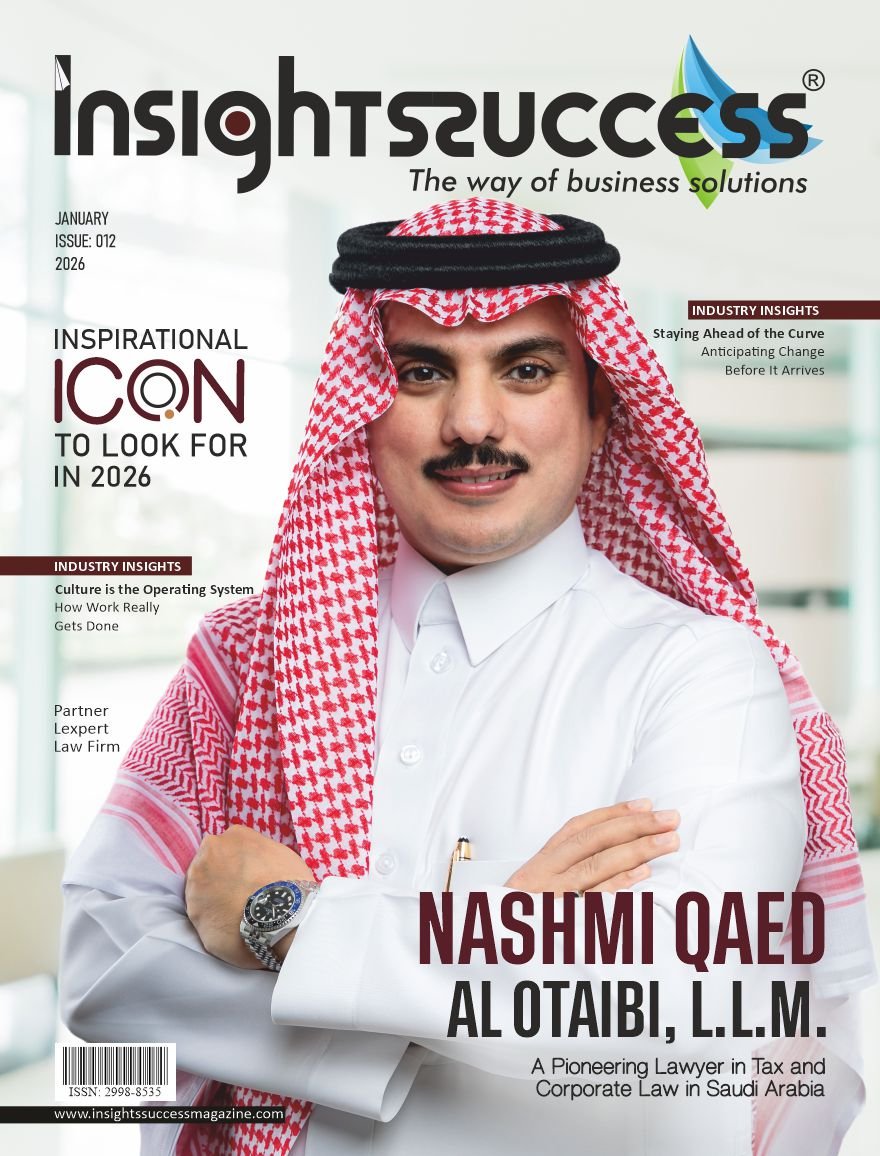
Inspirational Icon to Look For in 2026
Inspirational Icon to Look For in 2026 This edition recognizes Nashmi Qaed Al Otaibi a distinguished individual whose vision, resilience, and purpose-led leadership inspire meaningful change—setting a compelling benchmark through influence, innovation, and lasting impact across industries and communities. Quick highlights Quick reads

How Work Really Gets Done
Culture is the Operating System Strategy sets the ambition, structure assigns the responsibility, and processes lay down the workflow. However, it is not any of these that dictates the way work is actually done. It is culture that does. Culture is the organization’s operating system—the unseen yet mighty set of norms, behaviors, and beliefs that influence decisions, execution, and outcomes on a daily basis. Strategies may be replicated and systems may be acquired, but culture is experienced. It decides if an organization operates in unity or with conflict. Why Culture Outperforms Structure Organizational charts represent power, but the culture of the organization decides the influence. Rules set the ground for actions, but culture rules over behavior when the rules are not clear. In quick-changing environments, workers are making a lot of choices without the support of superiors. It is the culture that is leading those choices. When culture syncs with business strategy, implementation speeds up. When it is not, even the best plans are put on hold. Leaders tend to overlook this aspect, concentrating on formal levers and disregarding the informal system that is the performer’s driver. Culture is not how the leaders speak; it is how people act when there is no one around to watch them. The Unwritten Rules of Execution Every organization possesses unspoken codes—ways of dealing with conflicts, the perception of risks, the treatment of errors, and the actual decision-making processes. These codes make up the foundation of the cultural operating system. To illustrate, if workers get punishment for voicing their opinions, the innovation process will be slowed down, no matter the declared values. If fast results are appreciated, but mistakes are punished, then the taking of risks will only be on the surface. Such contradictions lead to the creation of a problem which no process improvement can eliminate. Cultural high-performers have a way of clarifying things and consistently behaving in the same manner. The employees do not know what is expected of them because it is written, rather they know it because it is demonstrated and rewarded. Leadership as the Primary Culture Driver The dynamic of the organizational culture is determined by the leaders, the way they act and behave. The list of things that the leaders tolerate, the things they promote, and the things they give highest priority to becomes the standard for the rest. When leaders think that culture is something that can be handed over, they are wrong about its essence. Every choice of a leader produces a cultural signal: who he/she employs, how he/she handles failures, what he/she values, and how he/she spends time. and gradually, these signals grow into norms. One of the characteristics of effective leaders is that they are the ones creating the culture by the use of their intention. They make sure their actions totally reflect the declared values and the misalignments are quickly corrected. The transformation of culture is not through the use of slogans but through the constant leadership behavior. Culture and Decision-Making The quality and the promptness of decisions are affected directly by the culture. High-trust cultures facilitate rapid decision-making since the flow of information is unrestricted and there is no ambiguity over who is responsible. On the other hand, in low-trust cultures, the decision-making process is prolonged as people wait for approval, try not to be held responsible or are in a self-protective mode. The teams in empowered cultures can work within the set limits. In control-oriented cultures, decision-making is concentrated, thus generating bottlenecks. There is no approach that is right or wrong in an absolute sense, but the mismatch between the culture and the organizational needs leads to inefficiency. Those leaders who perceive culture as an operating system are the ones who lay out the decision rights, the rewards, and the communication in a way that the desired behaviors get really reinforced. Measuring and Reinforcing Culture It is impossible to handle culture without its measurement. The fact that it is intangible does not mean that its influence is not felt in areas such as engagement, turnover, decision speed, and execution quality, which are all very visible. The middle managers promote culture by means of recognition, promotion standards, and performance evaluation. The things that are praised are the things that are done again. Cultural alignment is a matter of constant care, rather than one-off projects. Conclusion Culture is the underlying system of every activity that takes place in an organization. It influences the thinking, decision-making, and action of the members of staff—sometimes even more than strategy or structure mainly if the latter is excluded from the discussion. When leaders recognize this fact, they no longer limit their activities to the management of tasks but rather direct their efforts toward the creation of favorable settings. By putting the culture in line with the company’s objectives and strategies, they make sure that the employees are not coerced to perform, but rather, they willingly do so through proper understanding and allegiance. Ultimately, culture is not an intangible idea—it is the backbone of productivity. Read Also : Anticipating Change Before It Arrives

Anticipating Change Before It Arrives
Staying Ahead of the Curve In a business environment characterized by rapid technological advancement, changing customer preferences, and global uncertainty, simply reacting to change is no longer enough. Quite often, by the time a shift in the market or the competition is obvious, the competitive edge has already shifted. The resilient leaders and the resilient organizations are the ones that change soon, decode weak signs properly, and take deliberate action before disruption becomes inevitable. To be one step ahead is not to tell the future with complete certainty. It is rather to develop the ability to sense, decode, and react to the changes quicker and with more thoughtfulness than others. From Reactive to Anticipatory Leadership Reactive leadership center around fixing problems that are obvious. Anticipatory leadership is the one that looks ahead and detects the active problems. This transition is not easy because it needs a different mentality, which is considerate of the future, and it is always asking what might change the situation in the coming years. Change forecasters among leaders spend time on thinking about the future strategically. They withdraw from execution and monitor changes in technology, regulations, customer behavior, and political situations. This practice enables them to have options ready instead of running around looking for answers. Recognizing Weak Signals Early Big changes hardly ever come without a heads up. There are usually signs that may not be very clear such as slight changes in customer preferences, new but not fully developed technologies, small rival companies or even talks about regulations. These signs can easily be overlooked since they do not directly endanger the primary business. Those in command who keep a notch up are curious and open-minded. They motivate the staff to bring forth strange occurrences and question the beliefs. It is through the leaders’ focus on what is considered insignificant today that they get a glimpse of what may turn out to be significant tomorrow. The skill of detecting weak signals is a competitive edge. Scenario Thinking Over Forecasting The prediction methods of the past built on the idea of continuity. The assumption, however, is not always strong in uncertain environments. The future is not a single event for anticipatory leaders who use forecasts as one of the inputs for scenario thinking—thinking multiple plausible futures and not just one. Scenario planning aids leaders in experimenting with their tactics under various situations, spotting weak points in their plans, and determining which among the different strategic initiatives is the most important. It changes the main concern from being right about the future to being ready for it. Moreover, this method not only builds fortitude but also lessens the risk of being too confident in the outcome of the linear projections. Building Adaptive Organizations The ability to foresee change is not only a task for the leaders but also a skill for the whole organization. It is the leaders’ responsibility to create the right conditions through the right structures, processes, and cultures for the organization to be able to learn and adapt quickly. Things like handing over the power to the teams to try things out, making the decision processes quicker, and allowing easy movement of resources are among the measures to be taken. Companies that have the capacity to change their configuration rapidly will be able to take advantage of the situation when the predicted change happens. Flexibility is the tactical manifestation of prediction. Leadership Humility and Continuous Learning Anticipation is a very humble process. The rulers must take into account that the models of success already in place may decay, and the knowledge can turn into nothing. The constant learning that is to be done through getting outside, seeing things in different ways, and receiving candid criticism is a necessity. Those leaders who keep people with opposing views around them, and who have different opinions and ideas, will be able to see the change coming better. The mental comfort that comes with agreeing is the major obstacle to the practice of predicting events. Conclusion Staying ahead of the curve is not simply relying on astrology but being ready for all scenarios. Those leaders who foresee changes through their sights, by means of awareness, assumption challenging and adaptability investing, do so in a very subtle manner until disruption can be seen. Faster changes have always been in the first place, thus preparing ahead, getting constant learning, and acting with foresight are the ways of the winners. Timing is everything and being ahead of change is now a leader’s main responsibility. Read Also : What Leaders Actually Shape

Nashmi Qaed Al Otaibi, L.L.M. — A Pioneering Lawyer in Tax and Corporate Law in Saudi Arabia
“Success,” that prize in the pursuit of which the world is running the fastest ever, “is a journey built on purpose, discipline, and continuous learning,” believes Nashmi Qaed Al Otaibi, L.L.M., and his own proves it with élan. As a Saudi lawyer, Nashmi dedicated his career to empowering organizations to strengthen and safeguard their legal and financial positions. By ensuring corporate stability and compliance, he aims not only to protect businesses and their employees but also to advance the Kingdom’s broader economic objectives and contribute to the resilience and sustainability of our national economy. “For me, legal guidance is far more than a professional service—it is a catalyst for stability, growth, and positive societal impact.” A Vision Established as Lexpert Law Firm Driven by this vision, Nashmi founded Lexpert Law Firm, where he is proud to be among the first Saudi lawyers to specialize in tax law. At Lexpert, they guide organizations through an evolving regulatory landscape with precision, strategic foresight, and a deep understanding of both local and international legal frameworks. Nashmi’s academic and professional journey began in Saudi Arabia, where he earned my Bachelor of Laws (LL.B.) from Mustaqbal University, graduating at the top of his class. He then pursued an LL.M. in Commercial Law from Dar Al-Uloom University, authoring a thesis titled “Laws Governing the Sole Proprietorship Limited Liability Company in the Kingdom of Saudi Arabia.” This research deepened Nashmi’s understanding of corporate structures and legislative reform in the context of the Kingdom’s modernizing economy. Seeking a broader global perspective, he went on to complete a second LL.M. in International Taxation at the University of Florida, where he expanded his expertise in cross-border tax systems, treaties, and global compliance standards. Over the years, he has had the privilege of working with leading regional law firms, advising both multinational and domestic clients on complex tax and corporate matters. Today at Lexpert, Nashmi continues to integrate Saudi legal principles with international best practices, providing strategic counsel that positions clients for success in an era of unprecedented transformation. Beyond his practice, Nashmi is deeply committed to advancing the development of the legal and tax profession in Saudi Arabia. He has collaborated with global institutions—including IE University, LexisNexis, Monsha’at, and TaxNotes—to promote knowledge-sharing, policy dialogue, and innovation in taxation and corporate governance. “At every stage of my journey, I have remained guided by a single principle: to use law as a platform for progress—empowering businesses, supporting people, and shaping a transparent, globally aligned, and sustainable future for the Kingdom of Saudi Arabia.” A Deep Desire to Serve Saudi Arabia Nashmi’s journey into the legal profession—particularly in tax and corporate law—has been driven by curiosity, conviction, and a deep desire to contribute to Saudi Arabia’s rapidly evolving legal and economic landscape. Growing up in the Kingdom, he witnessed how strong legal frameworks can fuel business growth, enhance governance, and build trust across society. Early on, he realized that specializing in areas of law shaping economic transformation could be a meaningful way to make a tangible impact. The turning point came with Saudi Arabia’s ambitious legal and fiscal reforms, spearheaded by His Royal Highness Crown Prince Mohammed bin Salman, which strengthened the legal framework through modernized regulations. This significant change sparked Nashmi’s curiosity and motivated him to build expertise in tax law, ultimately establishing himself as a recognized specialist in this growing field. Motivated by this vision, Nashmi co-founded Lexpert Law Firm with a clear mission: to provide precise, forward-looking legal solutions that empower businesses while supporting the Kingdom’s regulatory evolution. Over time, Lexpert has grown beyond a traditional law firm into a hub for thought leadership, policy dialogue, and professional education—helping shape discussions around Saudi Arabia’s modern economy. “Looking back, my professional journey has been one of constant evolution—from academic curiosity to practical application, and ultimately to building a firm that contributes directly to the Kingdom’s transformation.” Today, Nashmi takes pride in helping drive Saudi Arabia toward a transparent, globally integrated, and legally robust economy—where law is not merely a profession but a strategic tool for innovation, growth, and enduring impact. A Lifelong Passion for the Law Nashmi’s passion for law was sparked long before he entered the courtroom or drafted his first contract—it began by observing his father, a businessman, and learning how contracts and legal structures could help a business grow and achieve sustainability. Both his parents played a defining role in shaping Nashmi’s character: “my father instilled in me a deep respect for strategic thinking and precision, while my mother raised me to value time and discipline—principles that continue to guide every decision I make.” He witnessed early on how sound legal guidance and unwavering commitment were essential not only for protecting interests but also for driving progress. Coming from a family deeply connected to both the legal and business worlds reinforced this understanding. Two of his sisters were among the first women in Saudi Arabia to serve as public notaries, breaking barriers and setting inspiring precedents, while two of his brothers are practicing lawyers. His father relied heavily on legal consultancy to navigate complex regulations and expand their family business, and seeing how law could directly shape their success and stability left a lasting impression on me. “Growing up in this environment, I saw firsthand how strong, transparent laws could foster trust, support entrepreneurship, and create stability across society. I realized early on that law was more than rules on paper—it was a transformative force capable of building economies, protecting livelihoods, and opening doors to opportunity.” This realization became deeply personal when the Kingdom embarked on bold legal and fiscal reforms, such as the introduction of the Value Added Tax. Nashmi was captivated by the challenge: how could she help organizations navigate these changes while contributing to the nation’s vision for economic modernization? That curiosity led him to specialize in tax and corporate law. It ultimately inspired him to co-found Lexpert Law Firm— “a space where I could guide businesses with precision, insight, and foresight.” What truly

The Sentinel of the Seas – Captain Jagdeep Singh Sodhi: Creating A Sustainable, Future-Ready Maritime Ecosystem Built on Trust, Excellence, and Collective Progress
The world’s oceans are vast. They are also unforgiving and demanding on the highest level. They require complete respect for Mother Nature and zero mistakes. Leading in the ocean means something much different than simply holding the title of a ‘Leader’ and having more than just the technical abilities to do so. It is a sacred responsibility to have developed a spirit that has been reinforced through past trials, and an analytical thought process that has been enhanced through many years of high-pressure challenges. In this regard, as the world prepares itself for 2026, we see that Captain Jagdeep Singh Sodhi, the Founder, CEO, and Co-Owner of Oceane Group of Companies, has emerged as one of the most admired leaders to watch for. Captain Jagdeep Singh has become an extraordinary case study of Maritime Sovereignty with an extensive background as a Master Mariner with 30+ years’ experience as a steady partner through difficult times. His expertise is focused on some of the most sophisticated and delicate aspects of maritime operations, that is, Ship to Ship (STS) transfer services. In an industry where giants of steel must meet with surgical accuracy, Captain Jagdeep Singh has executed numerous transfers with an indomitable commitment to safety and zero environmental impact. A custodian and protector of the deep, he guarantees that the vital artery of international commerce operates within all legal parameters and in total compliance with industry standards. A Sailing Ship Discovers the World In his words, “My journey in the maritime industry began over three decades ago, when I first stepped onboard as a young cadet driven by curiosity, discipline, and a deep respect for the sea.” Those early years were formative. “The sea became my greatest teacher, instilling in me resilience, accountability, humility, and an uncompromising respect for safety.” As he progressed through the ranks to Master Mariner, he sailed with globally respected tanker companies such as Tanker Pacific, Dynacom Tankers, and AET. These experiences exposed him to diverse operational environments and complex tanker operations, including ship-to-ship transfers, shaping his technical expertise and strengthening my leadership foundation. “Equally influential were the mentors I encountered along the way.” Their guidance reinforced the values of integrity, responsibility, and calm decision-making under pressure. During his extensive career, Captain Jagdeep Singh has built a successful corporation that embodies the principles of marine safety, health, and safety, as well as quality assurance. Transitioning from sea to shore marked a pivotal phase in his career. He assumed senior marine assurance and leadership roles with organizations including GAC Group, Teekay Shipping, and Safe STS. These roles broadened his perspective beyond ship operations to include regulatory compliance, terminal management, commercial strategy, and risk governance. A Transcontinental Voyage The change from being in charge of the operations from the deck of the ship to running a successful company is an example of how an effective business can have a tremendous influence on the growth of a person and the industry. A defining moment came when Captain Jagdeep Singh recognized a clear gap in the regional maritime landscape. The Gulf required a highly competent, safety-driven, and globally compliant ship-to-ship service provider. This realization led to the founding of Oceane Group in Dubai, built on principles of operational excellence, integrity, and innovation. Today, Oceane Group operates across the UAE and Oman, with an expanding global footprint including Malaysia, Korea, and East Africa and planning to operate across West Africa , South America and indian subcontinents Every stage of his journey, from cadet to captain and from shipmaster to founder, has shaped his leadership philosophy and reinforced his commitment to elevating industry standards through discipline, safety, and trust. Today, as the visionary behind the Oceane Group, he has mastered the “Phygital” bridge of the maritime world, where he negotiates with ship owners, sellers, and buyers with the same tactical brilliance he used to navigate the world’s most treacherous ports. From streamlining transportation logistics and facility design to managing complex union contracts and government relations, his leadership is a rare fusion of process engineering and human inspiration. A Revolutionary Core Idea Evolving into a Global Conglomerate Oceane Group was born from experience, not theory. After more than three decades working at sea and in senior onshore roles, particularly within ship-to-ship operations, Captain Jagdeep Singh witnessed firsthand the challenges faced by charterers, ship owners, terminals, and operators. Inconsistent standards, varying levels of expertise, and equipment limitations often compromised operational efficiency and safety. He realized the region did not need another service provider. It needed a standard setter. Oceane Group was founded with a clear objective to deliver world-class, incident-free, environmentally responsible ship-to-ship operations supported by certified personnel, reliable equipment, and disciplined procedures . Starting operations in Oman, the company steadily expanded to Fujairah and Dubai, earning trust through consistency, transparency, and uncompromising safety practices. Over time, its scope evolved beyond transfers to include equipment supply, fender maintenance, marine consultancy, emergency response, and marine asset management solutions with expert handling of liquid bulk cargo—Crude Oil, Refined Petroleum Products, Chemicals, Bio fuel and Ammonia , LPG & LNG. “We embraced technology early, digitized processes, and embedded quality-driven systems to support our zero-incident philosophy, a benchmark we proudly uphold.” Oceane Group’s growth has been driven not merely by expansion goals but by a responsibility to raise regional and global maritime standards. What began as a vision shaped by experience has evolved into a globally respected enterprise known for competence, reliability, and operational excellence. Managing Personal and Professional Life Balancing personal and professional life in the maritime sector requires discipline, clarity, and intentional prioritization, believes Captain Jagdeep Singh. “Whether at sea or managing high-risk operations ashore, I have learned that sustainable success is only possible when personal well-being and professional responsibility are aligned.” Maritime operations demand precision, availability, and sound judgment. Judgment is strongest when one is mentally and physically balanced. Time spent with family, reflection, and health is not a distraction from leadership, but a foundation for it. “My family has been my anchor throughout this journey,

Authority Earned, Not Assigned
The New Reality The concept of authority in leadership has changed completely. In modern organizations, the authority is not only based on the position, rank, or length of service. Formal positions are still important, but they do not necessarily carry the same weight as before or automatically attract followers. The new leadership scenario is unambiguous: authority has to be earned through being credible, trustworthy, and acting consistently. This change is in line with the development of deeper changes in how people work, communicate, and what they expect from their leaders. Why Traditional Authority Is Losing Ground In the past, the order of things was such that authority came from structure. The leaders were followed because the system demanded it. This system is becoming more and more ineffective in organizations where knowledge is the main factor and connectivity is very high. Information can be accessed easily by everyone, the expertise is located all over, and the teams want to know the reasons for the decisions made them. When the leaders use only their positional power, they will get the compliance, but rarely the commitment. Nowadays employees have the option of how much they want to be engaged, and their choice is determined much more by trust and respect than by the formal authority of the leader. Credibility as the Source of Influence Authority that has been earned starts with credibility. Leaders over a period of time prove their credibility through competence, good judgment, and dependability. In cases when leaders have a good understanding of their business, make knowledgeable decisions, and keep up with their promises, the followers will be more inclined to listen and get in line with the leaders. In addition, credibility needs intellectual honesty. Leaders who confess to being uncertain, asking for opinions, and altering their views when new data come up are the ones who reinforce their legitimacy. Oppositely, leaders who show false confidence or do not take into account the professional opinion will lose trust very fast. Trust Built Through Consistency and Integrity Trust is the main value in the current power structure. It is achieved when there is a complete match between the leaders’ words and deeds. Those leaders who verbally support one thing but practically oppose it are the ones, inadvertently, doing the most to erode their own power, no matter what their rank is. Integrity is an essential factor in this process. A leader’s conduct in difficult situations — when targets are not reached or when there is a lot at stake — discloses their real concerns. Consistency in ethics, fairness, and openness create a stronger and more enduring power base than orders or regulations do. Authority Through Relationships, Not Control In the new reality, power is in relationships. The gaining of influence by the leaders through listening, engaging, and respecting different views is the main way this power is. It does not lead to indecision; on the contrary, it enhances decisiveness by putting them on the basis of a common understanding. If the people are feeling like they are listened to and appreciated, they are more prone to going along with the decisions, even the hard ones. Authority gained through ties brings about alignment and not just obedience, and it also makes the process of realization faster and more efficient. Performance and Accountability As the saying goes, results still count. Responsibility showing leaders who convey their trustworthiness give them their power. What is more, accountability is for both directions mastery and servant in a way. The former are the ones who turn the sticks of their shortcomings and the ones who are sharing the glory of the triumphs having the most important asset of trust. Meanwhile, the latter are those who are putting the blame and picking the credit who soon lose the trust. Empowerment as a Leadership Strength It is a paradox that leaders get stronger when they give power to others. They have shown their trust rather than their doubt through their actions, and thus they have made a strong organization. When a leader takes the position of an enabler instead of a control, the capacity of the organization increases, and the leader’s role is reinforced as an enabler rather than a controller. Authority, therefore, becomes larger when leaders assist others in their achievements. Conclusion The new landscape of leadership is crystal clear: power is won, not given. Positions may bestow power, but sway has to be established through trustworthiness, moral character, and constant doing. Leadership who know this make up places of confidence, involvement, and responsibility. They do it not only by leading but also by changing the concept of leadership in the present time. Read Also : What Leaders Actually Shape

What Leaders Actually Shape
Culture is Leadership in Action Culture is a subject which is very often described as an abstract concept—walls with values, catchy phrases in presentations, or rules in manuals. But in the full spectrum of things culture is a real and operational phenomenon. It is leadership but exposed. The actions of the leaders, the things they give credit for, the things they put up with, and the things they consider important, turn into the existing experience of the organization. Culture, more than strategy papers or hierarchies, is the mirror of the everyday influence of leaders. From Stated Values to Observed Behavior In most cases, organizations express commendable values, but the workers perceive culture through behavior. The reinforcement of culture takes place when the declared values are in line with everyday actions. On the contrary, when they do not match, credibility is lost. It is not through proclamation that leaders alter the course of culture, but rather through their choices—how they distribute resources, deal with blunders, manage conflicts, and reward workers. Such behaviors indicate the core values of the organization. The gradual reiteration of such signals leads to the formation of norms that direct the behavior of the entire organization. Culture is not what gets talked about in the meetings; it is what gets done all the time. Leadership Attention as a Cultural Signal The places and aspects where leaders allocate their time and attention are very influential in communicating the organizational culture. The concerns that are under observation get the status of priorities and the ones that are not considered get the opposite treatment, no matter how important they are officially. To illustrate, leaders who are always interacting with the frontline personnel show respect and are perceived as open. On the other hand, the ones who look only at metrics indicate that results have more value than the process or the people. Neither way is correct in absolute terms but each creates its own culture. Decision-Making and Accountability One of the ways that culture is shown is through decision-making processes and who gets the blame for the outcomes. The managers determine if the decisions are going to be made by a central authority or dispersed, quick or slow, based on data or intuition. Accountability matters just as much. The leaders who deal with underperformance quickly and justly establish a certain level of performance. The ones who are lenient towards the top performers are not clear in their communication. Voicing the same expectations all the time generates confidence; doing it occasionally does the opposite. These habits affect how people take the responsibility and what risk management they will adopt. How Leaders Handle Pressure Culture is clearly seen when it is under pressure. Missing targets, crises, and increased scrutiny are situations where the leadership behavior acts as the main factor for the whole organization. Leaders under pressure who are calm, ethical, and open with their communication strengthen the organization’s resilience and moral values. On the contrary, executives who accuse others, lower the standards, or act without reasoning are the ones who create and promote a culture of fear or defensiveness. In such times, the employees are most observant. The actions of the leaders during hard times contribute greatly to the overall culture of the organization. Talent Decisions as Cultural Architecture Leaders have among their most potent cultural levers the hiring, promotion, and exit decisions. The assignment of rewards, the selection of personnel for advancement, and the decision of whom to dismiss offer a clearer definition of the tolerable behaviors than any rule does. Leaders who unconditionally reward good performance are the ones who establish the so-called performance-driven cultures. On the other hand, leaders who weigh other factors such as collaboration, ethics, and leadership capability along with results refine a more balanced environment. Talent decisions equal culture decisions. Culture is Not Delegable The human resource and communication departments might be the ones actually carrying out the cultural initiatives, but culture is not something that could be assigned. The cornerstones of business activities are heard noise only from the leaders who consider culture as an additional work along the road. The upper management invariably contributes to the prevailing culture, either on purpose or by accident. The aware leaders acknowledge their role in the process and assertively take the path of influencing culture in a desired direction rather than letting it develop randomly. Conclusion Culture is not an independent entity alongside leadership; it is simply the latter expressed through visible means. The formation of culture is by daily decisions, actions, and priorities and not by proclamations of intent. The leaders acknowledging this fact realize that their power is not limited to the areas of strategy and results only. They create cultures that allow for performance, trust, and resilience through their consistency in behavior, setting of standards, and aligning of systems with values. Ultimately, culture is not what leaders desire; rather, it is what they truly bring about. Read Also : Product Evolution: Software Company Strategies Driving Global Market Transformation

Why Human Judgment Still Matters in an AI-Driven World
The Irreplaceable Leader Artificial Intelligence (AI) has changed the way organizations perform, their methods of analyzing information, and making decisions. The algorithms nowadays are able to handle data in volumes far greater than what humans are capable of, detect trends with astonishing accuracy, and do large-scale automation of complex tasks. However, the question that quickly comes up is, as AI becomes more powerful, what is the human aspect that still sets leadership apart? The response is the judgment. In a world dominated by AI, human judgment doesn’t lose its value; rather, it gains it. Intelligence Without Context Is Not Wisdom AI’s capabilities are very much dependent on the parameters that are set for it. It can calculate the best alternative, suggest the next step, and identify the potential risks by using past events and statistical reasoning. One thing, however, that it still cannot do is to grasp the meaning behind the words, the intention and the moral consequence. The leaders during their decision making often need a context that can’t be entirely written down—the culture of the organization, the feeling of the stakeholder, the ethical consideration and the long-term effect. The human leader’s role is to combine data with their own experience, morals, and understanding of the situation. This combination turns data into knowledge, a trait that is still beyond the reach of machines. Judgment in Ambiguity and Novelty AI function at its best under situations where the patterns remain unchanged and the factors are already established. However, leadership often finds itself in a state of uncertainty—such as in emerging markets, through crises never seen before, during cultural transitions, and at the moments when strategies are very much in doubt. At such times, no historical data is available to back up and support human judgment. The latter will thus, definitely, take the form of human intuition. The leaders will rely on their gut feeling which has been molded through experience, will use analogical reasoning, and will be able to envision possible future that have not yet happened. This ability to explore the undiscovered path still belongs to humans. Ethical Accountability Cannot Be Automated AI systems are already influencing human lives through hiring, lending, healthcare, and security decisions and thus the question of accountability is raised ever more forcefully. It is the people at the top who are held responsible, not the algorithms. The presence of humans in the loop is necessary for setting the moral limits, making the evaluation of trade-offs, and making the decision to ignore an AI recommendation. The leaders will have to take into consideration fairness, dignity, and societal impact alongside efficiency and accuracy. These are moral choices, not computational ones. Organizations’ trust is built on the premise of visible human accountability. All the stakeholders want to be sure that responsible leaders—not the systems that are not transparent—are the ones who made the crucial decisions. Integrating AI Without Abdicating Judgment The most powerful leaders do not see AI as a competitor; rather, they treat it as a partner. AI is used to deepen understanding and lighten mental burden, but the leaders still keep the power to make the final choice. Such a partnership invites openness. Leaders have to specify the areas where AI gives guidance, where it carries out the decisions, and where human discretion is absolutely necessary. In the absence of this openness, organizations will be prone to excessive dependence on algorithms and will be held responsible for the resulting lack of accountability. The leadership in the age of AI is characterized by taking charge of the whole process, rather than delegating the responsibility. Experience as a Judgment Multiplier Human judgment is a process that gradually gets better through experience, reflection and learning. Leaders get to a point where they have an intuitive sense of how much to weigh the different factors involved—i.e., which risks are important, which signals can be trusted and when to act or wait. AI can bring out possibilities but it will never be able to gather human experience or learn from the consequences of its immoral actions. This experiential factor is what gives human judgment such a rich and wise quality that no technology has been able to imitate so far. Conclusion The emergence of AI does not eliminate leaders; rather, it changes their importance. An AI-empowered world will not have the leader that cannot be replaced, but the one who uses good judgment—joining data with morals, perception with compassion, and cleverness with integrity. With the fast pace of tech innovation, the triad of organizations that will win will not mix human judgment, but they will be the ones that boost it. AI can make decisions faster, but the leadership still belongs to the humans—it is based on judgment, holding one accountable, and the ability to make the right choice at the most critical time. Read Also : How Leaders Perform When Growth Accelerates