






The Role of Media Production Technology in Modern Storytelling
Advancing Content Production Stories have always found new ways to reach people, long before anyone had a name for the tools that carried them. A voice around a fire, a printed page, a projector in a dark room, each shift in tools opened new ways of telling and receiving a story. What has changed in recent decades is the pace of that shift. Tools that once took a generation to spread now change within a few years, sometimes within months. Behind nearly every story told today, whether on a screen, through headphones, or scrolling across a phone, sits a layer of technology that most audiences never think about. It shapes far more than how something looks or sounds on the surface. It shapes what kinds of stories become possible to tell, who gets to tell them, and how quickly an idea can move from someone’s head into something real. The tools have changed, and with them, the craft itself has quietly changed too. From Limitation to Possibility Not long ago, telling a story on screen or through audio meant working around serious limits. Equipment was heavy, expensive, and often out of reach for anyone without major backing. Many good ideas simply never got made because the tools required were too costly or too complicated to access. That barrier has largely fallen away. Media production technology has become smaller, cheaper, and far easier to use than it once was. A story that once needed a large crew and a significant budget can now come together with far less. This shift has changed who gets to make stories, not just how they get made. Widening the Circle of Storytellers When tools become accessible, more people get to use them. This is one of the quieter but more significant effects of modern media production technology. Voices that once had no real path into storytelling now have one, simply because the barrier to entry has dropped. This matters beyond fairness alone. New perspectives bring new kinds of stories, ones that might never have surfaced under the old system. A wider pool of storytellers tends to produce more variety and audiences benefit from that range even if they never think about where it came from. Technology as a Catalyst for Creative Experimentation Beyond who gets to tell stories, the tools themselves shape how those stories unfold. Certain techniques were nearly impossible before and are now routine. Editing that once took weeks can happen in a fraction of the time, freeing creators to try more versions and take more risks along the way. This flexibility changes the creative process itself. Ideas can be tested quickly rather than committed to in advance and mistakes cost less time to fix. Media production technology has made storytelling more forgiving in that sense, allowing for a kind of experimentation that used to be too expensive to justify. The Risk of Letting Tools Lead With so much technical capability available, there is a real temptation to let the tools drive the story rather than serve it. A striking visual effect or a clever technique can become the point of a piece, even when it adds little to what the story is actually trying to say. The strongest work usually resists that pull. Technology works best as a quiet support for the story rather than its main attraction. The most memorable pieces use their tools in service of something the audience actually feels, not simply to show off what the tools can do. Reaching Audiences in New Ways Making a story is only part of the process. Getting it in front of people matters just as much and this is another area where media production technology has changed the landscape. Distribution no longer depends on a small number of gatekeepers deciding what gets seen. The creators now have access to direct contact with the audience, and they usually form an association with the viewers or listeners by the time a piece of work is released. This trend has empowered the creators by letting them have a better understanding of the response to their creations. Keeping Pace Without Losing Focus The tools keep changing, and there is always pressure to adopt whatever comes next. Chasing every new development can pull focus away from the actual craft of storytelling, while ignoring change entirely risks falling behind. The better approach sits somewhere in the middle. Staying aware of new media production technology matters, but so does knowing which developments genuinely serve the work and which are simply new for the sake of being new. In Summary Technology will keep evolving, and storytelling will keep adapting alongside it. That relationship is not new, but its pace has picked up considerably, and there is little reason to expect it will slow down. What remains constant, through every shift in tools and formats, is the underlying purpose behind all of it. At its core, media production technology exists to help people tell stories more effectively, not to replace the human judgment that makes a story worth telling in the first place. The tools will keep changing shape. The reason people reach for them likely will not. Read Also : Expanding Leadership Opportunities for Women in Technology

How Media Entrepreneurship Turns Creative Ideas into Businesses
Building Media Ventures A good idea by itself does not pay anyone’s bills. It takes shape, structure, and a plan for reaching people willing to pay attention. This is where media entrepreneurship comes in. It is the process of turning creative work, whether that is writing, video, audio, or something harder to categorize, into a business that can actually sustain itself. The idea matters, but so does everything built around it. Where It Starts Most creative people do not set out to build a company. They start with a story they want to tell or a format they think is missing from the world. The business side arrives later, often reluctantly, once it becomes clear that passion alone will not cover rent or equipment costs. Media entrepreneurship begins the moment someone decides their creative work needs to support itself. That decision changes how everything else gets approached. Choices that once came purely from instinct now have to account for audience, cost, and whether the work can continue past the first burst of enthusiasm. Finding the Right Audience Creative work aimed at everyone usually reaches almost no one. A smaller, clearly defined audience tends to respond more strongly, and that response is what makes a media business viable in the first place. Figuring out exactly who the work is for is one of the earliest and hardest steps. This takes honest observation rather than guesswork. It means paying attention to who actually engages with the work, not who the creator hoped would show up. Media entrepreneurship depends on this kind of clarity, because a business built on a vague or shifting audience rarely holds together for long. Turning Attention into Revenue Attention alone does not pay anyone. It has to be converted into some form of revenue, and there are several paths for doing that. Advertising, subscriptions, sponsorships, and direct sales each work differently, and most creative businesses end up combining more than one. Choosing the right mix depends on the audience and the kind of work being made. What sustains one type of creative business might fail entirely for another. This is often the point where creative instinct and business thinking have to work together rather than in separate lanes, and it is a skill built through trial as much as planning. Building Something That Lasts A single successful project proves that an idea can work. It does not prove that a business can survive. Longevity requires systems, habits and processes that do not depend entirely on one person’s daily energy. This might mean building a small team, setting up repeatable routines for producing and distributing work or simply learning to manage time and money with more discipline than before. Media entrepreneurship rewards people willing to treat their creative practice as an ongoing operation rather than a series of one-off efforts. The shift from artist to operator does not come naturally to everyone, but it tends to separate short-lived projects from lasting ones. Staying Creative While Running a Business There is a real risk that the business side of things starts to crowd out the creative spark that started it all. Deadlines, budgets, and audience expectations can slowly narrow what someone is willing to try. Successful media entrepreneurs find ways to protect space for genuine creative risk even as the business grows more demanding. Balancing these two things is not an easy task. This usually involves setting limits on certain projects or certain hours during which no work is subjected to pressures of the marketplace. If not done, the very element that gave purpose to the business will fade away unnoticed. Adapting as the Landscape Shifts Media platforms and audience habits change constantly, sometimes faster than anyone can plan for. What worked two years ago may not work today, and clinging to an old approach out of comfort is a common way for a media business to decline. Flexibility becomes essential here. Successful media entrepreneurship means paying attention to where audiences are actually going, not where they used to be and adjusting course without losing what makes the work distinct. This does not mean abandoning creative identity to chase every new trend. It means staying alert enough to notice real shifts and responding to them with intention rather than panic. Looking ahead Media entrepreneurship gives creative people a way to build something that outlasts a single project or a single burst of inspiration. It turns individual talent into an operation capable of growing, adapting, and supporting the people behind it. The path is rarely straightforward, and it demands skills that have little to do with the original creative spark. Yet for those willing to learn both sides of the work, the reward is a career built on their own terms rather than one dependent entirely on someone else’s approval or budget. That independence, more than any single success, tends to be the real prize. Read Also : The Role of Enterprise Digital Transformation in Business Growth

7 PakFactory Competitors for High-Volume Custom Packaging: One Owner Across Plants
You searched for “pakfactory competitors for high-volume custom packaging” and kept hitting box builders that stall at 500 units. That’s fine for a side hustle, not for a 25,000-piece launch. At enterprise scale, you juggle landed cost, plant redundancy, color fidelity, and proof of compliance with the EU Packaging and Packaging Waste Regulation. This list filters the market for suppliers that can handle 25,000 units and scores them on design control, capacity, sustainability, and price clarity. The payoff: seven accountable partners you can plug straight into your RFQ. What “one owner across plants” really means When a supplier says, “We own the factories,” stop and sort that claim into three buckets: Asset ownership. Land, corrugators, presses, forklifts: the hard assets that soak up capital and maintenance. Commercial ownership. The legal entity that signs your PO, carries the liability, and pays if a run goes bad. Specification ownership. The team that guards the dieline, approves every color draw-down, and answers your 4 am panic call. Why split the idea? You can work with a vertically integrated converter that controls every corrugator and still battle regional fiefdoms for a simple tooling tweak. Zenpack pushes the model further for color-critical, multi-component launches. It operates five ISO 9001/14001-certified production hubs and applies G7-certified color matching and standardized QC protocols across the whole network, so the sample you approve is the reference at every site. Judge each candidate by who controls every bucket, not by the headline. Anything less leaves room for finger-pointing when deadlines bite. How the PakFactory competitors were ranked The shortlist started with six hard “must-haves.” Miss one and a supplier is out, no matter how polished the website looks. Qualification gates 25,000-unit capacity. Ability to run at least 25,000 custom-printed units per SKU or production release. Paper formats only. Corrugated, folding carton, or rigid board; plastic and metal programs fall outside this study. North American commercial support. Chicago buyers shouldn’t need a midnight Zoom for a die issue. Multi-plant safety net. Either corporate ownership of several qualified plants or a documented single-accountability network. In-house design and engineering. Structural checks, pre-press, and sampling under the same roof as production. Public evidence. Capacity, certifications, and lead-time promises must be visible without an NDA. These gates mirror the first questions in a serious RFQ, keeping the ranking honest and immediately actionable. Weighted criteria Once a provider clears the six gates, it is scored on the factors that protect your launch date and margin. Criterion Weight Why it matters Design-to-production control 22% A concept that can’t repeat at scale is useless. Accountability and quality governance 18% One contract, one escalation path, documented color transfer. Packaging breadth 16% Shippers, cartons, rigid boxes, and inserts from a single spec owner. Capacity and redundancy 15% Backup plants and open mill time absorb demand spikes. Delivery architecture 12% Regional production, warehousing, and VMI trim freight and inventory. Sustainability and compliance 10% FSC IDs, recycled-content proof, PPWR-ready data. Commercial transparency 7% Clear MOQs, itemized quotes, and published lead times. Weighting the criteria first keeps the scorecard objective and buyer focused, rather than marketing driven. At-a-glance comparison Seven suppliers cleared every gate and earned their place on the scorecard below. Use the grid as a fast RFQ starting point, then verify any “ND” (not disclosed) fields during sourcing. Rank Provider Best-fit use case Footprint¹ Published MOQ Lead-time signal² Credential highlight 1 Zenpack Premium, design-led multi-material programs 5 ISO-certified hubs (mainly China and Taiwan, some U.S.) No rigid minimums; 1,000 to 5,000 by format; 10,000+ most economical 3–4 weeks production + freight FSC-C171732 2 GPA Global Luxury rigid boxes, global reach 32 owned sites in over 13 countries ND ND 1,300+ employees across 32 sites 3 Menasha Packaging Retail-ready packs and displays Over 50 facilities across North America ND ND ISTA-certified testing; Amazon APASS network 4 Pratt Industries Domestic recycled corrugated at scale 6 mills; 63 corrugating, converting, and display sites One to one million boxes Lead times as low as 2 weeks 100 percent recycled containerboard 5 Smurfit Westrock Global enterprise capacity 57 mills; 500+ packaging and other facilities in 40 countries ND ND Integrated mills + converters 6 Green Bay Packaging U.S. high-graphic corrugated 40+ locations; 2 mills ND ND FSC-C021629; SFI sourcing 7 PaperWorks Integrated recycled folding cartons Own paperboard mills feeding own carton plants ND ND Mill-to-carton integration; ECG printing ¹ Plant counts and site totals are company-reported figures; confirm at the RFQ stage. ² Lead-time figures are best-case marketing statements, not audited averages. “ND” = data not publicly disclosed. Treat it as a cue for sharper RFQ questions, not as a red flag. In the next sections, you will see why Zenpack tops the list and where each runner-up shines. Competitor #1: Zenpack Zenpack custom packaging page screenshot Why it’s on top Zenpack serves brands that treat unboxing as part of the product. Its case studies span consumer electronics, spirits, coffee gear, beauty, and fashion. Its sweet spot starts around 10,000 units per SKU, and it does not enforce rigid factory minimums; format minimums run from about 1,000 units for rigid boxes to 5,000 for folding cartons. Best-fit buyer Choose Zenpack when packaging is part of the product experience: a consumer-electronics launch kit, a spirits gift set, or a multi-component retail roll-out. The company says projects become most cost-efficient at 10,000+ units, and its FAQ sets the typical project budget at $10,000 or more. That volume suits a 25,000-unit campaign where tooling amortization and consolidated freight matter. With headquarters in San Jose, California, an office in New York, and teams in Taipei, Dongguan, and Xiamen, you get coverage across U.S. and Asian time zones. If your roadmap calls for staggered regional SKUs, that mix keeps projects moving. In short, pick Zenpack when design integrity, color fidelity, and cross-material harmony outweigh the lowest possible unit cost. The platform is optimized for complexity, not commodity. Operating and ownership model Zenpack positions itself as a single-accountability packaging partner, coordinating design, engineering, production, and logistics through one point

Why Investors Should Calculate Both Trading Costs and Investment Returns?
A trade can look profitable on the screen and still leave you with a much smaller amount in your pocket. The reason is simple: buying and selling investments involves costs. At the same time, money placed in a fixed deposit follows a completely different return pattern. Looking at both sides of the calculation can make financial decisions more realistic. Profit is not the same as the price difference Let’s assume you acquire shares for ₹50,000 and subsequently sell them for ₹55,000. The ₹5,000 difference first looks to be your profit. But the actual result depends on the expenses attached to the transactions. Brokerage, taxes and other applicable charges can reduce the amount you finally receive. This is why calculating the expected cost before placing an order can be useful, particularly when the expected gain is relatively small. A brokerage calculator provides a practical way to estimate these expenses. By entering relevant trade details, investors can get an idea of the brokerage and other applicable charges associated with a transaction. That makes it easier to judge whether a trade still makes sense after costs are considered. Why small charges deserve attention Trading costs can become more noticeable when an investor makes frequent transactions. A charge that appears insignificant on a single order can have a much larger effect when repeated across numerous trades. This does not mean investors should avoid trading simply because charges exist. It means the decision should be based on the net outcome rather than the headline buying and selling prices. For example, someone targeting a modest return should know exactly how much of that return may disappear through applicable costs. Having the numbers beforehand can also prevent unrealistic profit expectations. Returns need a different perspective Investors also need to understand that not every financial decision revolves around market price movements. Fixed deposits, for instance, offer returns based on the deposit amount, interest rate and chosen tenure. An FD calculator helps estimate how much a fixed deposit could grow over a particular period. Instead of asking whether a share price might rise, the investor can examine the maturity amount and interest generated under the selected deposit terms. That comparison can be useful when deciding where surplus money should go. Equity investments may offer the possibility of market linked returns, but they also involve market risk. A fixed deposit provides a more predictable calculation based on the applicable interest rate and tenure. Put the two calculations together The interesting part is not choosing one calculator over the other. It is understanding what each calculation tells you. For a proposed stock transaction, work out the purchase value, expected selling value and associated trading costs. What remains gives you a more useful picture of the potential outcome. For a fixed deposit, consider the amount invested, interest rate and tenure to estimate the maturity value. You can then compare the potential outcome with your financial objective and time horizon. Neither calculator can tell you exactly what will happen in the future. A brokerage calculator does not predict whether a stock will rise, while an FD calculator does not measure inflation or changes in your personal circumstances. What they can do is remove some guesswork. And that matters. Good investing is not simply about finding an opportunity that looks profitable. It is about understanding what you put in, what you may receive back and what stands between those two numbers. Read Also : Best Value 2027 Online Training Platforms Comparison for Corporate Upskilling

How Businesses Capture Feedback Across the Entire Customer Journey
Modern customers go through many phases in the buying cycle. The customers may learn about the brand through social media, visit the online store website, receive marketing emails, interact with customer service representatives, and eventually make the purchase via the mobile application. Each interaction has an effect on the overall experience and impression a customer forms regarding the company. Nevertheless, although customers communicate with the company on various digital channels, many companies continue to fail to collect and analyze data related to customer interaction throughout the entire journey. The data about customers’ behavior collected on websites, during the marketing email campaigns, via SMS marketing, on social media, in support tickets, in mobile applications, etc., is often isolated from each other, making it hard for businesses to analyze it and learn something from customer feedback. To overcome the issue described above, companies turn to journey orchestration software solutions and marketing analytics platforms to collect and analyze data about customer behavior at every step of the journey to provide a positive customer experience and promote customer loyalty. What is customer journey analytics? Customer journey analytics collects, organizes, and analyzes data gathered during ongoing interactions with the business to understand them better. Such analysis helps to deliver a better customer experience. In the current digital-first reality, businesses reach out to customers through many channels, including: websites mobile applications social networks email marketing SMS communication various support channels online reviews live chats in-store experiences, etc. Since customer journeys have become nonlinear, it is quite challenging for businesses to understand the full impact of such interactions. According to the Salesforce State of Data & Analytics report, 94% of business leaders believe that they are not deriving as much value as they could from the data available. This means that there is a great need for companies to consolidate customer information. Customer journey analytics can help businesses to address the issue above by gathering all the data about customer interactions on various digital channels and creating a complete picture of customer interactions. Typically, the companies start by creating a customer journey map illustrating each step customers undertake in their journey, from awareness to post-purchase stages of the buying process. Using customer journey maps, businesses can identify: customer behavior patterns engagement levels conversion points friction areas expectations customers have depending on the stage of their journey marketing effectiveness, etc. With the help of customer journey analytics and advanced customer feedback tools, businesses are able to gain measurable insights into customer behavior and use them to refine their customer experience management strategy. Why is collecting customer feedback throughout their journeys crucial Today, customer feedback goes far beyond the results of surveys or conversations with customer support specialists. Any interaction a customer has with the business provides valuable information about customer preferences, dissatisfaction, frustrations, expectations, etc. The collection of customer feedback throughout the customer journey enables businesses to: better understand customer needs enhance customer experiences improve customer retention increase loyalty find out about obstacles in the buying process improve the products and services offered make their marketing efforts more efficient generate more revenue increase return on investment, etc. When businesses miss collecting customer feedback, they may end up working based on false assumptions about the customers and their behavior. The most successful companies are aware that collecting customer feedback requires effort on behalf of the business at every stage of the customer lifecycle. How businesses gather feedback throughout the customer journey Although customers leave valuable feedback at each phase of their journey, there is no single channel capable of covering the entire experience. To capture comprehensive customer feedback, businesses should use various strategies. Below are some ways businesses can use to collect customer feedback throughout their journey: Surveys – provide valuable data about customer sentiment, satisfaction level, etc. Interviews – give businesses insight into customers’ feelings Interactions with customer support specialists – reveal real-life problems customers face when using a product Behavioral analysis – shows customers’ behaviors, pain points, and expectations Social media monitoring – enables businesses to learn about public opinion, etc. All these methods can be used together to gather actionable insights into the customer experience. 1. Surveys (In-app) Among the most popular customer feedback collection techniques are surveys, as they produce measurable results. Businesses tend to use: NPS (Net Promoter Score) CSAT (Customer Satisfaction Score) CES (Customer Effort Score) product feedback surveys exit surveys, etc. Well-designed surveys by Sprinklr Surveys help companies gather customer feedback and analyze customer sentiment in real-time. 2. Customer Interviews/Focus Groups While surveys help to learn what customers think, customer interviews help to understand why. Conducting interviews or organizing focus groups allows businesses to explore customer motivations, emotions, and opinions. When It Is Best to Conduct Customer Interviews Customer interviews can be particularly helpful when dealing with: product discovery understanding reasons for customer churn validating features user experience testing product onboarding optimization finding out about the customers’ unmet needs. 3. Customer Feedback In-app / In-product Perhaps the most efficient way to gather valuable customer insights is to ask customers for feedback inside the product. Some examples of such tools are: micro-survey tools feedback widgets feature rating tools bug reports contextual prompts, etc. 4. Interactions with Customer Support Another important source of valuable customer insights is interaction with customer service specialists since they work closely with frustrated customers. Customer support interactions offer insights into: problems with products customers’ frustrations customers’ expectations service quality process inefficiency, etc. 5. Social Media, Communities, and Reviews Public customer feedback can often provide very candid opinions of customers that they would not be likely to share through regular surveys. Examples of feedback channels: social media channels review websites community forums discussion groups video reviews blog comments, etc. 6. Behavioral and Analytics-Driven Customer Feedback Not always do customers say explicitly what is wrong with the product or service. However, their behaviors can tell businesses a lot about the problems customers face. Behavioral and analytics-driven customer feedback provides insights into how customers: navigate products/websites spend time on the website/inside
Best Value 2027 Online Training Platforms Comparison for Corporate Upskilling
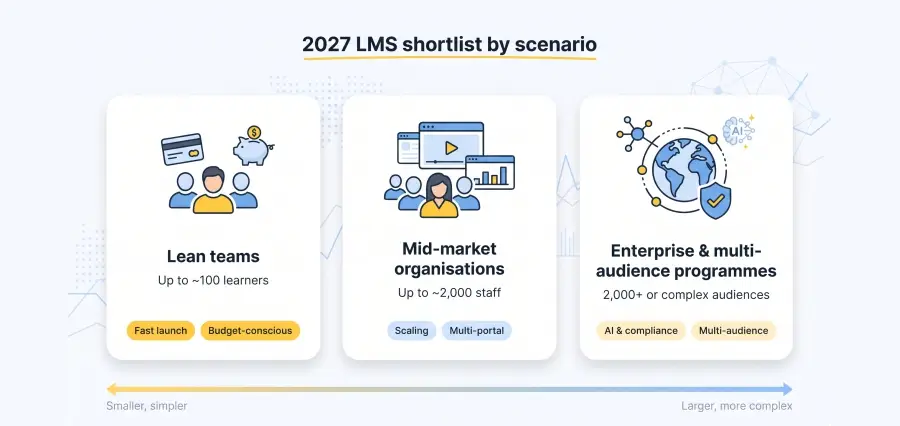
We’re in a skills crunch. The World Economic Forum estimates that 59 percent of today’s workers will need new capabilities by 2030, and 85 percent of employers already rank upskilling as a top priority. LinkedIn’s 2025 Workplace Learning Report echoes the gap, noting that 49 percent of L&D leaders say their teams still lack those critical skills. Yet budgets haven’t kept pace. This guide compares 15 corporate training platforms across a three-year total cost of ownership—licences, implementation, content, AI usage, and support—so you can zero in on the best fit for a lean team, a scaling mid-market firm, or a global enterprise without wasting a dollar. Executive summary – the shortlist you came for Busy L&D teams wanted one thing: a fast starting point. After running 15 platforms through the same 100-point scorecard, where total cost of ownership carries a 20 percent weight, we landed on three scenario-based leaders: Lean teams (up to about 100 learners) GoSkills: one login for LMS, ready-made courses, and AI creation on transparent pricing. TalentLMS: flexible active-user billing plus an optional 1,000-course library. Mid-market organisations (up to 2,000 staff) 360Learning: turns subject-matter expertise into courses with peer review and AI drafting. LearnUpon: single stack for employees, customers, and partners when you need multi-portal scale. Enterprise or multi-audience programmes Docebo: leads on AI maturity and extended-enterprise reach. Cornerstone: pairs global compliance with integrated talent data. Workday Learning powered by Sana: best fit for organisations already on Workday that want an AI-native layer. We call these “best value” picks because licence fees tell only half the story. Implementation time, content seats, AI usage, and weekly admin hours can double or even triple the bill. Use the clusters above as your first filter, then dive into the detailed profiles next to move from long list to laser-focused shortlist quickly. How we evaluated and ranked the platforms We began with 42 corporate-ready products. Each had to clear six non-negotiable hurdles: Generally available today. Road-map slides don’t train real learners. Core LMS functions included. Assign, track, and report without third-party plug-ins. Corporate target market. Higher-ed-only and creator storefronts were excluded. Security evidence on file. Recent SOC 2 or ISO 27001 plus a sub-processor DPA. Verifiable customer sentiment. Public G2 or Capterra ratings, analyst notes, or named case studies. Transparent pricing inputs. GoSkills is a useful yard-stick here: its pricing page lists LMS Pro at $9.71 per learner per month and offers a free organization plan with access to 10 sample lessons from every course, so we could feed precise seat costs and setup assumptions into the three-year TCO model without waiting on an NDA. Fifteen vendors met all six checks and moved to our 100-point scorecard. The rubric weighs what matters most in a three-year contract: Bucket Weight Total cost of ownership 20 percent Core LMS capabilities 14 percent Content depth 14 percent Data & integrations 12 percent Learner experience & accessibility 10 percent AI & skills intelligence 10 percent Security & global readiness 8 percent Implementation & support 7 percent Customer evidence 5 percent Each feature scores 0–5. We then tag every claim with an evidence grade: A = hands-on plus independent proof · B = documentation plus third-party reviews · C = vendor-only promise. Finally, we publish our assumptions instead of hiding them. If a reader can’t reproduce the ranking with the same inputs, the method fails its own transparency test. What changed heading into 2027 AI shifts from “write my course” to coached action In 2026, almost every vendor added a Generate course button. In 2027 the frontier is automation inside the flow of work. Docebo’s Harmony chat layer and AgentHub now enrol learners and trigger workflows with cited sources. Similar tutor-bots and role-play agents have appeared in 7 of the 15 platforms we reviewed. When you evaluate claims, ask two questions: Does the AI ground answers in approved content? Can it take an action (enrol, update, open a ticket) or only suggest one? LMS, LXP, and knowledge tools are blending Workday Learning powered by Sana (GA 22 July 2026) merges assignment, knowledge search, and personalised paths in one interface. Docebo is moving the same way from the LMS side, adding skills graphs and agent hubs that talk to SharePoint and Slack. One stack means tighter data loops but also deeper vendor lock-in. Map your HRIS, CRM, and document systems first; insist on open APIs such as LTI 1.3 or xAPI before signing. AI governance becomes a checklist item The EU AI Act has required companies to foster AI literacy since 2 February 2025 and allows fines after 3 August 2026. Even a single learner logging in from the EU brings the rules to your door. During our interviews we scored vendors on model providers, data-retention windows, and audit-trail access. Treat those answers like a SOC 2: no proof, no purchase order. Accessibility moves from courtesy to contract WCAG 2.2 became ISO/IEC 40500:2025 in October 2025, and the European Accessibility Act took effect on 28 June 2025. Buyers now request three proofs: a current VPAT or ACR, keyboard or screen-reader test logs, and a roadmap for new success criteria such as reduced redundant entry. Products without fresh evidence lost points in our scorecard. How to read the 2027 comparison table Each column answers a different budget or risk question: Rank – scored by buyer segment, not overall, so a small-team champion may sit mid-pack for enterprises. Best for – six words or fewer on the primary use case; skip tools that don’t match yours. Public starting price – lowest published tier that meets basic corporate needs. “Custom quote” means you’ll need to speak with sales. Pricing model – active user, registered seat, or MAU. Read this first; the wrong model can triple real cost. Three-year TCO band – Low, Medium, or High based on all hidden expenses: implementation, content, author seats, SSO, premium support, and weekly admin hours. AI maturity – four checkpoints: Authoring, Tutor, Skill inference, Agents. More ticks only help if grounding and audit

How Diesel Fuel Costs Impact Heavy Equipment Operations and Fleet Management
Diesel fuel remains the lifeblood of heavy equipment operations across construction, agriculture, mining, and logistics sectors. As fuel prices fluctuate due to geopolitical tensions, supply chain disruptions, and seasonal demand, fleet managers and equipment operators face mounting pressure to optimize fuel efficiency while maintaining productivity. Understanding the relationship between diesel costs and operational performance has become essential for businesses relying on heavy machinery to maintain competitive advantage in capital-intensive industries. The Economic Burden of Rising Diesel Prices Diesel fuel expenditures represent one of the largest variable costs in heavy equipment operations. Recent data shows that farmers spent 1.4 billion dollars more on diesel during planting season, highlighting the dramatic financial impact of price volatility on equipment-dependent sectors. This surge in operational costs forces businesses to reconsider their fuel management strategies and explore efficiency measures that can offset rising expenses without compromising productivity. The volatility in diesel markets creates unpredictability in project budgeting and profit margins. Construction firms bidding on long-term contracts must account for potential fuel cost escalation, often building in contingencies that affect their competitiveness. Similarly, agricultural operations working within narrow seasonal windows face immediate pressure when fuel prices spike during critical planting or harvesting periods, leaving little room for strategic adjustment. Compression Ignition Technology and Fuel Efficiency The diesel engine’s compression ignition mechanism delivers inherent fuel efficiency advantages over gasoline counterparts, making it the preferred power source for heavy-duty applications. Modern diesel engines achieve thermal efficiency rates exceeding forty percent, converting more energy from fuel into useful work. This efficiency becomes particularly critical when operating equipment under sustained heavy loads, where the torque characteristics of diesel engines provide optimal performance. Advanced compression ignition systems now incorporate electronic controls, variable geometry turbochargers, and common rail fuel injection to maximize combustion efficiency. These technologies enable precise fuel metering across varying load conditions, reducing waste and improving power delivery. Rugged compression ignition hardware has proven practical for heavy-duty machines and vehicles because it withstands extreme operating conditions while maintaining fuel economy standards that directly impact operational costs. Durability Requirements for Heavy Equipment Engines Heavy equipment operates in punishing environments where temperature extremes, vibration, dust, and moisture pose constant challenges. Diesel engines designed for these applications must incorporate robust materials and engineering tolerances that ensure reliability over extended service intervals. The compression ignition process itself generates higher cylinder pressures than spark ignition, requiring stronger engine blocks, reinforced crankshafts, and durable fuel injection components capable of withstanding continuous high-pressure operation. Maintenance intervals for heavy equipment diesel engines often extend beyond ten thousand hours of operation, reflecting the durability built into these power plants. This longevity reduces total cost of ownership by minimizing downtime and replacement expenses, factors that become increasingly important as initial equipment investments rise. Fleet managers prioritize engines that combine fuel efficiency with proven reliability, recognizing that unexpected failures in remote locations or during critical project phases carry costs far exceeding fuel savings. Fuel Management Strategies for Fleet Operators Choose a title or paragraph based on the anchor text when considering comprehensive approaches to fuel cost management. Effective fleet management requires combining technology solutions with operational best practices to minimize consumption without sacrificing productivity. Goldfarb Inc. and similar industry leaders emphasize that successful fuel management begins with accurate consumption tracking and performance benchmarking across equipment types and operational conditions. Modern telematics systems provide real-time visibility into fuel usage patterns, enabling managers to identify inefficient practices and optimize equipment deployment strategies. Operator training represents another critical component of fuel management programs. Studies consistently demonstrate that skilled operators can reduce fuel consumption by fifteen to twenty percent through proper technique, including minimizing idle time, avoiding aggressive acceleration, and matching engine speed to load requirements. Regular equipment maintenance also preserves fuel efficiency, as worn components, clogged filters, and degraded lubricants all contribute to increased consumption. Alternative Fuels and Hybrid Technologies The heavy equipment industry continues exploring alternative fuel sources and hybrid power systems to reduce diesel dependency. Biodiesel blends offer renewable content that can substitute for petroleum diesel in existing engines with minimal modification, though availability and pricing vary by region. Natural gas engines provide another option for stationary or regional applications, delivering lower fuel costs and reduced emissions compared to diesel, though infrastructure requirements limit widespread adoption in mobile heavy equipment. Hybrid systems combining diesel engines with electric motors show promise in specific applications where load cycling allows energy recovery. Excavators and wheel loaders equipped with hybrid technology can capture energy during braking and boom lowering operations, reducing overall fuel consumption in high-cycle applications. However, the added complexity, weight, and upfront cost of hybrid systems require careful analysis to determine economic viability for specific operational profiles. Industry Leadership in Equipment Solutions Companies specializing in heavy equipment understand that fuel economy cannot be separated from overall equipment performance and reliability. The integration of advanced engine management systems, efficient hydraulics, and optimized drivetrain components creates comprehensive solutions that address operational costs holistically. Industry leaders focus on engineering equipment that delivers productivity advantages while maintaining fuel efficiency standards that help customers manage volatile diesel markets. The commitment to fuel-efficient design extends throughout the equipment lifecycle, from initial specification through ongoing support and maintenance programs. Manufacturers increasingly provide data analytics tools that help operators understand their equipment’s fuel consumption patterns and identify optimization opportunities. This partnership approach recognizes that achieving optimal fuel economy requires collaboration between equipment designers and end users who understand specific application requirements. Future Outlook for Heavy Equipment Fuel Efficiency Regulatory pressures and economic imperatives continue driving innovation in fuel efficiency technologies for heavy equipment. Emissions standards worldwide have pushed manufacturers to develop engines that burn cleaner while maintaining or improving fuel economy. These dual objectives have accelerated the adoption of sophisticated combustion management, exhaust after-treatment, and engine control systems that optimize performance across diverse operating conditions. Looking forward, the heavy equipment sector will likely see continued refinement of diesel technology alongside gradual introduction of alternative power sources. Electric equipment may gain traction in specific applications where battery technology and charging infrastructure support

Sourcing Replacement Components for Agricultural Equipment
Agricultural operations depend on reliable machinery to maintain productivity throughout demanding seasons. When equipment experiences wear or component failure, operators face a critical decision: identify and source the correct replacement parts quickly or risk extended downtime that impacts revenue. The complexity of modern farm machinery, with its specialized hydraulic systems, precision electronics, and brand-specific engineering, makes parts sourcing a skill that separates efficient operators from those who struggle with prolonged equipment unavailability. Understanding the procurement process for agricultural components requires knowledge of manufacturer systems, parts cataloging methods, and verification techniques that ensure compatibility. The Economic Impact of Equipment Downtime Every hour that a tractor, harvester, or implement sits idle represents lost operational capacity. During critical periods such as planting windows or harvest seasons, this downtime translates directly into financial loss. The cost extends beyond the immediate work stoppage—delayed planting can reduce yield potential, while harvest delays may result in crop quality degradation or weather-related losses. Operators who maintain efficient parts procurement systems minimize these risks by reducing the time between component failure and repair completion. This efficiency requires preparation, including maintaining relationships with parts suppliers, understanding lead times for specialized components, and keeping critical spare parts in inventory. Preventive Maintenance and Parts Planning Proactive operators approach parts sourcing as an ongoing maintenance strategy rather than a reactive crisis response. This methodology involves tracking component wear patterns, anticipating replacement needs based on operating hours, and ordering parts before failure occurs. Hydraulic hoses, filters, belts, and bearings represent high-wear items that can be replaced during scheduled maintenance intervals. By sourcing these components in advance, operators avoid emergency orders that often incur expedited shipping costs and extend equipment downtime. Documentation of maintenance schedules and parts replacement history provides valuable data for predicting future needs and budgeting for component replacement costs. Navigating Manufacturer Parts Systems Major agricultural equipment manufacturers maintain extensive parts cataloging systems that organize components by model, serial number, and system. These databases represent decades of engineering documentation, with detailed diagrams showing component relationships and assembly sequences. When you need to locate specific components for your machinery, understanding how to find New Holland parts through official lookup systems ensures you receive factory-specification components designed for your exact equipment configuration. This precision matters because agricultural machinery often undergoes running changes during production, meaning two tractors from the same model year may have different component specifications based on their serial number ranges. Serial number identification forms the foundation of accurate parts lookup. This alphanumeric code, typically found on a plate affixed to the machine frame, unlocks the complete configuration record for that specific unit. Manufacturers use this information to match the correct components to your machine, accounting for factory options, engine specifications, transmission types, and regional variations. Without this serial number, parts specialists must make assumptions that can result in incorrect components, return processes, and extended downtime. Operators should photograph their equipment serial number plates and store this information in accessible formats for quick reference during parts ordering. Component Verification and Cross-Referencing Part numbers represent the most precise method for ensuring component compatibility. These codes, printed on many components or listed in parts manuals, eliminate ambiguity in the ordering process. However, components may carry multiple identifiers—superseded part numbers when manufacturers redesign components, OEM part numbers that differ from aftermarket equivalents, and cross-reference numbers that identify compatible alternatives. Skilled operators verify part numbers through multiple methods: visual inspection of failed components, consultation with parts diagrams, and confirmation with parts specialists who can check supersession records and current availability. Custom Agricultural Machinery Considerations While standardized production equipment dominates most operations, specialized farming applications sometimes require custom machinery solutions. Innovative approaches to agricultural equipment design address unique operational challenges, from specialized harvesting equipment for niche crops to custom implements for specific soil conditions. These customized solutions present distinct parts sourcing challenges, as standard manufacturer catalogs may not cover modified components or specialized attachments. Operators running custom equipment should maintain detailed documentation of modifications, including component specifications, supplier information, and technical drawings that facilitate future parts replacement. Aftermarket and OEM Component Decisions The choice between Original Equipment Manufacturer (OEM) parts and aftermarket alternatives involves balancing cost, availability, quality, and warranty considerations. OEM components guarantee fit and performance specifications identical to original installation, backed by manufacturer engineering and often required to maintain warranty coverage on newer equipment. Aftermarket parts may offer cost savings and sometimes improve upon original designs, but quality varies significantly between manufacturers. Critical systems such as fuel injection, hydraulic controls, and electronic modules typically warrant OEM components, while less critical items like filters, lights, and basic hardware may perform adequately with quality aftermarket alternatives. Operators should evaluate aftermarket suppliers based on reputation, warranty support, and performance history rather than price alone. Building Supplier Relationships Long-term relationships with parts suppliers provide advantages beyond transactional efficiency. Knowledgeable parts specialists learn your equipment fleet, understand your operation’s priorities, and can provide insights about component availability, alternative solutions, and upcoming price changes. These relationships prove especially valuable during supply chain disruptions when allocation of scarce components may favor established customers. Regional agricultural dealers often maintain emergency parts inventory for critical components common to local equipment populations, while national distributors provide access to broader catalogs and competitive pricing. Successful operators cultivate relationships across multiple supplier tiers to ensure sourcing options regardless of availability challenges. Emergency Sourcing Strategies Despite careful planning, unexpected component failures occur. Emergency sourcing requires quick decision-making about repair versus replacement, OEM versus aftermarket components, and local availability versus expedited shipping. Making informed equipment decisions during high-pressure situations requires preparation—knowing which components can be rebuilt locally, which suppliers maintain emergency stock, and which items justify overnight shipping costs. Some operators maintain reciprocal relationships with neighboring farms, sharing critical spare parts inventory to minimize downtime across their community. This cooperative approach recognizes that equipment availability benefits the broader agricultural economy beyond individual operations. Digital Resources and Technical Support Modern parts sourcing increasingly relies on digital tools that streamline identification and ordering processes. Manufacturer websites offer parts lookup portals where

Drop Shipping Merchant Approval: What Businesses Need to Know About Payment Processing in High-Risk Industries
For entrepreneurs operating in competitive and often misunderstood sectors, securing reliable payment processing is one of the most consequential steps in building a sustainable business. Drop shipping, sweepstakes, and similar industries face unique scrutiny from financial institutions, making merchant approval a complex and often frustrating process. Understanding what underwriters look for, how to position your business favorably, and which payment partners specialize in your niche can mean the difference between a thriving operation and one that stalls before it ever gains momentum. Why Merchant Approval Is More Complicated for Certain Industries Not all businesses are treated equally by acquiring banks and payment processors. Industries such as drop shipping, sweepstakes, nutraceuticals, and subscription services are frequently categorized as high-risk due to elevated chargeback rates, regulatory complexity, and the potential for consumer disputes. This classification is not necessarily a reflection of a business’s legitimacy — it is a risk management decision made by financial institutions to protect themselves from financial exposure. For drop shippers specifically, the model itself introduces layers of uncertainty. Because the merchant does not hold inventory and relies on third-party suppliers to fulfill orders, delivery timelines and product quality can be inconsistent. This creates a higher likelihood of customer dissatisfaction, refund requests, and chargebacks — all of which raise red flags during the underwriting process. Banks and processors evaluate these patterns carefully before extending merchant accounts. The Role of Chargebacks in Underwriting Decisions Chargebacks are one of the primary metrics underwriters use to assess risk. A chargeback occurs when a customer disputes a transaction with their bank rather than resolving it directly with the merchant. For drop shippers, chargebacks can stem from delayed shipments, products that do not match descriptions, or fulfillment errors made by the supplier. Even a relatively small percentage of chargebacks — typically above one percent — can trigger account reviews, holds, or terminations. Merchants who understand this dynamic and implement proactive chargeback mitigation strategies are far more likely to secure and maintain merchant accounts. The Sweepstakes Connection: Shared Challenges in Payment Processing Sweepstakes businesses face a parallel set of challenges. The promotional nature of sweepstakes, combined with the involvement of prizes and entry fees, places these operations under heightened regulatory scrutiny. Payment processors must ensure that sweepstakes merchants comply with applicable laws in every jurisdiction where they operate, which varies significantly from state to state and country to country. This compliance burden, combined with the perception of risk, makes it difficult for sweepstakes operators to find processors willing to work with them at competitive rates. Both drop shipping and sweepstakes businesses benefit enormously from working with payment processors that have direct experience in their respective industries. Generic processors often lack the infrastructure, compliance knowledge, and risk appetite to support these merchants effectively. Specialized processors, by contrast, have developed underwriting frameworks specifically designed to evaluate and support high-risk business models. What Underwriters Look for During the Approval Process When a drop shipping or sweepstakes merchant applies for a merchant account, underwriters conduct a thorough review of the business. This typically includes an examination of the business model, website content, terms and conditions, refund policies, processing history, and the personal credit history of the business owner. Merchants who present clean, professional websites with transparent policies, clear product or service descriptions, and a documented history of responsible processing are far more likely to receive approval. Gaps in any of these areas can result in delays, additional documentation requests, or outright denial. Strengthening Your Application Before You Apply Preparation is the most powerful tool a merchant has when seeking approval. Before submitting an application, businesses should audit their websites for compliance, ensure that refund and dispute resolution policies are clearly stated, and gather at least three to six months of processing statements if available. New businesses without processing history should be prepared to provide detailed business plans, supplier agreements, and financial projections. The goal is to demonstrate to the underwriter that the business is legitimate, organized, and capable of managing risk responsibly. It is also worth noting that the broader digital payment landscape is evolving rapidly. As explored in this analysis of strengthening digital payment infrastructure worldwide, financial institutions and payment networks are investing heavily in technology and compliance frameworks that affect how merchants are evaluated and onboarded. Staying informed about these developments helps merchants anticipate changes in underwriting standards and adapt accordingly. Building a Relationship with a Specialized Processor One of the most strategic decisions a high-risk merchant can make is to partner with a processor that understands their industry. Specialized processors have established relationships with acquiring banks that are willing to work with high-risk merchants, and they often provide additional services such as chargeback monitoring, fraud prevention tools, and dedicated account management. These relationships are built over time and can provide merchants with greater stability and more favorable terms as their processing history matures. 2Accept: A Trusted Partner for High-Risk Merchant Accounts For businesses operating in the sweepstakes and drop shipping space, finding a payment processor with genuine industry expertise is not optional — it is essential. 2Accept has built a reputation for supporting merchants in high-risk categories by offering tailored solutions that address the specific compliance, underwriting, and processing challenges these businesses face. Their team works closely with merchants to structure applications that meet underwriter requirements and to identify banking relationships that align with each merchant’s business model. Whether you are launching a new drop shipping venture or scaling an existing sweepstakes operation, 2Accept provides the infrastructure and expertise needed to process payments reliably and compliantly. Regulatory Frameworks That Shape Merchant Approval Understanding the regulatory environment is equally important for merchants seeking approval. Payment systems in the United States are governed by a complex web of federal and state regulations that dictate how funds are transferred, how disputes are resolved, and how merchants must conduct themselves. The OCC’s guidance on payment systems and funds transfer activities provides a comprehensive overview of the regulatory standards that financial institutions must follow, which in turn shapes the criteria

Revology 1969 Boss 429 Debut Signals a New Era for American Muscle Restoration
The American automotive landscape has always been defined by moments of bold reinvention — from the original muscle car wars of the late 1960s to the modern resurgence of heritage-inspired performance vehicles. Today, a new chapter is being written, one that honors the past while embracing the engineering precision of the present. At the intersection of nostalgia and innovation, a handful of visionary builders are proving that the golden age of American muscle never truly ended — it simply evolved. The 2025 Los Angeles Auto Show became the stage for one such defining moment, capturing the attention of enthusiasts, collectors, and automotive journalists alike. The Legacy of the Boss 429: Why It Still Matters Few nameplates in automotive history carry the mythological weight of the Boss 429. Originally produced by Ford in 1969 and 1970, the Boss 429 Mustang was born out of NASCAR homologation requirements — Ford needed to produce enough street-legal cars to qualify its racing engine for competition. The result was a brutish, wide-body Mustang fitted with a semi-hemispherical 429 cubic inch V8 engine that pushed the boundaries of what a production car could deliver. Only about 3,500 units were produced in 1969, making original examples extraordinarily rare and valuable today. The Boss 429 wasn’t just fast — it was a statement. Its aggressive stance, functional hood scoop, and unmistakable engine note made it an icon of an era when American automakers competed with reckless ambition. Decades later, that spirit continues to inspire builders, collectors, and engineers who refuse to let these legends fade into museum obscurity. The question for modern craftsmen has always been: how do you honor something so perfect without diminishing it? Revology Cars and the Art of Faithful Reinvention Revology Cars has built its reputation on answering that question with extraordinary care. Based in Orlando, Florida, the company specializes in producing continuation Mustangs — vehicles that are faithful to the original designs of the 1960s but built with modern components, safety systems, and reliability standards. Their approach is neither a simple restoration nor a full-blown restomod. It occupies a precise middle ground: authenticity in appearance, modernity in execution. The Revology 1969 Boss 429 debut at the 2025 Los Angeles Auto Show represented the culmination of years of meticulous engineering and design work. Revology unveiled a continuation version of the legendary Boss 429 Mustang, reinterpreting the original with period-correct styling cues while integrating modern drivetrain technology, updated suspension geometry, and contemporary safety features. The reveal drew immediate acclaim from the automotive press and underscored Revology’s position as one of the most serious players in the continuation car market. Engineering Philosophy Behind the Continuation Model What separates Revology’s approach from lesser imitations is the depth of their engineering commitment. Every panel, every curve, and every detail is scrutinized against original factory specifications. Yet beneath that authentic exterior lies a vehicle designed to be driven — not just displayed. Modern fuel injection, updated braking systems, and improved chassis rigidity ensure that the driving experience matches the visual drama. The result is a car that feels genuinely connected to its 1969 ancestor while being entirely practical for today’s roads. The Broader Shift in American Automotive Culture The enthusiasm surrounding the Revology Boss 429 debut doesn’t exist in a vacuum. It reflects a broader cultural shift in how Americans relate to their automotive heritage. As the industry accelerates toward electrification and autonomous driving, a significant segment of enthusiasts is pushing back — not out of resistance to progress, but out of a genuine desire to preserve the tactile, emotional experience of driving a great internal combustion machine. Continuation cars and high-quality restorations have become a form of cultural preservation, not unlike the restoration of historic architecture or the reissuing of classic literature. This sentiment is echoed across the industry. Major automakers are also investing heavily in U.S. manufacturing expansion, signaling that domestic production and American automotive identity remain central priorities even as the industry transforms. The parallel between legacy builders like Revology and mainstream manufacturers is striking — both are navigating the tension between honoring what came before and building for what comes next. Collectors, Investors, and the Rising Value of Authenticity The collector car market has responded enthusiastically to the continuation car segment. Buyers who might once have sought out original examples — often requiring extensive restoration work and carrying the mechanical uncertainties of 50-year-old components — are increasingly drawn to continuation models that offer the aesthetic experience of a classic with the dependability of a modern vehicle. For many, this represents the ideal compromise: a car that can be driven to a show, taken on a weekend cruise, and stored without the anxiety that accompanies a numbers-matching original. Revology’s pricing reflects the premium nature of their craftsmanship, positioning their vehicles firmly in the luxury collector segment. But for buyers who understand what they’re getting — a hand-built, meticulously engineered continuation of one of America’s greatest automotive legends — the value proposition is compelling. Electrification and the Future of the Mustang Nameplate While Revology celebrates the combustion-powered heritage of the Mustang, the broader nameplate is simultaneously navigating an electric future. Ford’s decision to extend the Mustang brand into the electric vehicle space has been both celebrated and debated. Ford’s electric Mustang strategy continues to evolve as the automaker balances performance expectations with sustainability goals, a challenge that will define the brand’s identity for the next generation of drivers. The contrast between Ford’s electric ambitions and Revology’s combustion-focused continuation work illustrates the fascinating duality of the current automotive moment — two very different visions of what the Mustang can be, coexisting in the same cultural space. Revology’s Place in Automotive History What Revology has accomplished with the Boss 429 continuation is more than a commercial achievement — it is an act of cultural stewardship. By applying modern manufacturing discipline to a beloved historical design, they have created something that transcends the typical restoration or replica. These are new cars built in the spirit of originals, carrying forward