






Digital Disruption: The Role of Leadership in Shaping the Tech-Enabled Future
Digital disruption is no longer in front of us — it is here. With automation via AI, blockchain, cloud computing, and data business models, technology is transforming industry operations, competition, and growth. For those institutions that are making their way through the complex landscape, leadership is no longer about leading change — it is about driving it. It is the leadership teams’ capacity to leverage digital disruption and use it as a strategic tool that will forge tomorrow’s champions. It is more than technology expertise. It demands vision, flexibility, decision-making ability, and most crucially, the mindset to perceive disruption as a driver of innovation, rather than an adversary of stability. From Old-School Thinking to Digital Foresight The majority of organizations remain rooted in previous systems, hierarchical models, and conventional thinking that hinder digital transformation. Leadership in a world of technology is about turning convention on its head and establishing a culture of anticipating. Leaders must now anticipate change in the marketplace, master new technology, and re-imagine business models according to emerging trends. Foresight is not a prediction of what’s coming but preparedness of organizations to be adaptable and agile. Leaders will have to create cultures where experimentation is welcomed, failure is paired with learning, and innovation is instilled in the strategic DNA of the company. The ones who will survive will be those who see digital disruption as not a sporadic storm but as new climate reality — one that calls for active, visionary stewardship. Human-Centric Leadership in the Age of Technology Technology can be powering the disruption, but leadership should still be quintessentially human. At a time when automation and artificial intelligence dominate the talk, workers and customers are asking for more emotional intelligence, empathy, and sense of purpose from leadership. Human-centric leadership demands that digital transformation doesn’t dis-embed but enables people throughout the organization. Active listening and empathy are strategic competencies now. Leaders must take their employees with them on the digital journey, talk openly about the “why” behind digital initiatives, and invest in re-skilling to enable their people to match their capabilities against machines. By rooting digital strategy in human needs and values, leaders can pair innovation with trust — an unbeatable combination across industries. Data-Informed Decision-Making: More Than Instinct In an age dominated by technology, decision science is evolving. Instinct and experience remain useful, but data is becoming a strategic enabler. Leadership needs to get better at reading high-end analytics, marrying AI inputs, and leveraging data to enhance performance, customer experiences, and discover new revenue streams. But data dependency is not easy. Ethical leaders need to be able to provide ethical data use, neutralize algorithmic bias, and safeguard data privacy. That requires finesse by which data informs decision making without erasing ethics or human nuance. Great leaders will harmonize data acuity with emotional acuity to achieve balanced, responsible leadership in a machine-enabled world. Building Agile, Resilient Organizations One of the traits that distinguish effective leadership in a digital disruption context is agility. The speed of change makes traditional, linear planning mechanisms ever more useless. Agile leadership allows incremental strategy, adaptive structures, and distributed decision to facilitate quick reaction to emergent danger. Resilience is needed too. Digital transformation initiatives never occur without some problems. Projects fail when they can be expected to fail, technologies become obsolete very rapidly, and resistance from within may occur. Teams need leaders who are resilient in the face of the unknown — demonstrating grit, making things up as they go along, and keeping team momentum through times of uncertainty. They will also need to establish organizational resilience by pushing digital dexterity right across teams and establishing a culture of continuous learning. Closing the Innovation Gap Fewer executives have been able to convert digital intent into action even with the obvious imperatives. The “innovation gap” — the gap between knowing that something new is needed and actually doing it — is a persistent issue. It takes vision, intelligence, and collaboration to close the gap. Effective digital leaders don’t fly solo. They involve various stakeholders, construct cross-functional teams, and co-create with internal and external collaborators. They are willing to make tough choices — reengineering fundamental processes, phasing out old systems, or flipping entire business models on their heads. Most importantly, they win small battles while keeping their gaze on the distant horizon of the long-term digital horizon. Embracing Ethical and Inclusive Technology Great power, great responsibility. To lead in the time of digital transformation is not merely to move quickly and nimbly — it is to think about ethics and inclusion. The technologies that will shape our tomorrow — AI, machine learning, predictive analytics — have deep stakes in equity, privacy, and human dignity. Leaders have to lead by example and establish an ethical benchmark for innovation. That means maintaining open governance mechanisms, making ethical impact assessments, and engaging all voices in the design and deployment of digital technology. By becoming champions of inclusive technology, leaders can ensure that digital transformation benefits society as a whole — not just shareholders. The Path Ahead: Visionary Leadership for a Digital Tomorrow Disruption isn’t something that happens, it’s something that evolves. Successful leaders are those who understand this truth and step not only into being guardians of business as it is, but also into designing what it will be. They get digitally literate, they lead with empathy, they make fact-based decisions, decisively, and they own change. As the future is built upon technology as a foundation, leadership is what makes all the difference. It will dictate the tone on whether an organization simply survives disruption — or succeeds because of it. The course will be navigated by leaders prepared to lead courageously, innovate with integrity, and humanize technology along the way. Read More: The New Era of Leadership: Digital Transformation as a Catalyst for Growth
Pi Coin Drops 31%, but Technical Signals Hint at Imminent Rebound
Prime Highlights : Pi Coin falls 31%, yet Elliott Wave theory predicts possible bullish reversal. Investor sentiment will improve as listing rumors on major exchanges gain momentum. Key Facts : Pi Coin is currently the 19th largest crypto with a value of $8 billion. Price may reach up to $1.64–$1.87 if technical trends prevail. Key Background : Pi Coin, the cryptocurrency of Pi Network’s own network, recently saw its sudden 31% price drop to trim its worth down to $1.1475. This after a temporary bullish momentum sparked speculative demand. The sudden correction aside, Pi Coin is still in the top 20 market-cap coins of the world with an approximate $8 billion market value. Technical analysts are now using Elliott Wave Theory to interpret and predict the upcoming trend of the coin. According to the theory, Pi Coin could be headed towards the fifth wave of a bull impulse wave. The wave usually indicates direction to new growth momentum. Analysts have noted price resistance levels at $1.64, $1.72, and $1.87 in this respect. Supporting the argument is the neutral read on Relative Strength Index (RSI), which implies space for price action higher without near-term overbought stress. The volatility is in the context of a bigger decline in the overall crypto space, which saw more than $160 billion of total global crypto market cap lost in a 24-hour period. Nevertheless, Pi Coin thus far has been comparatively more stable than its larger brethren in Bitcoin and Ethereum, who both fell for the same period. Assuming Pi Coin can hold above its underlying support level of $1.46, though, analysts believe the bullish break-out is still on the menu. Fueling investor psychology are reports of listing Pi Coin on prominent exchanges, specifically Binance. A January poll of Binance users showed strong demand, with more than 87% voting in favor of listing the coin. Although no official announcement has been made, such a listing would significantly raise Pi Coin’s visibility, accessibility, and liquidity—factors that have a history of being followed by explosive price action. In brief, while Pi Coin is trading in speculative mode right now, technical analysis coupled with increasing community sentiment and momentum implies a likely short-term reversal. Read More: Google Announces Advanced Protection Mode for Highest-Risk Android Users

The CIO Leaders Showcases Richard Larson as One of The Most Impactful EdTech Innovators Transforming Digital Learning in 2025
Known for its engaging content and captivating interviews of outstanding business leaders, The CIO Leaders magazine is pleased to feature Richard Larson, Professor at MIT, who unfolded his professional journey reflecting resilience, empathy and dedication. Having spent thirty years of professional life in research, academia, and innovation, he has never stopped attempting to advance frontiers of knowledge and inspiring his environment to do so. From leading the way in creating advances in queueing theory and operations research to shaping current designs in education and decision science, his efforts have left indelible marks in theoretical as well as application domains. A student first of all, he never thought of education as an end in itself, a mere moneymaker, one limited to university borders and beyond but also in life. His endeavors were always supported by the steadfast dedication of his late wife, Mary Elizabeth Murray (“Liz”), whose collaboration was at the heart of their common vision of greater access to high-quality education. From giving talks at global conferences to creating new models of education or mentoring up-and-coming researchers, Richard has consistently been committed to mental exploration and societal progress. Even at retirement, his interest in MODEL-Based Thinking and teaching never wavered, showing learning is not just a phase but a mentality. His enthusiasm for learning was heightened, pushing him to study for postgraduate and eventually a PhD in Operations Research. Larson’s academic highlight was interacting with students, both in lectures and research guidance. He was greatly proud of watching his students explore the boundaries of knowledge, making meaningful contributions to their fields, and succeeding greatly in their professional lives. While still retired from active teaching and advising, Larson is as actively engaged in intellectual discussion and public debate as ever. His energies are now devoted to bringing the highly technical concept itself into everyday language, something that he accomplishes through his book, MODEL THINKING For Everyday Life. Here, he recapitulates his belief that good decision-making and problem-solving depend on comprehending conceptual and exemplary models. He hopes to empower human beings to think more wisely, be good at solving problems, and make good decisions in everyday life.

Enterprise Review Celebrates the Inspirational Career of Andrei Lyskov
The latest edition of Enterprise Review puts Andrei Lyskov on the center stage. Being a data science leader, he aims to drive innovation and societal impact by bringing together technical expertise, strategic foresight, and ethical clarity. Andrei merges advanced analytics, machine learning, and domain knowledge to drive incredible outcomes. He implements ethical AI to enhance transparency, fairness, and accountability. He promotes a culture which builds curiosity and resilience. He ensures that the teams shift from the traditional norms and embrace innovation and emerging trends so that they can come up with creative and pragmatic solutions. Andrei’s journey in the field of data science started when he started working on personal projects such as the Quantified Self-movement and building dashboards to gain actionable perceptions. While working for some of the top companies such as Apple, Coinbase, and Square, Andrei got the opportunity to amalgamate analytics and storytelling. This enabled him to convert raw data into informational narratives which would take use experience to the next level. Enterprise Review is proud to feature a dedicated leader like Andrei. While working at Apple and Coinbase, he developed KPIs and dashboards for enhancing the product roadmap experience, which assisted in successful launches. The prime objective of Andre is to create a culture driven by data fueled by trust, accountability, and decentralized experimentation. He wants to ensure that the data is accurate, and improvements are taking place continuously. Enterprise Review applauds Andre’s dedication towards introducing technological innovations. By using cutting-edge technologies like IoT, quantum computing, and generative AI, he wants to expand data science’s impact so that operations can be streamlined and smarter, more agile solutions are delivered. Andre is always focused on bringing different teams together so that they can align their goals and collaborate effectively. He uses data sciences as a “data controller” to ensure that there is harmony in the company and objectives are achieved while working as one cohesive unit. Read More: The CIO Leaders Showcases Richard Larson as One of The Most Impactful EdTech Innovators Transforming Digital Learning in 2025

CIOLook Proudly Showcases Jaakko Jalkanen as One of the Most Influential Leaders in Marketing to Watch in 2025
Reputed global business magazine CIOLook is pleased to have Jaakko Jalkanen, the Vice President of Marketing at CybExer Technologies, share with us the qualities that will enable us to lead in this changing world. His leadership is of a visionary kind with strategic thinking coupled with pragmatic thought, leading to productive and goal-oriented results. Jaakko’s ability to balance strategic planning with execution enables him to create marketing strategies aligned which resonate with many different stakeholders. His focus on building cooperation, creativity, and profound understanding of marketplace phenomena makes him an agent towards change within the marketplace for cybersecurity advertising. He has worked to create stories of technical stature and instill confidence and interest in the broader community by the manner in which he works. His cybersecurity training also helped to contribute to the appeal, allowing him to blend work with a calling he was passionate about as an expert. What struck him the most, however, was the technology of CybExer’s cyber range—the flexibility and limitless applications that lay beneath its potential to spearhead the revolution of cybersecurity training globally. Jaakko employs all means at his disposal to stay in the loop in this fast-paced world. Peer networking is invaluable—it’s really a question of information exchange, though, as it is learning new ideas about how other individuals are solving similar problems. Attending industry conferences is another item on his agenda; these are a way of learning about future trends, technologies, and best practices. Reading research studies and case studies from reliable sources is also something he never misses. Jaakko is enthusiastic about AI as one of the most interesting marketing technology developments. AI is transforming the way personalization, automation, and data analysis are being carried out.Great marketing is a question of understanding where the people are and how to communicate with them in modern and advanced ways, through the latest technology otherwise through the traditional systems. Jaakko’s dream is to establish CybExer Technologies as the brand of choice for the cyber range industry in the long run. This involves raising awareness, generating interest, and establishing trust among public and private sector clients. He attempts to bridge marketing strategy and CybExer Technologies’ mission by guiding its technology’s record-breaking scalability and flexibility in the past. By establishing tighter ties with customers and focusing on the value of empowering cybersecurity readiness, he believes in maintaining long-term growth and driving CybExer Technologies’ greater aspirations. Read More: Enterprise Review Celebrates the Inspirational Career of Andrei Lyskov
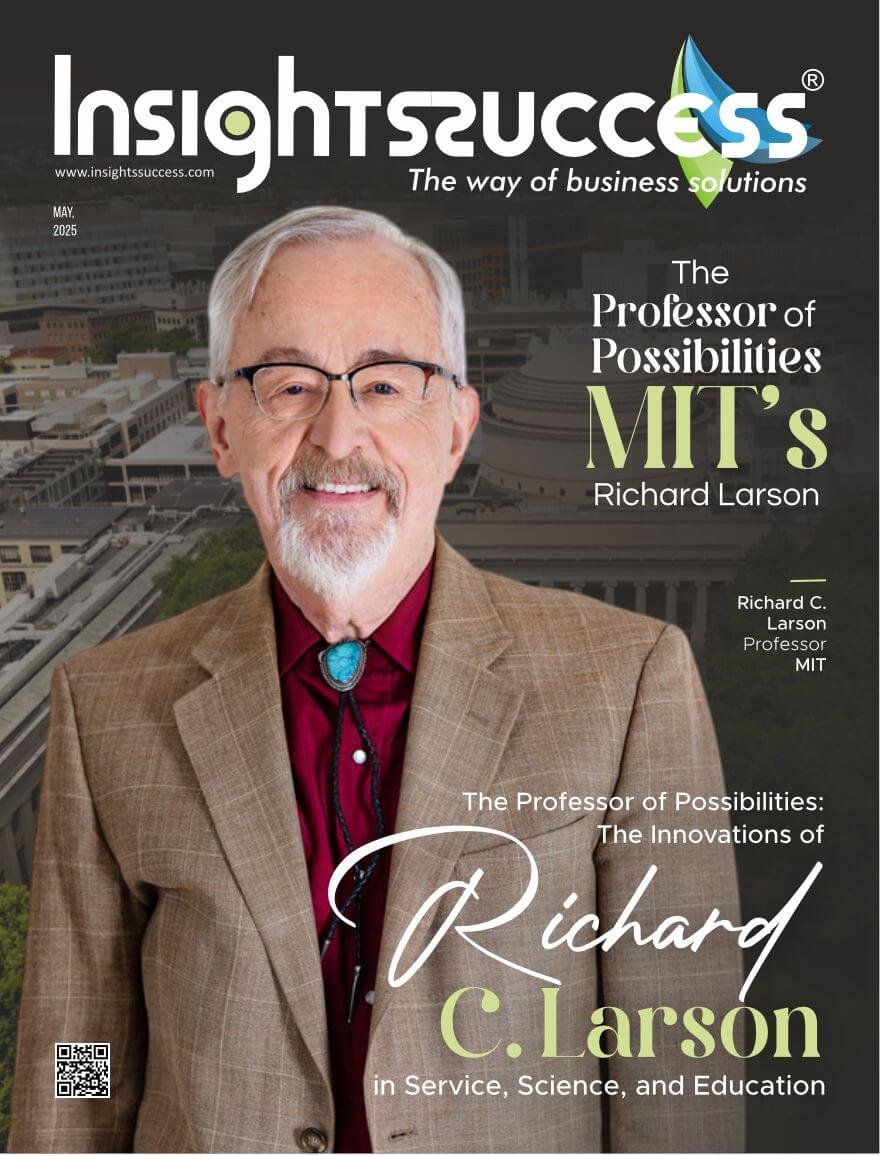
The Professor of Possibilities: MIT’s Richard Larson
The Professor of Possibilities: MIT’s Richard Larson Insights Success is delighted to feature Richard Larson in its recent edition as The Professor of Possibilities. Renowned globally as Doctor Queue, Prof. Richard C. Larson has charted a pioneering path at the intersection of service systems, operations research, and educational innovation. Through decades of transformative work at MIT and beyond, Larson has exemplified how curiosity, resilience, and a commitment to human-centered solutions can shape industries and inspire future generations. Quick highlights Quick reads

Propelling Innovation: How to Implement Effective Engineering Solutions?
In the dynamic world of engineering, the path to effective solutions is guided by a structured and strategic approach. The success of any engineering project hinges not only on technical expertise but also on a thorough understanding of the problem, careful design, meticulous planning, and diligent execution. Each stage of the process from problem identification and solution design to resource allocation and quality assurance plays a crucial role in delivering outcomes that meet both technical specifications and broader organizational goals. This article highlights the essential steps in implementing engineering solutions, focusing on the importance of problem understanding, solution design, project planning, and effective execution to ensure that engineering efforts lead to sustainable and impactful results. Understanding the Problem in Depth A thorough understanding of the problem is fundamental to developing any effective engineering solution. Without a clear and accurate grasp of the issue, solution development may lack direction, resulting in inefficiencies or misaligned outcomes. Engineers must undertake comprehensive problem scoping, which involves identifying root causes, assessing constraints, and considering the perspectives and requirements of all relevant stakeholders. This analytical approach ensures that the engineering process is grounded in the realities of the challenge it seeks to address. During this initial phase, engineers typically gather and evaluate data, identify patterns or anomalies, consult with clients or end-users, and review relevant historical records or precedent projects. The goal is to define the problem in precise terms and deconstruct it into manageable elements that can be addressed systematically. This level of clarity is essential for crafting a solution strategy that is not only technically sound but also aligned with broader organizational objectives and responsive to user needs. Designing Viable and Scalable Solutions Following a comprehensive understanding of the problem, the next critical phase is the design of solutions that are both technically sound and scalable. Effective engineering design strikes a careful balance among innovation, feasibility, cost-effectiveness, and sustainability. This stage demands consideration of various elements such as the selection of appropriate materials, the integration of suitable technologies, the anticipated environmental impact, and the durability and efficiency of the proposed solution over time. Incorporating design thinking during this phase supports a user-centered, iterative approach to innovation. Engineers are encouraged to develop prototypes, test concepts, and refine their designs based on real-world feedback. Advanced tools like computer-aided design (CAD) software, simulation platforms, and collaborative modeling systems facilitate this process by enabling accurate visualization and performance testing before implementation. Concurrently, conducting thorough risk assessments helps identify vulnerabilities or design limitations early on, allowing engineers to establish contingency strategies and embed safety measures. This forward-looking methodology strengthens the reliability and resilience of the final engineering solution. Project Planning and Resource Allocation The successful implementation of engineering solutions relies heavily on thorough and strategic project planning. Engineers are responsible for clearly defining the project scope, establishing achievable timelines, setting key milestones, and allocating resources effectively. Depending on the complexity and specific requirements of the project, various project management frameworks such as Agile, Waterfall, or PRINCE2 may be utilized to guide execution and ensure structured progress. Effective resource management goes beyond financial and material considerations; it also involves the optimal deployment of human capital. Aligning the right skills and expertise with each project phase is essential to maintain efficiency and technical accuracy. Interdisciplinary collaboration, often involving mechanical, electrical, software, and civil engineering specialists, is frequently required, particularly in multifaceted or large-scale projects. Engineers must collaborate closely with financial stakeholders to ensure cost-effectiveness without compromising safety or performance, using tools like cost-benefit analysis and life-cycle costing to inform decision-making. Execution and Quality Assurance The shift from planning to execution marks a pivotal moment in any engineering project. During this phase, it is crucial that the execution aligns closely with the defined objectives and specifications, as any deviation can result in significant delays or failures. Consequently, effective supervision, coordination, and strict adherence to established standards are essential to ensure the project progresses as planned and achieves the desired outcomes. Quality assurance (QA) plays a vital role in this phase, encompassing testing, inspection, and verification processes to confirm that all components meet the required performance and safety standards. Regulatory compliance is also a critical consideration, especially in industries such as aerospace, healthcare, and construction, where strict regulations must be followed. To maintain momentum and address issues efficiently, clear communication channels and feedback loops are necessary. Additionally, engineering teams must remain adaptable, prepared to adjust the implementation process in response to emerging challenges or unforeseen circumstances. Conclusion The process of implementing effective engineering solutions is complex, requiring a blend of technical knowledge, strategic planning, and careful execution. Starting with a clear understanding of the problem, followed by innovative solution design, detailed project planning, and rigorous execution, engineers can achieve successful outcomes that address both immediate needs and long-term objectives. By incorporating thorough analysis, collaboration, and continuous quality assurance throughout each phase, engineering teams can navigate challenges, optimize resources, and deliver solutions that are not only feasible but also scalable and sustainable. Read More: The Professor of Possibilities: The Innovations of Richard C. Larson in Service, Science, and Education

The Professor of Possibilities: The Innovations of Richard C. Larson in Service, Science, and Education
In a time marked by turbulence and intricate challenge, few have helped to light the way from difficulty to possibility as much as Professor Richard C. Larson. Popular around the world as “Doctor Queue,” Larson’s professional journey at MIT and beyond has served as a witness to the transformative power of inquiry, persistence, and the ongoing human urge to make a positive impact. Early Life: Origins of Curiosity and Autonomy Richard Larson’s journey starts in Bayside, Queens, New York, in 1943. His early years, though, played out against the backdrop of various American landscapes, each contributing to his worldview and personality. When Larson was five, his family relocated to Sunbury, Pennsylvania-a small, rural farming town. There, set amidst open fields and woodlands, Larson learned the importance of exploring and being independent for the first time. A pivotal experience in his youth says a lot about how he grew up and what values were imparted by his parents. When he came of age for kindergarten, his parents gave him a choice: go to kindergarten or stay at home another year. “I thought that was pretty cool,” he remembered. Following a weekend of consideration, young Larson decided to stay a child for another year, playing outside and learning from the world around him. When he finally enrolled in first grade, he lagged behind his peers, unable to count to ten or sign his name. But with typical resolve, he soon caught up-a harbinger of the persistence and flexibility that would characterize his subsequent career. The Spark of Science: Falling in Love with Learning Richard Larson’s interest in math and the physical sciences began early and intensified each year. At Needham High School, outside Boston, he was one of the first to enroll in MIT’s new PSSE physics course, a byproduct of the post-Sputnik era’s emphasis on scientific achievement. This mathematics-infused course, which connected math with the physical world, revolutionized Larson’s learning. “I sort of fell in love with that way of learning, and of research, and of science,” he said. This experience did not only solidify his love for science, but also place MIT on his radar as a destination where those passions could be pursued at their highest level. By his fourth year, MIT was his “stretch school”-something he hoped to aim for, but never thought that he would ever actually get there. MIT: Finding Belongingness in a World of Possibility Richard Larson’s acceptance to MIT was exciting and daunting. As with many outstanding students, he at first assumed that his invitation was an error. The cultural diversity and academic excellence of the students around him-from Argentina, Austria, Italy, Cuba, Iowa, and California-was inspiring and, at times, humbling. But as he became immersed in MIT’s cooperative culture of analytical intensity, he found his niche. “When you work hard, and you earn competitive grades, and your peers accept you as a supporting colleague, you know you belong,” he said. He decided to major in Electrical Engineering (Course 6), motivated by both family tradition-his father was an electrical engineer-and the field’s reputation for developing systematic, quantitative thinking. “If you don’t know what you’re going to do, but you want to bring systematic reasoning, quantitative reasoning, to bear on the world, the default choice here on campus has been, and remains, I think, Course 6, Electrical Engineering and now Computer Science. Because it conditions your mind to think systematically about hard problems in ways which are very useful, regardless of what you do later,” Larson said. The Accidental PhD: Seizing Opportunity Richard Larson’s course to graduate studies at MIT was, according to his own self-description, unplanned. Brought into MIT on a Master’s degree invitation through a fellowship from Bell Laboratories, he was urged on by mentors to follow through on earning a PhD. In spite of his own feelings that he wasn’t “doctoral material,” he was badgered-frequently at great length-by teachers and peers into preparing for and sitting the qualifying exams. Paying them left the way to Ph.D. study, one which he didn’t expect but to which he would be outstandingly well-adjusted. A turning point came during his MIT residency, when an theft in his residential group got him interested in examining police investigation practices. Browsing through titles, he found himself borrowing an entire pile of detective novels in the library which became noticed by his advisor Professor Al Drake. Seeing the potential for academic research, Drake urged Larson to make this a formal area of study. This resulted in his master’s and doctoral theses on policing, his first book (Urban Police Patrol Analysis), and even a position as the youngest member of the Science and Technology Task Force of the President’s Crime Commission. From Student to Faculty: Finding a Voice Becoming a faculty member at MIT was its own challenge. “You glance around, you see all these Nobel laureates, and members of the National Academy of Sciences and Engineering, you say, why am I here?” Larson confesses. But as he sat down to write, do research, and work with students, he came into his own. “You begin receiving research funding, and all of a sudden you feel you are in,” he adds. Larson’s humility and humor-he compares his early imposter syndrome to a Groucho Marx routine-have won him over colleagues and students alike. Over time, he has become not only a respected scholar, but a beloved mentor and leader. Teaching at MIT: A Laboratory of Ideas Larson’s teaching style is marked by experimentation, activity, and a fundamental respect for his students. “The greatest asset of MIT is our students,” he declares. “They’re very, very smart, they’re very, very energetic, and you can experiment with them. Provided you challenge them and keep them engaged, they always return more than you give to them.” He has instructed everything from large undergraduate lectures in applied probability-sometimes with more than 350 students-to small graduate seminars and freshman seminars with only eight students. He enjoys the various dynamics each environment presents, from the challenge of motivating

Google Announces Advanced Protection Mode for Highest-Risk Android Users
Prime Highlights: Google’s newly announced Android 16 features an “Advanced Protection” mode aimed at protecting highest-risk users such as journalists and human rights activists. The feature fortifies security on the devices by limiting legacy technology and features secure intrusion logging. Key Facts : Improved protection mode turns off features such as sideloading of apps and limits 2G network usage for cyber attack protection. Intrusion Logging, a feature that stores logs securely in the cloud for enabling identification of potential compromise of the device, is added by the mode. Hardware security technologies such as Memory Tagging Extension (MTE) are turned on for defense against attacks. Key Background : Google’s dedication to taking security to at-risk users can be seen through its rollout of its Advanced Protection mode on Android 16. The rollout entails Google’s existing Advanced Protection Program, previously a Google account feature, being rolled out onto phones. The new mode is precisely designed for the most vulnerable and get particular cyber attacks, such as human rights defenders, journalists, and politicians. The primary purpose of the Advanced Protection mode is to enjoy stronger device protection through deactivation of potentially abusive features. The core purpose is the sideloading block for apps to avoid the installation of potentially harmful apps from unknown sources. It also avoids using older networking technologies such as 2G, which are more vulnerable to intercept and hacking. Through the deactivation of legacy systems, the mode greatly minimizes the attackers’ surface area. The other interesting feature is the availability of Intrusion Logging. It allows device logs to be securely stored in the cloud with end-to-end encryption so that even when a device gets hacked, logs are not exposed and can be used for post-compromise analysis. It is beneficial primarily for post-breached threat detection, offering extra security for the users. Advanced Protection mode also mandates the use of sophisticated hardware security capabilities like Memory Tagging Extension (MTE). The hardware capability provides safeguard against memory vulnerabilities that attackers might use to seize control of a device. These capabilities are only one aspect of Google’s larger effort to improve mobile security for its most at-risk users. The Android 16 update also features the AdvancedProtectionManager API, which enables third-party apps to check whether a device is enrolled in Advanced Protection and modify their own security features in response. Through this mode, Google plans to give the most vulnerable the safer online experience, using a mix of software limits, secure logging, and advanced hardware security to repel increasing cyber threats. Read More: Stripe Launches AI Model to Transform Payment Fraud Detection

The Most Dynamic Leader To Watch In 2025
The Most Dynamic Leader To Watch In 2025 This edition featuring Salimatou Baldé celebrates a visionary trailblazer whose leadership, innovation, and impact are reshaping industries and inspiring global change. This special edition highlights her remarkable journey, groundbreaking initiatives, and unwavering commitment to empowering communities and driving sustainable, inclusive growth in the modern world. Quick highlights Quick reads