






Balancing Speed, Scale, and Sustainability
With Discipline in Real Estate Assets Real estate has always favored those who act fast but in the current scenario, it is taking too long to get ready and speed without discipline can be as risky. Capital flows quickly, markets change suddenly, and the expectations of the stakeholders are not only to get paid back but also to get something beyond that. The leadership of real estate is thus changing who can manage to perform this balancing act between three, sometimes, conflicting forces: the execution speed, the ambition scale, and the outcome’s sustainability. Discipline is what underpins these forces and leads to the transformation of growth into long-term value instead of short-lived expansion. In the field of modern real estate, discipline has changed its role and gone from being a mere conservative practice to a strategic one. Speed as a Competitive Necessity Speed is still the key factor in real estate. Opportunities have durations, capital markets change quickly, and there is not much time before the return on investment is lost. The leaders in real estate have to be able to make decisive moves, whether it is buying the right properties, starting new projects, or repositioning their asset mixes to match the current demand. On the other hand, a disciplined speed is not the same as a rush. It is always the case that such speed is getting the most from being prepared rather than from being pressured. Leaders who rely heavily on solid underwriting frameworks, dependable data, and unambiguous decision rights are the ones who can operate at high speeds without losing the quality of their judgment. The case of speeding up comes out of being ready and not of being first to react in the case of urgency. Scaling with Strategic Intent For a considerable time, scale has been synonymous with strength in the real estate sector. Bigger portfolios give the investor the advantage of being able to hold a variety of properties, get better deals, and have funds available to them. However, if there is no strategy and discipline behind it, scaling could be a sure way to take more risks. Often, these quick expansions into new markets or different asset classes may be a strain on the management and net attention is being focused on the core business area. Leaders who have discipline are the ones who scale with purpose. They go to places where they have the strength in operations, and the knowledge and understanding of the market, and where they can remain committed for the long term. The ability to grow is synchronized with the organization’s capacity, thus making it possible for the scale to fortify resilience instead of being the source of fragility. It is scalable or it is not that easy. Sustainability as a Value Driver, Not a Constraint Sustainability has shifted from a compliance requirement to a core determinant of asset value. Environmental performance, energy efficiency, and climate resilience increasingly influence tenant demand, financing terms, and exit valuations. Real estate leaders must now integrate sustainability into asset strategy from the outset. Discipline plays a critical role here. Sustainable investments require upfront capital, long-term thinking, and rigorous performance measurement. Leaders who approach sustainability strategically avoid superficial initiatives and focus instead on measures that deliver measurable impact and financial return. Sustainability becomes a source of differentiation and durability rather than a cost center. Capital Allocation with Long-Term Perspective To achieve the desired results, one has to seriously consider where to put the money. The CFOs have to face an increasingly difficult task of predicting not only the future returns but also the risk involved, the regulations that may come, and the relevance of the asset in the long run. Discipline in capital allocation goes for quality first and not for quantity. Only the most adaptable, most resilient, and of future demand will be selected among the assets and that goes with the assumption of short term yield. This gives the ability to protect against losing while still having the chance of gaining in different market cycles. Data and Governance Enabling Disciplined Growth The contemporary real estate industry is more and more dependent on data. Sophisticated analysis, market wisdom, and performance indicators are constantly giving the decision-makers information about the asset’s performance and risk at the moment. This understanding helps to make quicker decisions that are still thorough. Supportive governance structures in a way make the discipline stronger. Unambiguous authorization procedures, responsibility setups, and risk limits make it clear that quality is not sacrificed for the sake of time. Governance turns into an activator of bold moves instead of a hindrance to development. Tenant and Community Alignment Real estate leadership that is disciplined understands that the long-term value is not only determined by the investors but also by the tenants and the communities. Properties that adapt to the way people work, live, and buy last longer and show more stable performance. The approach of combining speed and scale with sustainability consists of stakeholders’ involvement from the very beginning, creating flexible spaces, and making the developments fit the local demands. This fitting decreases the resistance, quickens the renting process, and builds the good image of the company even more. Read Also : Skills, Strategies, and Mindset for the Next Decade
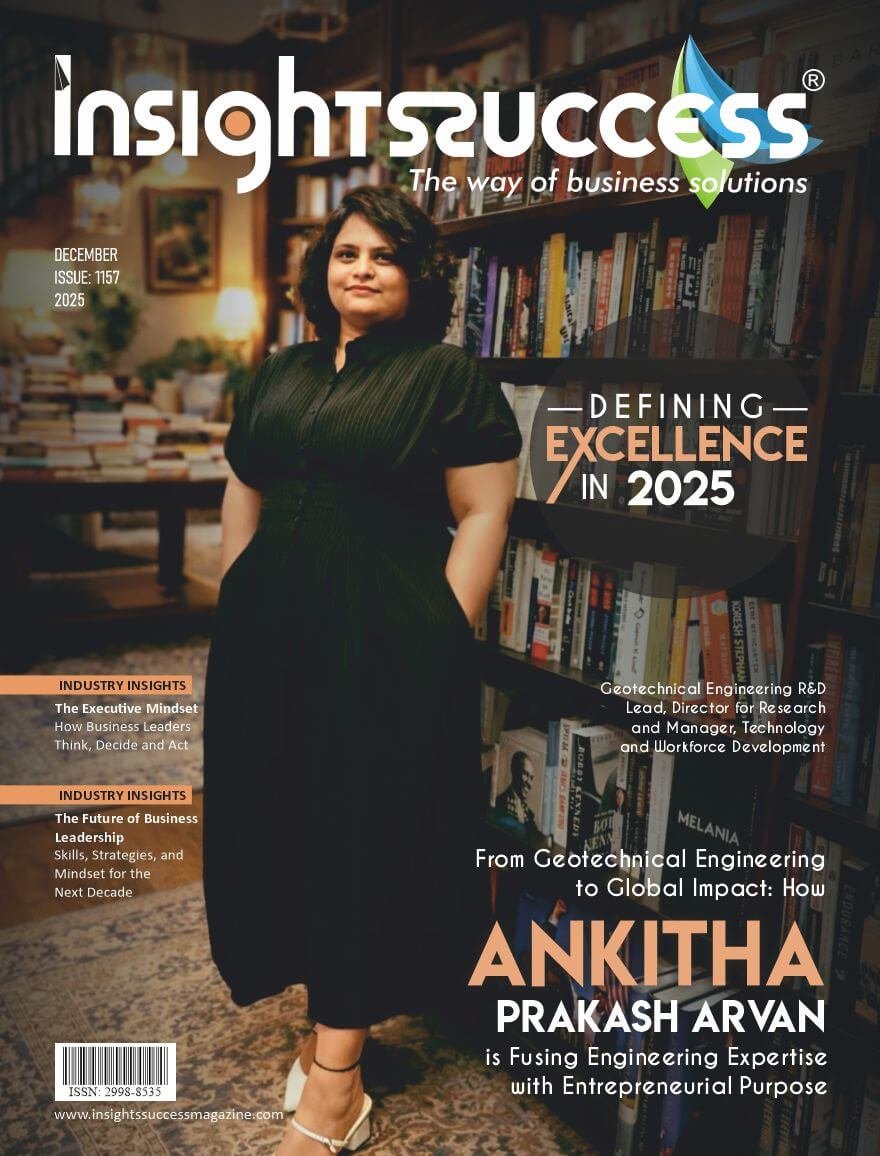
Defining Excellence in 2025
Defining Excellence in 2025 Excellence in 2025 is no longer defined solely by scale, speed, or short-term success. It is shaped by purpose, adaptability, and the ability to create lasting impact in a world marked by constant change. Defining Excellence in 2025 recognizes Ankitha Prakash Arvan who is setting new benchmarks for leadership, innovation, and responsibility. Quick highlights Quick reads

From Geotechnical Engineering to Global Impact: How Ankitha Prakash Arvan is Fusing Engineering Expertise with Entrepreneurial Purpose
Excellence is measured by whether one can associate top-tier science with sustainable application when it comes to the complex realm of high-level engineering and research. It is the arena where theoretical models go from theory to long-lasting infrastructure in practice. Emerging as a powerful architect of this fusion of passion and excellence is Ankitha Prakash Arvan. Already recognized as one of Florida’s Most Influential Women and a finalist for the Top 50 Women Leaders of Florida at the age of 33, Dr. Arvan stands as a paragon of multidisciplinary leadership who is unequivocally ‘Defining Excellence in 2025.’ Currently serving in two prime roles as the Geotechnical Engineering R&D Lead at Tierra South Florida Inc. (TSF Geo) and the Manager of Technology and Workforce Development at TRANS-IPIC, University of Illinois Urbana-Champaign, she brings over a decade of rigorous expertise in managing high-stakes research initiatives from conception to high-quality completion. Dr. Arvan is not just a researcher but a leader in Civil Engineering, well-noted for establishing revolutionary interventions to integrate Artificial Intelligence into geotechnical engineering sciences. Her PhD work culminated in GEOS© Version 1.0, a standalone software to characterize complex soil-pile models and fills a critical void for easy-to-use applications for practitioners and researchers alike. She has received a great deal of international recognition for her thought-provoking contributions to the field and was awarded the 2023 ASCE State-of-the-Art of Civil Engineering Award. Her work is so instrumental that it was featured among the ASCE’s Special Collection for United Nations Sustainable Development Goals (UN SDG), influencing civil engineers across the world to think about sustainable civil engineering practice with respect to clean energy, climate resilience, and resilient infrastructure. Honored with the 2022 3MT Thesis Scholarship Award for her captivating communication skills and selected as a recipient of the 2024 Women in Deep Foundations Professional Development Grant from Deep Foundations Institute, Dr. Arvan is more than an academic leader. She is a visionary force driving innovation, entrepreneurship, and workforce development, ensuring that the infrastructure of tomorrow is built on the solid foundation of today’s most brilliant research. The Father’s Blueprint: Roots of Resilience Dr. Arvan’s foundation was laid by her greatest inspiration: her father, Mr. Jaya Prakash Arvan. His perseverance and unshakeable belief in continuous learning became the bedrock of her own ambitions. He encouraged a young Ankitha to stay curious and pursue excellence—values that she carried from childhood into the rigorous halls of academia. Later supported by her grandfather, Mr. Sathyanandam Shamarthi, her uncle Mr. Sandeep Shamarthi, her mother Ms. Prashanthi Arvan and a circle of close family and friends who believed in her potential, she developed the confidence to navigate a career defined by high-stakes research. This resilience proved essential. Over a decade of managing complex research initiatives, Dr. Arvan navigated both breakthroughs and failures—redesigning methodologies and overcoming technical setbacks. These challenges didn’t deter her; they sharpened her capabilities, transforming her into a master of project management and research design. From Legacy to Innovation: The Engineer’s Calling A profound evolution of purpose shaped her professional destiny. Initially, her father envisioned her as a doctor, admiring the profession’s service and discipline. For years, Dr. Arvan carried this aspiration as a badge of his belief in her. However, a different fascination took hold—a captivation with how infrastructure shapes communities when she personally witnessed her father working on great infrastructure development projects. She realized her calling was to design structures that could stand for decades and serve thousands. While her journey began with a dream passed down to her, it evolved into a purpose uniquely her own. During her doctoral research, she realized engineering offered the power not just to design, but to innovate. This epiphany led to the integration of Artificial Intelligence with Geotechnical Engineering and the birth of GEOS© Version 1.0. She honored her father’s inspiration by channeling his values into a field where she could deliver sustainable, impactful solutions for the new Civil Engineering world. The Architecture of Equilibrium Dr. Arvan understands that sustaining high-performance research requires a deliberate architecture of balance. She views work-life equilibrium not as a fixed achievement, but as a “continuous practice.” Applying the discipline instilled by her father, she approaches her personal life with the same intentionality as her research: breaking large goals into manageable steps to manage pressure without sacrificing quality. To maintain mental clarity amidst intense focus, she relies on regular yoga and meditation, tools she considers essential for reconnecting with her purpose. Furthermore, she invests deeply in mentorship—learning from others and guiding the next generation—which reminds her of the bigger picture. By knowing when to pause, reflect, and spend time with loved ones, Dr. Arvan ensures that she returns to her work with renewed clarity. Her success is a result of this holistic commitment: professional structure supporting personal well-being, allowing her to define excellence in every endeavor. The Entrepreneurial Resonance: From Science to Scale Dr. Arvan’s journey reveals that her appetite for business was not an ambition of finance, but a natural progression from her engineering and research experiences. She realized that technical expertise alone was insufficient to generate meaningful, large-scale impact. The moment her focus shifted to the intersection of innovation, strategy, and entrepreneurship, her ideas truly came to life. Throughout her research career, she was continually drawn to decision-making, planning, and value creation—skills essential for any entrepreneur. She enjoyed not only solving technical problems but also understanding market needs and crafting strategies for long-term impact. “My appetite for business is rooted in passion, curiosity, and the desire to create meaningful, scalable, and sustainable impact.” Entrepreneurship, in particular, appeals to her because it serves as a dynamic platform where creativity is encouraged, risks are transformed into opportunities, and solutions can reach broader audiences. This commitment to continuous learning in financial models, operations, and leadership perfectly complements her engineering background, empowering her to think holistically and imagine new possibilities for infrastructure innovation. The Unwavering Driver: Pursuit of Excellence with Purpose The passion that drives Dr. Arvan is the unwavering desire to “do better

Skills, Strategies, and Mindset for the Next Decade
The Future of Business Leadership The coming years will be a critical turning point for business leadership. Changes in technology at a rapid pace, the changing expectations of the workforce, unpredictability of global politics, and a demand for accountability that continues to grow are some of the factors that will redefine leadership. The model of leadership that was generally accepted and traditionally practiced—primarily based on exercising power, being the most experienced, and controlling—has been replaced by a more flexible, people-focused, and strategically aligned method. The leaders who are going to be successful in the next decade are going to be the ones who advance their skills, re-evaluate their strategies, and have a mindset suitable for constant change. Leading in the future will not prize being certain. It will reward being adaptable, clear, and purposeful. Leadership in a World of Constant Disruption The next ten years will be characterized by continuous disruption instead of separate transformation cycles. The interplay of technological advances, AI assimilation, climate goals, and economic changes will constantly reshape the environment for businesses. The leaders of the day won’t be able to trust either fixed plans or old practices anymore. The future-ready leaders need to master the art of effectively working in the midst of confusion. They make sound decisions without having the full picture, change their route fast, and keep the active state even when the environment is not favorable. Having the ability to tolerate uncertainty is no longer a nice-to-have trait but a must-have core capability of leaders. Strategic Thinking Beyond Short-Term Performance It is true that short-term outcomes are still a priority, but the leaders of the next generation need to consider the long term. The factors mentioned above: sustainable growth, organizational resilience, and stakeholder trust, all require a mix of short-term and long-term performance strategies. This strategic discipline comprises amongst others, the making of investments in capabilities before they are massively needed, the careful and purposeful alignment of innovations, and the spurning of short-term decisions that might erode long-term value. The leaders that prevail will be those who manage to weave foresight into usual decision-making practices. Human-Centered Leadership as a Competitive Advantage Man’s ability to lead distinctly will increase with the help of automation and AI to a very large extent. Engagement and performance are now basically impossible without empathy, emotional intelligence, and communication; no longer secondary traits, these are now the most important ones in the entire hierarchy of human interaction and cooperation. The leader talking about the future recognizes that the adaptability of an organization depends on the people working there. By promoting psychological safety, inclusion and continuous development, the leaders will be able to get more creative and committed their followers. Empathy-led organizations will not only be more attractive to the new workforce but also be able to keep the current one and, finally, to cope with the changes in the market easily. Digital Fluency as a Leadership Skill Digital transformation is now a collaborative effort between specialists and non-specialists. It is necessary for leaders to acquire digital fluency to be able to tell how technology affects the strategy, operations, and risk. This does not mean having programming skills, but it does mean being able to ask the right questions and understand the meaning of the digital insight. Future leaders incorporate data-driven thinking into their decision-making processes, thus making sure that technology investments are not only in line with business goals but also with moral principles. Digital fluency allows leaders to take advantage of innovation while keeping control and trust. Building Organizational Agility Agility will set the bar for competition in the coming decade. The first challenge for the leaders would be to create such organizations that are able to shift very quickly without losing their inner peace. The changes in this regard may be made through less hierarchical structures, mighty teams, and shorter decision-making processes. Agile management style brings the focus through the lens of the control function into the domain of the leadership support. The giving of instructions is replaced by the engaging in discussions. The leaders are the ones who keep the light of the way for the rest while taking for granted that the teams are quite capable to do the work. This trade-off makes it possible for the companies to be swift in their change and at the same time internally coherent. Collaboration Across Boundaries The following ten years will be a period when executives will have no choice but to cooperate together, breaking the boundaries of organizations, cultures, and geography. Difficult issues—from nature preservation to virtual business environments, can’t be handled by one party alone. Leaders skilled in creating partnerships, managing oppositional stakeholders, and exercising influence instead of power will be more successful. Thus, teamwork is seen not as a nice-to-have, but rather as a core strategic competency.

How Business Leaders Think, Decide, and Act
The Executive Mindset It is not just the authority or experience that differentiates executives from managers, but also their mindset. The executive mindset, in this sense, is the main factor that determines how leaders perceive the difficulty of the situation, how they choose to act in tense situations and how they make the vision come true through the continuous flow of activities. In a world where there is no real certainty, everything is happening so fast, and the stakes are high, the way leaders think is considered to be as important as what they know. Getting the executive mindset opens the door to why certain leaders always impact positively while others find it hard to get out of the short-term execution trap. The executive mindset, at its most basic level, is about outlook, rigor, and purpose. Thinking in Systems, Not Silos Executives work in an area where hardly any decision impacts only one function or outcome. Good leaders think in systems, knowing how strategy, operations, human resources, finance, technology, and culture interact. They don’t just take care of the pluses of individual parts; they put their attention on the whole organization’s wellness and the value it will take in the long run. This systems approach makes it possible for the top management to foresee effects of decision-making at the second and third levels. They know that a move made in one department might have negative side effects in another and they consequently make adjustments. Their mindset is not limited to the immediate challenges but is rather directed to the whole environment where the company is located. Decision-Making Under Ambiguity Executives seldom have access to complete information. There are changes in the market, data is not fully available, and timing is very important. The executive mentality treats ambiguity as an inseparable part of the scenario instead of a limitation. The best of the leaders learn to be uncertain and take their decisions by combining chance, wisdom, and values rather than waiting for the light to be absolutely clear. However, it is not synonymous with being reckless. The executives’ choice of the time to act is quick yet they are thorough at the same time. The leaders take it upon themselves to evaluate the risks, think about the other options, and take steps with a firm grasp of the situation knowing that often the cost of doing nothing is greater than the cost of making a mistake. Prioritization as a Strategic Discipline An executive’s foremost characteristic is the continuous ability to prioritize. Those at the highest level always have more chances and requests than they can ever meet. The executive attitude separates the unimportant from the important and concentrates the focus on the most significant issues. This practice brings about a safeguard for the company’s energy. Executives allow themselves to work on the strategic area by refusing the distractions and the low-impact initiatives. Prioritization is not about doing more; it is about doing what creates the greatest leverage. Balancing Short-Term Results with Long-Term Value The demand for instant results is a never-ending factor in managerial positions. Nevertheless, the ones who only consider quarters as their horizon lose the ability to create value in the long run. The mindset of top management encompasses the simultaneously taking care of short-term execution and creating long-term value. To achieve this balance is a tough job. The top management teams invest in the organization’s capabilities, culture, and resilience even when the investments do not get returns up to their expectations. They know that the success that lasts has to be based on making the right decisions which may not even give perks immediately but will make the institution stronger in the future. Emotional Control and Composure There is usual intense scrutiny and pressure on executive leadership. The way leaders react during hard times influences the conduct of the organization. The executive way of thinking is characterized by the ability to control emotions, uninterruptedness, and the capacity to see things clearly despite the pressure. Cold leaders keep teams steady and improve the quality of decisions. The top management does not get rid of feelings; instead, they control it well and make sure that the right people will not be able to react. This firmness turns out to be the confidence of the company. The Mindset That Sustains Leadership Impact The executive mindset is not determined by one’s position in the organization but rather by the way he or she thinks, decides, and acts consistently throughout the time. It is a combination of strategic view with disciplined performance, confidence imbued with humility, and decisiveness accompanied by reflection. Smart managers are not characterized by the number of decisions they take but rather by the level of good reasoning that lies behind them. In a challenging and intricate world, the executive mindset is the leadership quality that gives the greatest advantage—controlling together outcomes, culture, and legacy.

Founded by Dhawal Laheri, Tap Tap Go is Engineering the Next Layer of Global Digital Interaction
Digital interaction has evolved rapidly over the past decade—social networks connected people, platforms enabled transactions, and mobile devices collapsed distance. Yet despite this progress, one critical layer remains fragmented: how identity, trust, and value move together across physical and digital worlds. Tap Tap Go, founded by entrepreneur Dhawal Laheri, is being built to address exactly that gap. What initially appeared as a refined networking solution is quietly developing into a deeper infrastructure layer—one designed to unify how individuals and businesses identify themselves, connect, and interact economically on a global scale. Beyond Platforms, Toward Interaction Infrastructure Most digital platforms focus on a single function: networking, payments, content, or commerce. Tap Tap Go takes a different approach by treating interaction itself as the core problem to solve. At the center of the platform is a portable, user-owned digital identity that moves effortlessly between offline and online environments. A single tap can introduce a person, verify credibility, share content, initiate communication, or trigger a transaction—without relying on multiple apps or intermediaries. This convergence signals a shift away from fragmented digital experiences toward unified interaction layers—systems that sit beneath applications rather than competing with them. “There’s a growing realization that platforms come and go, but infrastructure persists,” says one observer familiar with the space. “Tap Tap Go is positioning itself in that persistent layer.” Identity Designed for the Real World Unlike traditional digital profiles that exist only within closed platforms, Tap Tap Go is designed to function in real-world contexts: meetings, events, commerce, travel, and cross-border interaction. Its non-custodial architecture ensures users retain control over their identity and digital presence, rather than surrendering it to centralized platforms. This ownership model aligns with a broader movement toward decentralized identity—where individuals, not companies, control access and visibility. In practice, this allows identity to become dynamic and situational. What is shared in a professional meeting can differ from what is visible in a public event or commercial transaction—all controlled by the user. Financial Interaction as a Native Capability Where Tap Tap Go moves beyond identity alone is in its treatment of finance as an inherent part of interaction. Rather than bolting on payment features, the platform is integrating licensed global banking infrastructure directly into its ecosystem. This includes multi-currency support, international settlement rails, crypto-to-fiat and fiat-to-crypto conversion, and virtual debit cards—embedded at the identity level. The result is a system where connecting and transacting are no longer separate actions. Interaction itself becomes economic. In regions where access to traditional banking is limited or inefficient, this integration could significantly lower friction for cross-border participation. Designing for Circulation, Not Consumption Another defining element of Tap Tap Go’s architecture is its emphasis on circulation rather than extraction. Through loyalty programs, marketplace integration, and strategic token-based utility partnerships, the platform is structured to keep value moving within its ecosystem. Users are rewarded for participation, partners benefit from recurring engagement, and transactions reinforce network effects rather than ending them. This circular design mirrors how sustainable economies function—where value compounds through repeated use rather than dissipating after each interaction. Global by Assumption Tap Tap Go has been built with the assumption that digital interaction is inherently global. Localization, compliance readiness, and interoperability across jurisdictions have been addressed early in development. This allows the platform to operate across diverse markets simultaneously rather than expanding sequentially. As digital identity and financial interaction increasingly detach from geography, platforms designed with global assumptions gain structural resilience. The Next Layer Takes Shape Tap Tap Go has not positioned itself as a category leader—at least not yet. There have been no aggressive announcements or mass-market campaigns. But the convergence of identity, interaction, finance, AI-assisted onboarding, and ecosystem design suggests the platform is evolving into something more foundational than a single-use product. Historically, the most impactful digital layers are not immediately recognized for what they are. They integrate quietly, become indispensable, and only later are understood as infrastructure. Founded by Dhawal Laheri, Tap Tap Go appears to be engineering exactly that kind of layer—one that sits beneath digital interaction itself. By the time the market gives it a name, the interaction may already be happening. Disclaimer – This article is a work of original content created for public relations and informational purposes only. It may be published across multiple digital platforms with the full knowledge and consent of the author/publisher. All images, logos, and referenced names are the property of their respective owners and used here solely for illustrative or informational purposes. Unauthorized reproduction, distribution, or modification of this article without prior written permission from the original publisher is strictly prohibited. Any resemblance to other content is purely coincidental or used under fair use policy with proper attribution.
Why Silence Matters
In sports gaming, most platforms follow a predictable pattern: launch quickly, acquire users aggressively, and resolve regulatory challenges later. W11 reversed that order entirely. “There’s a difference between building a product and building a system,” says one executive familiar with the project. “W11 chose the harder path first.” Instead of optimizing for short-term traction, the platform has been designed as infrastructure — capable of supporting multiple sports, markets, and regulatory environments without fragmentation. The decision to remain largely silent during this phase appears intentional. By the time W11 enters the public conversation, much of the groundwork that slows competitors down will already be complete. Not a Game, an Architecture W11 is not positioning itself as another fantasy or betting app competing on promotions or bonuses. Its internal framing is closer to a sports participation layer — one that blends artificial intelligence, real-time data, and blockchain-based verification into a single system. The AI layer processes live match data, player form, historical performance, and in-game variables to create skill-weighted participation models. Outcomes are designed to reward insight, timing, and understanding of the sport — not randomness. Underpinning this is blockchain architecture that governs contest logic, scoring transparency, and reward settlement. In regulated markets increasingly focused on auditability and fairness, this foundation may prove critical. “It’s not about making gaming louder,” one team member explains. “It’s about making it cleaner.” Rethinking Live Sports Engagement Where W11 becomes particularly interesting is in how it treats live sports. Instead of anchoring engagement at the match level, the platform breaks participation down into moments. In cricket, every ball becomes an interaction point. In football, engagement revolves around defining events — goals, assists, fouls, cards, substitutions — as they happen. This approach transforms a 90-minute match or a 50-over game into a continuous stream of decisions and participation opportunities. The effect is subtle but powerful: fans are no longer waiting for outcomes; they are involved throughout the narrative of the game. Industry observers suggest this kind of granularity could significantly increase engagement depth, especially among digitally native audiences accustomed to real-time interaction. Early Signals Without Noise Despite remaining officially in pre-launch mode, W11 has already onboarded more than 50,000 fantasy users organically. The company has not disclosed detailed metrics, but early traction without mass marketing is often viewed as a strong signal of underlying product strength. Notably, this growth has occurred without celebrity endorsements, league sponsorships, or large advertising budgets. “The interesting thing isn’t the number,” says one observer. “It’s how quietly it happened.” Global From Day One W11’s design reflects a global-first mindset. Localization, compliance, and multi-sport adaptability have been built directly into the platform, rather than added as afterthoughts. The company has also begun low-profile discussions within major football ecosystems across Europe and EMEA, with strategic timelines extending toward the 2026 World Cup cycle. These conversations remain largely private, but their existence signals ambition beyond regional launches. Rather than testing one market at a time, W11 appears positioned to scale across multiple regions simultaneously — a difficult feat without prior regulatory preparation. What Comes Next As W11 approaches the end of its pre-launch phase, the silence is starting to feel less like absence and more like anticipation. Strategic partners and institutional investors are now being engaged selectively, with a focus on long-term alignment rather than short-term acceleration. The emphasis remains on durability: technology that can scale, systems that regulators can trust, and engagement models that deepen over time. No official launch date has been announced. No marketing blitz has begun. But in industries shaped by regulation, data integrity, and global reach, the platforms that arrive fully formed often reshape the landscape quietly — and permanently. Something is taking shape. And by the time it’s visible to everyone, it may already be too late to ignore. Disclaimer – This article is a work of original content created for public relations and informational purposes only. It may be published across multiple digital platforms with the full knowledge and consent of the author/publisher. All images, logos, and referenced names are the property of their respective owners and used here solely for illustrative or informational purposes. Unauthorized reproduction, distribution, or modification of this article without prior written permission from the original publisher is strictly prohibited. Any resemblance to other content is purely coincidental or used under fair use policy with proper attribution.

Precious Metals Soar as Gold, Silver, and Platinum Hit Record Highs Amid Rate-Cut Bets
Prime Highlight Global investors drove gold, silver, and platinum prices to new records due to thin year-end trading, geopolitical tensions, and expectations of U.S. interest rate cuts. Analysts expect gold to approach $5,000and silver $90 in early 2026 as momentum trading and safe-haven demand continue to push prices higher. Key Facts Spot gold rose 6% to $4,505 per ounce, silver jumped 3.6% to nearly $74.60, and platinum surged 7.8% to about $2,393. Gold has gained nearly 72% in 2025, silver 158%, and platinum 165%, marking the strongest yearly rises in decades. Background Global precious metals markets saw a sharp rally on Friday as investors rushed into gold, silver, and platinum amid thin year-end trading, rising geopolitical tensions, and growing bets on U.S. interest rate cuts. Spot gold climbed 0.6% to about $4,505 per ounce in early Asian trade, after hitting a record high above $4,530 earlier in the session. U.S. gold futures for February delivery rose 0.7% to around $4,535. Analysts said strong speculative buying and a weaker dollar pushed prices higher. Silver outperformed gold, jumping 3.6% to nearly $74.60 per ounce after touching a lifetime high of $75.14. Platinum surged 7.8% to about $2,393, after crossing $2,429 during the day. Palladium gained 5.2% to $1,771, extending its weekly rally. Kelvin Wong, senior market analyst at OANDA, said momentum traders have driven the rally since early December. He added that thin liquidity, expectations of extended U.S. rate cuts, and fresh geopolitical risks have combined to lift precious metals to new records. Wong said gold could move closer to the $5,000 mark in the first half of 2026, while silver may approach $90. Gold has logged its biggest yearly rise since 1979, gaining nearly 72% so far in 2025. The rally has drawn strength from Federal Reserve easing, steady central bank buying, higher ETF holdings and a shift away from the dollar. Silver has soared 158% this year on strong industrial demand and supply gaps. Markets now price in at least two U.S. rate cuts next year, which supports non-yielding assets like gold. Rising global tensions, including U.S. actions linked to Venezuela and Nigeria, have also increased safe-haven demand. Platinum and palladium, used in vehicle emission systems, have surged due to tight supply and tariff worries. Platinum is up about 165% this year, while palladium has gained over 90%. Also Read : Alphabet Strengthens Data Center Growth With $4.75 Billion Intersect Acquisition

Inspirational Icons to Watch in 2025
Inspirational Icon to Watch in 2025 As the world moves through a period of rapid transformation, certain individuals rise above titles and trends to become true symbols of hope, courage, and progress. This edition celebrates these remarkable personalities whose journeys, values, and leadership are inspiring change across industries, communities, and cultures. Quick highlights Quick reads

Alphabet Strengthens Data Center Growth With $4.75 Billion Intersect Acquisition
Prime Highlight Alphabet plans to acquire Intersect to speed up the expansion of its data centers and power infrastructure, supporting the company’s long-term technology growth. The deal will help Google secure a reliable energy supply while building new data centers more efficiently. Key Facts Alphabet will purchase Intersect for $4.75 billion in cash, along with the assumption of debt. Intersect will continue to operate independently after the acquisition, with some assets excluded from the deal. Background: Alphabet, Google’s parent company, plans to buy Intersect, a data center and energy infrastructure company, for $4.75 billion in cash and debt. The acquisition is aimed at growing Alphabet’s data center capacity and ensuring a steady power supply for its technology services. Alphabet said Intersect will continue to run as a separate business after the deal is completed. The company said the deal will speed up the building of new data centers and power projects. This will help Google better meet the growing demand for its cloud and digital services Sundar Pichai, CEO of Google and Alphabet, said the deal will make it easier for the company to grow its infrastructure while focusing on cleaner energy options. He also noted that the partnership will encourage innovation and strengthen the country’s position in technology and energy. Google already owned a small share of Intersect after taking part in a funding round announced in December last year. At that time, Intersect said its collaboration with Google and TPG Rise Climate focused on developing gigawatts of data center capacity across the United States, supported by major investments in renewable power infrastructure by the end of the decade. After the deal is completed, Intersect will collaborate with Google’s infrastructure teams on key projects, including a combined power and data center facility in Haskell County, Texas. Google has already committed to investing $40 billion in Texas through 2027, covering new data center campuses in multiple counties. Alphabet said that Intersect’s active and planned projects in California, along with certain facilities in Texas, are not part of the deal. These assets will stay with Intersect’s current investors and will continue to operate separately. The deal is expected to close in the first half of 2026, subject to regulatory approvals and customary closing conditions. Also Read : Visa Pilot Program Streamlines Shopping, Completes Hundreds of Transactions Successfully