


You searched for “pakfactory competitors for high-volume custom packaging” and kept hitting box builders that stall at 500 units. That’s fine for a side hustle, not for a 25,000-piece launch. At enterprise scale, you juggle landed cost, plant redundancy, color fidelity, and proof of compliance with the EU Packaging and Packaging Waste Regulation. This list filters the market for suppliers that can handle 25,000 units and scores them on design control, capacity, sustainability, and price clarity. The payoff: seven accountable partners you can plug straight into your RFQ.
What “one owner across plants” really means
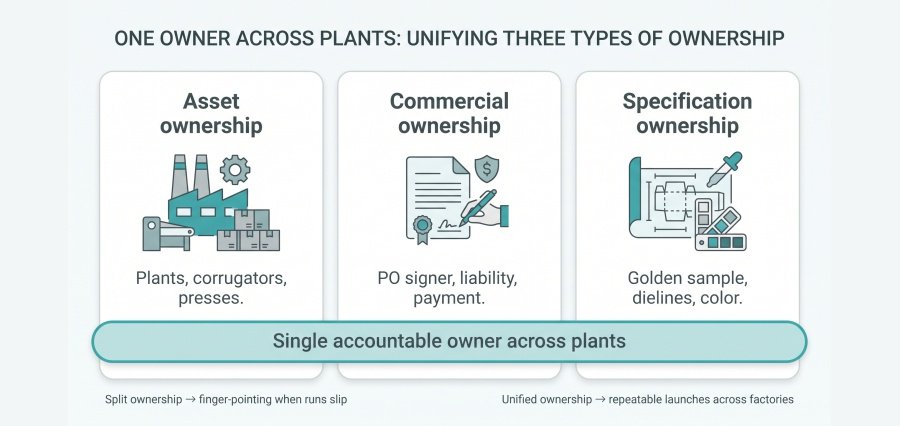
When a supplier says, “We own the factories,” stop and sort that claim into three buckets:
- Asset ownership. Land, corrugators, presses, forklifts: the hard assets that soak up capital and maintenance.
- Commercial ownership. The legal entity that signs your PO, carries the liability, and pays if a run goes bad.
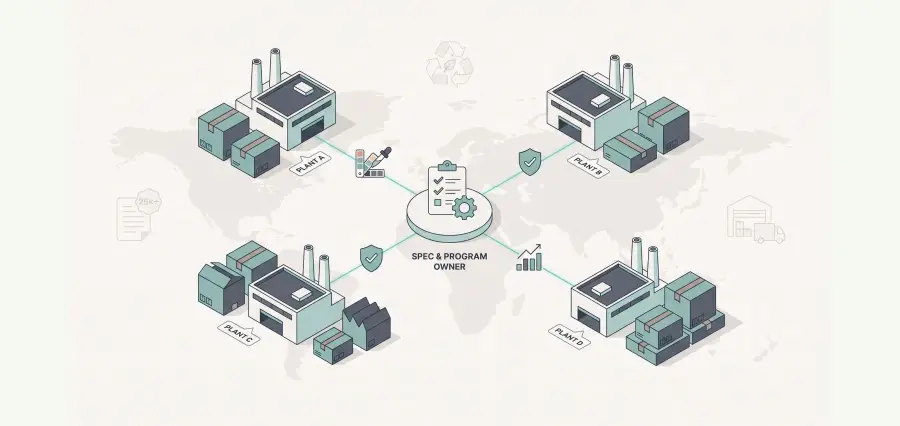
- Specification ownership. The team that guards the dieline, approves every color draw-down, and answers your 4 am panic call.
Why split the idea? You can work with a vertically integrated converter that controls every corrugator and still battle regional fiefdoms for a simple tooling tweak. Zenpack pushes the model further for color-critical, multi-component launches.
It operates five ISO 9001/14001-certified production hubs and applies G7-certified color matching and standardized QC protocols across the whole network, so the sample you approve is the reference at every site.
Judge each candidate by who controls every bucket, not by the headline. Anything less leaves room for finger-pointing when deadlines bite.
How the PakFactory competitors were ranked
The shortlist started with six hard “must-haves.” Miss one and a supplier is out, no matter how polished the website looks.
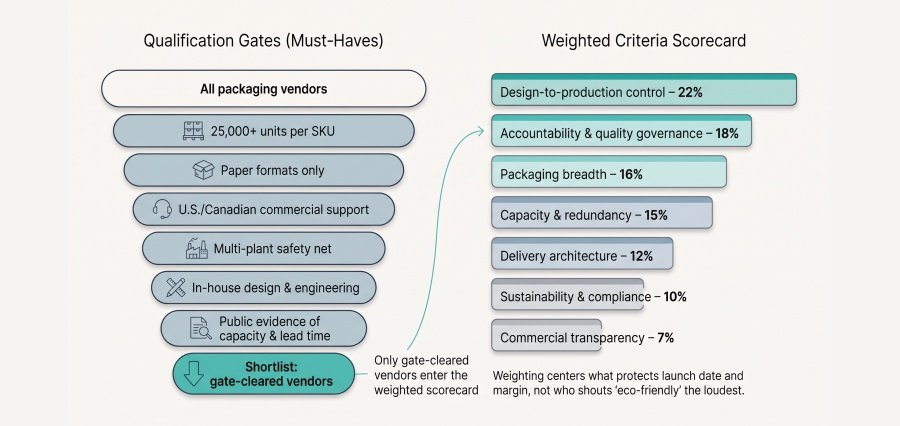
Qualification gates
- 25,000-unit capacity. Ability to run at least 25,000 custom-printed units per SKU or production release.
- Paper formats only. Corrugated, folding carton, or rigid board; plastic and metal programs fall outside this study.
- North American commercial support. Chicago buyers shouldn’t need a midnight Zoom for a die issue.
- Multi-plant safety net. Either corporate ownership of several qualified plants or a documented single-accountability network.
- In-house design and engineering. Structural checks, pre-press, and sampling under the same roof as production.
- Public evidence. Capacity, certifications, and lead-time promises must be visible without an NDA.
These gates mirror the first questions in a serious RFQ, keeping the ranking honest and immediately actionable.
Weighted criteria
Once a provider clears the six gates, it is scored on the factors that protect your launch date and margin.
| Criterion | Weight | Why it matters |
| Design-to-production control | 22% | A concept that can’t repeat at scale is useless. |
| Accountability and quality governance | 18% | One contract, one escalation path, documented color transfer. |
| Packaging breadth | 16% | Shippers, cartons, rigid boxes, and inserts from a single spec owner. |
| Capacity and redundancy | 15% | Backup plants and open mill time absorb demand spikes. |
| Delivery architecture | 12% | Regional production, warehousing, and VMI trim freight and inventory. |
| Sustainability and compliance | 10% | FSC IDs, recycled-content proof, PPWR-ready data. |
| Commercial transparency | 7% | Clear MOQs, itemized quotes, and published lead times. |
Weighting the criteria first keeps the scorecard objective and buyer focused, rather than marketing driven.
At-a-glance comparison
Seven suppliers cleared every gate and earned their place on the scorecard below. Use the grid as a fast RFQ starting point, then verify any “ND” (not disclosed) fields during sourcing.
| Rank | Provider | Best-fit use case | Footprint¹ | Published MOQ | Lead-time signal² | Credential highlight |
| 1 | Zenpack | Premium, design-led multi-material programs | 5 ISO-certified hubs (mainly China and Taiwan, some U.S.) | No rigid minimums; 1,000 to 5,000 by format; 10,000+ most economical | 3–4 weeks production + freight | FSC-C171732 |
| 2 | GPA Global | Luxury rigid boxes, global reach | 32 owned sites in over 13 countries | ND | ND | 1,300+ employees across 32 sites |
| 3 | Menasha Packaging | Retail-ready packs and displays | Over 50 facilities across North America | ND | ND | ISTA-certified testing; Amazon APASS network |
| 4 | Pratt Industries | Domestic recycled corrugated at scale | 6 mills; 63 corrugating, converting, and display sites | One to one million boxes | Lead times as low as 2 weeks | 100 percent recycled containerboard |
| 5 | Smurfit Westrock | Global enterprise capacity | 57 mills; 500+ packaging and other facilities in 40 countries | ND | ND | Integrated mills + converters |
| 6 | Green Bay Packaging | U.S. high-graphic corrugated | 40+ locations; 2 mills | ND | ND | FSC-C021629; SFI sourcing |
| 7 | PaperWorks | Integrated recycled folding cartons | Own paperboard mills feeding own carton plants | ND | ND | Mill-to-carton integration; ECG printing |
¹ Plant counts and site totals are company-reported figures; confirm at the RFQ stage.
² Lead-time figures are best-case marketing statements, not audited averages.
“ND” = data not publicly disclosed. Treat it as a cue for sharper RFQ questions, not as a red flag.
In the next sections, you will see why Zenpack tops the list and where each runner-up shines.
Competitor #1: Zenpack
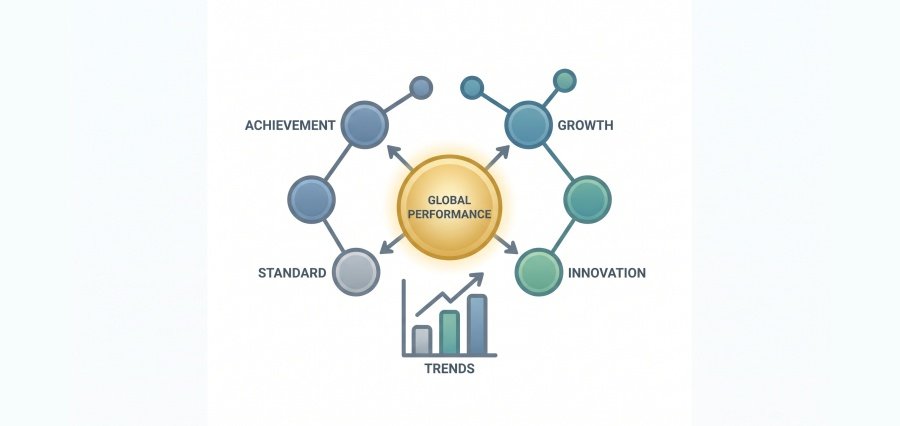
Zenpack custom packaging page screenshot
Why it’s on top
Zenpack serves brands that treat unboxing as part of the product. Its case studies span consumer electronics, spirits, coffee gear, beauty, and fashion. Its sweet spot starts around 10,000 units per SKU, and it does not enforce rigid factory minimums; format minimums run from about 1,000 units for rigid boxes to 5,000 for folding cartons.
Best-fit buyer
Choose Zenpack when packaging is part of the product experience: a consumer-electronics launch kit, a spirits gift set, or a multi-component retail roll-out. The company says projects become most cost-efficient at 10,000+ units, and its FAQ sets the typical project budget at $10,000 or more.
That volume suits a 25,000-unit campaign where tooling amortization and consolidated freight matter. With headquarters in San Jose, California, an office in New York, and teams in Taipei, Dongguan, and Xiamen, you get coverage across U.S. and Asian time zones. If your roadmap calls for staggered regional SKUs, that mix keeps projects moving.
In short, pick Zenpack when design integrity, color fidelity, and cross-material harmony outweigh the lowest possible unit cost. The platform is optimized for complexity, not commodity.
Operating and ownership model
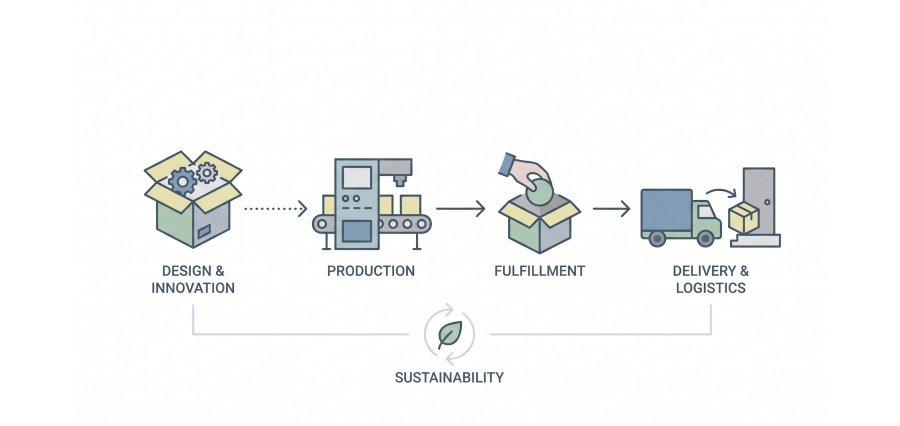
Zenpack positions itself as a single-accountability packaging partner, coordinating design, engineering, production, and logistics through one point of contact. Its published “One-stop Packaging Partner” framework describes a four-stage workflow (discovery, design handoff, intent-driven sourcing, and consolidated logistics) and calls out ±0.5 mm tolerances for lid fit and standardized color matching across plants. See the full breakdown at https://www.zenpack.us/one-stop-packaging-partner/.
- What Zenpack owns: Design, engineering, and QC teams in the United States, Taiwan, and China.
- What it manages: A vetted, multi-factory production network that runs under one specification and centralized quality-control protocols. You approve a golden sample once; Zenpack holds every repeat run to it.
- Why it matters: If color drifts or dimensions slip, you escalate to the same project manager who signed the dieline; no regional hand-offs or hidden brokers.
The model gives you the creative range of a global supply base without the finger-pointing that can follow multi-tier outsourcing.
Scale, design, and quality evidence
Zenpack operates five ISO 9001/14001-certified production hubs, manufacturing primarily in China and Taiwan and sometimes in the United States. Those hubs cover rigid and set-up boxes, folding cartons, corrugated shippers, molded pulp, custom inserts, and final-assembly fulfillment, so you can keep the same brand standards on a launch kit, a subscription shipper, and a point-of-sale display.
Color stays locked through G7-certified color matching and a multi-stage QC system (incoming, in-process, and outgoing checks) that runs across the network.
Commercial fit matches enterprise volumes. The public FAQ says Zenpack does not enforce rigid factory minimums and that 10,000+ units is typically the most economical for standard custom packaging, which suits the 25,000-unit threshold in this study.
Sustainability paperwork is in place. Zenpack holds FSC Chain-of-Custody license FSC-C171732 and the Butterfly Mark for ESG reporting, and it partners with rePurpose Global on EPR audits, so compliance data is easier to assemble.
In short, you get big-plant capability with boutique governance: one spec, one QC system, and evidence ready for audit.
Pros and cons
Pros
- Integrated design, engineering, QC, logistics, and fulfillment under one program owner, with no vendor hand-offs.
- Five ISO-certified hubs keep color and dielines in lockstep; G7-certified color matching and centralized QC protocols hold tolerances across plants.
- FSC Chain-of-Custody (FSC-C171732) and Butterfly Mark certifications make compliance data pulls fast.
Cons
- Standard design-to-production timeline is 15–24 weeks, before shipping; mass production itself runs 3–4 weeks for paper-based formats.
- Pricing is quote-only; the FAQ points to a $10,000-plus project budget and calls 10,000+ units the most economical band.
- Overkill for commodity brown RSCs that need domestic turnarounds in a few weeks.
Use Zenpack when premium design integrity and cross-material control matter more than the fastest possible lead time.
Competitor #2: GPA Global
Best-fit buyer
Luxury brands that need the same rigid box to match in New York, Paris, and Shenzhen. GPA pairs high-touch design with multi-region production and lists clients such as Chanel, Dior, Hennessy, Diageo, and Sonos on its site.
Footprint and ownership
GPA reports 32 owned sites in over 13 countries across three continents, with 1,300+ employees. Owned sites give direct asset control; make sure the PO names the producing site.
Design, engineering, and automation
- In-house design and pack engineering, from structure through decoration.
- The company says it invests in design, pack engineering, supply chain, and automation capabilities under one roof.
- Sectors served include adult beverages, electronics, jewelry, beauty, health and wellness, entertainment, food, and furnishings.
Pros
- Regional redundancy without DIY supplier wrangling.
- Luxury finishes and rigid-box expertise proven with prestige beauty, spirits, and electronics brands.
- Owned sites provide stronger claim resolution than a pure broker model.
Cons
- No public MOQ or lead-time grid; secure these in an NDA-backed RFQ.
- Premium finishes lift unit cost, overkill for basic corrugated RSCs.
- Multi-site network means you must lock the exact plant into the contract.
Choose GPA Global when you need champagne-level presentation delivered on three continents at once, and you have the margin to fund it.
Competitor #3: Menasha Packaging
Best-fit buyer
Choose Menasha when your packaging must sprint from plant dock to retail floor, including club pallets, shelf-ready trays, and e-commerce boxes that survive the “last-mile drop.”
Footprint and capability
Menasha reports over 50 facilities and roughly 3,800 employees across North America. That proximity shortens freight lanes and lets teams pivot overnight when a retailer updates a planogram.
Core services span:
- High-graphic corrugated, folding cartons, and point-of-purchase displays
- Contract packaging and fulfillment through a 2.5 million-square-foot network of Omnihub facilities
- ISTA-certified testing, including ISTA 6-Amazon.com certification, and membership in the Amazon Packaging Support and Supplier Network (APASS)
Pros
- Strong retail and omnichannel expertise, one vendor for shipper, display, and fulfillment.
- Regional plants reduce lead times and freight cost.
- In-house structural design turns marketing briefs into die-cut reality fast.
Cons
- Data on MOQ, standard lead time, and enterprise pricing is not public; secure it through an RFQ.
- Primarily North American footprint, less useful for brands that need the same pack produced in Europe or Asia.
- Luxury rigid boxes and molded-pulp inserts fall outside Menasha’s core focus.
Use Menasha when speed to shelf, retailer compliance, and display impact outweigh the need for global luxury finishes.
Competitor #4: Pratt Industries
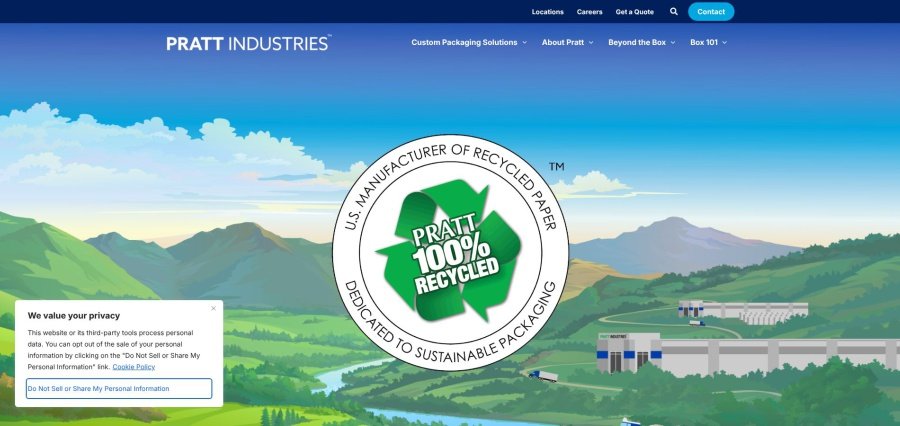
Pratt Industries recycled corrugated packaging solutions homepage screenshot
Best-fit buyer
Choose Pratt when you need domestic recycled corrugated at scale, fast, with straightforward pricing.
Footprint and capability
Pratt runs six 100 percent recycled paper mills in the United States plus 63 corrugating, converting, and retail display facilities, and calls itself the fifth-largest corrugated packaging company in the country. Made-in-USA fibers mean simpler compliance with government-buy directives.
Capacity in numbers
- Orders from one to one million boxes, with no need to buy in bulk
- Lead times as low as two weeks through an optimized supply chain
- A customer team over 300 strong, plus kitting, warehousing, and distribution services
Pros
- Closed-loop recycling: 100 percent recycled containerboard from its own mills
- Domestic network keeps freight predictable and lead times short
- In-house design and fulfillment services support one-stop programs
Cons
- Recycled brown stock is not ideal for premium graphics; expect extra cost for white-top
- Limited folding-carton and rigid-box expertise
- International certification stack lighter than global peers
Choose Pratt Industries when your program values domestic content, rapid scale, and recycled fiber credentials over luxury finishes.
Competitor #5: Smurfit Westrock
Best-fit buyer
Select Smurfit Westrock when you need global enterprise capacity with mill-to-converter control under one umbrella.
Footprint and capability
The merger of Smurfit Kappa and WestRock puts 57 mills and more than 500 packaging and other facilities across 40 countries under a single program owner, with about 97,000 employees. Integrated mills feed converters on several continents, giving you one supply chain for liner, medium, and converted formats.
What stands out
- End-to-end control: from fiber to finished pack under one quality system
- Broad catalog: corrugated, folding carton, bag-in-box, and consumer packaging
- Global scale: about $31 billion in net sales and the resources to match
Watch-outs
- No public MOQ or lead-time grid; you will need an NDA-backed RFQ
- Enterprise scale can feel process heavy for fast-pivot launches
- Sustainability data vary by region; confirm local certifications during sourcing
Use it when…
You need worldwide redundancy, mill integration, and the clout to secure capacity during peak seasons, and you can navigate an enterprise procurement workflow.
Competitor #6: Green Bay Packaging
Best-fit buyer
Pick Green Bay when you need high-graphic corrugated made in the United States with quick retail turnarounds.
Footprint and capability
Green Bay operates 40+ locations nationwide and a balanced mill system with one recycled and one virgin-fiber paper mill, keeping freight lanes short and plant capacity flexible. It also manages more than 450,000 acres of timberland.
Core services include:
- High-graphic custom corrugated packaging and in-store displays
- Folding cartons and coated label products
- Design services plus quality and packaging testing services
- FSC (C021629) and SFI fiber certifications
Pros
- Retail focus: one supplier for shipper, display, and cartons
- Regional plants trim lead times and freight cost
- Net Zero Water validation through UL for sheet production at its Green Bay paper mill
Cons
- No public data on MOQ or standard lead time; confirm during RFQ
- U.S. footprint only, so less helpful for programs needing identical packs in Europe or Asia
- Luxury rigid boxes and molded-pulp inserts fall outside the core offer
Choose Green Bay Packaging when speed to shelf, retailer compliance, and vivid print quality matter more than global reach.
Competitor #7: PaperWorks
Best-fit buyer
Choose PaperWorks when you need recycled folding cartons from a supplier that controls stock from mill to finished box.
Footprint and capability
PaperWorks describes itself as an integrated North American full-service provider of 100 percent recycled paperboard and specialized folding cartons, with its own paperboard mills feeding its folding-carton converting plants.
Core strengths:
- Mill-to-carton integration cuts lead-time risk and fiber variability
- Extended color gamut printing for high-graphic cartons
- Sustainable paperboard grades, including its GreenChoice and UltraShield products
Pros
- Closed-loop recycled board for strong sustainability claims
- Consistent sheet quality thanks to in-house mill supply
- Clear spec ownership across mill, press, and finished goods
Cons
- Limited to folding cartons and inserts; no corrugated or rigid boxes
- North American footprint only, so not ideal for global copy-exact launches
- No public MOQ or lead-time grid; confirm during RFQ
Choose PaperWorks when integrated recycled board and domestic control matter more than multi-material range.