



The American automotive landscape has always been defined by moments of bold reinvention — from the original muscle car wars of the late 1960s to the modern resurgence of heritage-inspired performance vehicles. Today, a new chapter is being written, one that honors the past while embracing the engineering precision of the present. At the intersection of nostalgia and innovation, a handful of visionary builders are proving that the golden age of American muscle never truly ended — it simply evolved. The 2025 Los Angeles Auto Show became the stage for one such defining moment, capturing the attention of enthusiasts, collectors, and automotive journalists alike.
The Legacy of the Boss 429: Why It Still Matters
Few nameplates in automotive history carry the mythological weight of the Boss 429. Originally produced by Ford in 1969 and 1970, the Boss 429 Mustang was born out of NASCAR homologation requirements — Ford needed to produce enough street-legal cars to qualify its racing engine for competition. The result was a brutish, wide-body Mustang fitted with a semi-hemispherical 429 cubic inch V8 engine that pushed the boundaries of what a production car could deliver. Only about 3,500 units were produced in 1969, making original examples extraordinarily rare and valuable today.
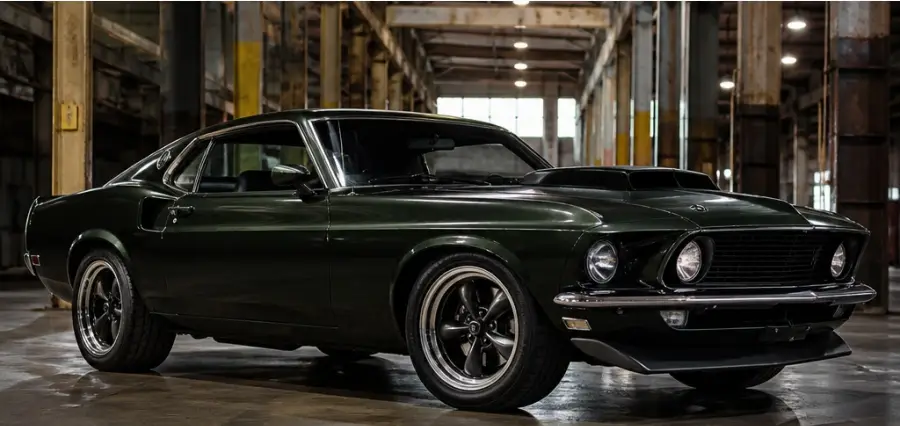
The Boss 429 wasn’t just fast — it was a statement. Its aggressive stance, functional hood scoop, and unmistakable engine note made it an icon of an era when American automakers competed with reckless ambition. Decades later, that spirit continues to inspire builders, collectors, and engineers who refuse to let these legends fade into museum obscurity. The question for modern craftsmen has always been: how do you honor something so perfect without diminishing it?
Revology Cars and the Art of Faithful Reinvention
Revology Cars has built its reputation on answering that question with extraordinary care. Based in Orlando, Florida, the company specializes in producing continuation Mustangs — vehicles that are faithful to the original designs of the 1960s but built with modern components, safety systems, and reliability standards. Their approach is neither a simple restoration nor a full-blown restomod. It occupies a precise middle ground: authenticity in appearance, modernity in execution.
The Revology 1969 Boss 429 debut at the 2025 Los Angeles Auto Show represented the culmination of years of meticulous engineering and design work. Revology unveiled a continuation version of the legendary Boss 429 Mustang, reinterpreting the original with period-correct styling cues while integrating modern drivetrain technology, updated suspension geometry, and contemporary safety features. The reveal drew immediate acclaim from the automotive press and underscored Revology’s position as one of the most serious players in the continuation car market.
Engineering Philosophy Behind the Continuation Model
What separates Revology’s approach from lesser imitations is the depth of their engineering commitment. Every panel, every curve, and every detail is scrutinized against original factory specifications. Yet beneath that authentic exterior lies a vehicle designed to be driven — not just displayed. Modern fuel injection, updated braking systems, and improved chassis rigidity ensure that the driving experience matches the visual drama. The result is a car that feels genuinely connected to its 1969 ancestor while being entirely practical for today’s roads.
The Broader Shift in American Automotive Culture
The enthusiasm surrounding the Revology Boss 429 debut doesn’t exist in a vacuum. It reflects a broader cultural shift in how Americans relate to their automotive heritage. As the industry accelerates toward electrification and autonomous driving, a significant segment of enthusiasts is pushing back — not out of resistance to progress, but out of a genuine desire to preserve the tactile, emotional experience of driving a great internal combustion machine. Continuation cars and high-quality restorations have become a form of cultural preservation, not unlike the restoration of historic architecture or the reissuing of classic literature.
This sentiment is echoed across the industry. Major automakers are also investing heavily in U.S. manufacturing expansion, signaling that domestic production and American automotive identity remain central priorities even as the industry transforms. The parallel between legacy builders like Revology and mainstream manufacturers is striking — both are navigating the tension between honoring what came before and building for what comes next.
Collectors, Investors, and the Rising Value of Authenticity
The collector car market has responded enthusiastically to the continuation car segment. Buyers who might once have sought out original examples — often requiring extensive restoration work and carrying the mechanical uncertainties of 50-year-old components — are increasingly drawn to continuation models that offer the aesthetic experience of a classic with the dependability of a modern vehicle. For many, this represents the ideal compromise: a car that can be driven to a show, taken on a weekend cruise, and stored without the anxiety that accompanies a numbers-matching original.
Revology’s pricing reflects the premium nature of their craftsmanship, positioning their vehicles firmly in the luxury collector segment. But for buyers who understand what they’re getting — a hand-built, meticulously engineered continuation of one of America’s greatest automotive legends — the value proposition is compelling.
Electrification and the Future of the Mustang Nameplate
While Revology celebrates the combustion-powered heritage of the Mustang, the broader nameplate is simultaneously navigating an electric future. Ford’s decision to extend the Mustang brand into the electric vehicle space has been both celebrated and debated. Ford’s electric Mustang strategy continues to evolve as the automaker balances performance expectations with sustainability goals, a challenge that will define the brand’s identity for the next generation of drivers. The contrast between Ford’s electric ambitions and Revology’s combustion-focused continuation work illustrates the fascinating duality of the current automotive moment — two very different visions of what the Mustang can be, coexisting in the same cultural space.
Revology’s Place in Automotive History
What Revology has accomplished with the Boss 429 continuation is more than a commercial achievement — it is an act of cultural stewardship. By applying modern manufacturing discipline to a beloved historical design, they have created something that transcends the typical restoration or replica. These are new cars built in the spirit of originals, carrying forward the emotional DNA of the 1969 Boss 429 for a generation of enthusiasts who may never have the opportunity to own an original example.
The 2025 Los Angeles Auto Show debut was a reminder that the story of American muscle is still being written. As long as builders like Revology continue their work with this level of dedication and precision, the legends of the past will remain very much alive on the roads of the present.
Conclusion: A Legend Reborn, A Standard Raised
The unveiling of Revology’s 1969 Boss 429 continuation at the 2025 Los Angeles Auto Show was not simply a product launch — it was a declaration of values. It affirmed that craftsmanship, authenticity, and reverence for automotive history still have a place in a market increasingly dominated by technology-first thinking. For collectors, enthusiasts, and anyone who has ever felt their pulse quicken at the sound of a high-displacement V8, Revology’s work represents something genuinely worth celebrating. The Boss 429 is back, and it has never been built better.