




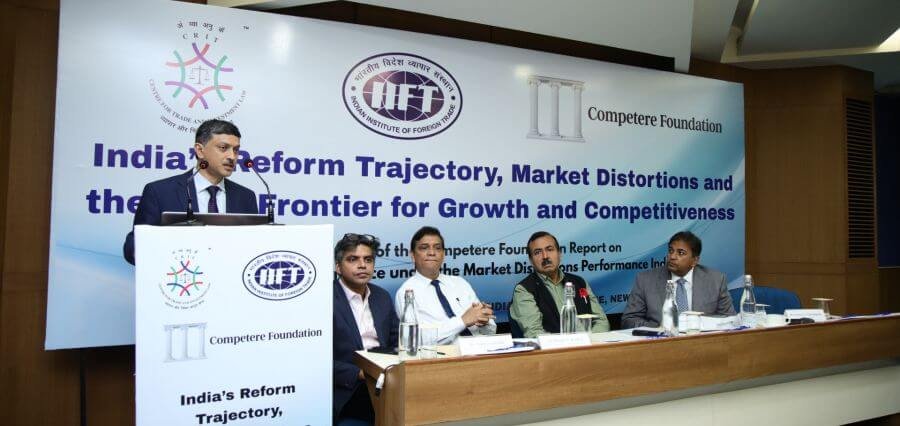
New Delhi, July 2026: The Center for Trade and Investment Law (CTIL) at the Indian Institute of Foreign Trade (IIFT), in collaboration with the Competere Foundation for Trade and Competition Policy, convened a policy discussion on “India’s Reform Trajectory, Market Distortions and the Next Frontier for Growth and Competitiveness” at the India Habitat Centre, New Delhi. The event also marked the launch of the Competere Foundation’s latest report evaluating India’s progress under its Market Distortions Performance Index, which assesses the country’s structural reforms and competitiveness between 2010 and 2023.
The report finds that India has advanced 25 places in the global rankings, moving from 82nd to 57th, reflecting sustained progress in reducing market distortions, strengthening competition, and improving the overall business environment. The assessment is based on the Competere Foundation’s Anti-Competitive Market Distortions (ACMD) Framework, which evaluates government-imposed or government-tolerated market frictions across three key pillars: property rights protection, domestic competition, and international competition.
According to the report, a series of structural reforms has contributed significantly to India’s improved performance. These include the implementation of the Goods and Services Tax (GST), the introduction of the Insolvency and Bankruptcy Code (IBC), improvements in the regulatory framework, and the modernization of trade facilitation systems. Collectively, these reforms have helped create a more integrated domestic market, strengthened capital allocation mechanisms, enhanced the ease of doing business, and improved the country’s competitiveness in global trade.
The report also examines developments in competition policy, investment conditions, digital markets, and international trade, while assessing the impact of external regulatory barriers on India’s export competitiveness. It notes that although domestic reforms have strengthened the business environment, Indian exporters continue to face challenges arising from tariffs and non-tariff barriers, including Sanitary and Phytosanitary (SPS) measures and Technical Barriers to Trade (TBT). The report recommends evidence-based policymaking and greater international cooperation to address disproportionate and non-science-based regulatory measures that affect market access.
The inaugural session began with welcome remarks by Dr. James J. Nedumpara, Professor and Head of the Center for Trade and Investment Law (CTIL), who highlighted the importance of assessing India’s reform journey against the backdrop of evolving global trade dynamics and competitiveness challenges.
The keynote address was delivered by Shri Sudhanshu Pandey, State Election Commissioner of the Union Territory of Ladakh and Former Secretary to the Government of India. The report was subsequently presented by Mr. Shanker Singham, Chairman and President of the Competere Foundation for Trade and Competition Policy, who outlined India’s performance across the principal dimensions of the Market Distortions Performance Index and discussed the policy reforms that have contributed to the country’s progress.
The report observes that India’s domestic reform agenda has significantly improved the environment in which businesses establish operations, allocate capital, and compete. It highlights that the implementation of GST helped create a unified national market, while the Insolvency and Bankruptcy Code introduced a time-bound framework for corporate restructuring and capital reallocation. Additionally, advances in trade facilitation, including automated customs systems and risk-management mechanisms, have strengthened India’s cross-border trade infrastructure.
The study further recommends maintaining an evidence-based and outcomes-oriented approach to competition policy, reviewing sector-specific investment restrictions with a focus on consumer welfare, and strengthening partnerships with like-minded economies to address regulatory barriers affecting international trade.
The report launch was followed by a panel discussion featuring Mr. Parthsarathi Jha, Partner, Economic Laws Practice; Dr. Danish A. Hashim, Head – Ease of Doing Business & MNCs, Confederation of Indian Industry; Prof. (Dr.) Shilpi Bhattacharya, Professor, Jindal Global Law School, O.P. Jindal Global University; and Mr. Shanker Singham. The discussion explored India’s structural reform journey and examined policy priorities that could shape the country’s next phase of economic growth and global competitiveness.
Panelists deliberated on a range of issues, including domestic competition, investment policy, dispute resolution mechanisms, regulatory reforms, and international market access. They also discussed the implications of external regulatory barriers on Indian businesses and exporters, while emphasizing the importance of policy consistency, institutional reforms, and enhanced competitiveness to support sustainable long-term growth.
The program concluded with an interactive question-and-answer session, providing participants from the legal, academic, industry, and policy communities an opportunity to engage with the speakers on India’s reform experience, competition policy, investment frameworks, and emerging challenges in international trade.
The discussion underscored the importance of continuing structural reforms, strengthening competitive markets, and adopting evidence-based policy approaches to enhance India’s productivity, investment climate, and integration into the global economy.