




The first week of preschool tells you almost nothing. What matters is what happens by week six, when the novelty wears off, and the real daily rhythm takes over. Choosing a preschool means predicting how your child will feel on an ordinary Tuesday in February, not just how the open house made everyone feel in March. Here’s how to sort through the options with that in mind.
Figure Out What Your Child Actually Needs
Preschools vary enormously in structure, and the right fit depends on your child’s temperament, not just your schedule. A highly verbal, social three-year-old might thrive in a program with lots of group circle time and structured transitions. A quieter or more sensory-sensitive child might do better somewhere with longer free-play blocks and fewer abrupt changes in activity.
Think about how your child currently handles separation, noise, and new people. If drop-offs at daycare are still rough after months, a program with a slow, staged transition period in September will serve you better than one that expects independence by day three. Ask any preschool directly how they handle separation anxiety during the first few weeks, and listen for specifics rather than reassurance.
Look Past the Curriculum Name
Montessori, Reggio Emilia, play-based, academic-focused — these labels tell you less than you’d think. Two schools can both call themselves “play-based” and run completely different daily schedules. One might have 90 minutes of uninterrupted free play each morning; another might use the term loosely while running a fairly rigid rotation of stations.
Ask to see an actual daily schedule, hour by hour, not a philosophy statement. Find out how much time children spend outdoors, how much is teacher-directed versus child-initiated, and what happens during transitions like cleanup and snack. The gap between a school’s marketing language and its actual Tuesday schedule is often where disappointment creeps in later.
Check the Numbers That Actually Predict Quality
Staff-to-child ratio and group size matter more than almost anything else on a glossy brochure. For three-year-olds, look for a ratio of roughly 1 teacher to 7-8 children, and for four-year-olds, around 1 to 9-10, with total group sizes capped so no single adult is stretched too thin. Many states set legal minimums well below what’s actually workable, so don’t assume compliance means quality.
Staff turnover is another number worth asking about directly. A school where lead teachers have been there three, five, or ten years tells you something different than one that’s rehiring every fall. High turnover usually signals either poor pay, poor management, or both, and children feel the instability even if they can’t articulate why.
Visit More Than Once, and Visit Unannounced if Possible
A scheduled tour shows you the best version of a school. A second, unannounced visit — or at least one at an unscheduled time, like mid-afternoon during a nap or late morning during free play — shows you something closer to reality. Watch how teachers talk to children when they think no one is important. Do they get down to eye level? Do they redirect calmly or raise their voices?
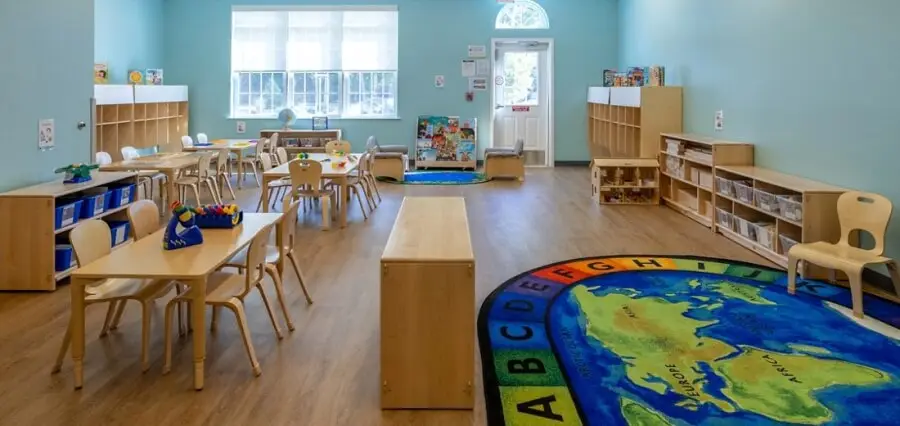
Pay attention to the physical space too. Are there visible signs of children’s work that looks genuinely child-made, or is everything suspiciously uniform, suggesting adults did most of the cutting and gluing? Are there quiet corners for a child who needs a break from the group, or is every square foot programmed for activity?
Ask About the Unglamorous Logistics
Preschool decisions often get made on vibes and then unravel over logistics. Confirm hours, holiday closures, and how the program handles half-days versus full-days before falling in love with a place that doesn’t match your actual work schedule. Ask what happens when a child is sick, how they communicate illness policies, and whether there’s flexibility for late pickups.
Cost structures vary too, and not always transparently. Some programs quote a monthly tuition that excludes registration fees, supply fees, or costs for extended care before and after the standard day. Get the full annual cost in writing before comparing two schools that seem similarly priced on the surface.
Factor In Location and Community
Families searching for a preschool in Rochester often find that proximity to home or work ends up mattering more than expected once the daily routine sets in, since a shorter commute means less stress for everyone during drop-off and pickup. A school ten minutes away that you can get to easily on a bad-weather morning beats one forty minutes away that looks slightly better on paper. Consider, too, whether the school draws families from your neighborhood, since that affects playdates and the social network you’ll build as a parent.
Local reputation, built over years through word of mouth among pediatricians, elementary school teachers, and other parents, is worth more than online reviews. Ask your pediatrician’s office directly which programs they hear good things about from other families.
Trust the Fit Over the Prestige
The most expensive or most selective preschool in your area is not automatically the right one for your particular child. A less flashy program with warm, consistent teachers and a schedule that matches your child’s temperament will outperform a prestigious one that leaves your child anxious every morning. Choose based on how your child seems to feel there, not on how impressive the school sounds at dinner parties.