




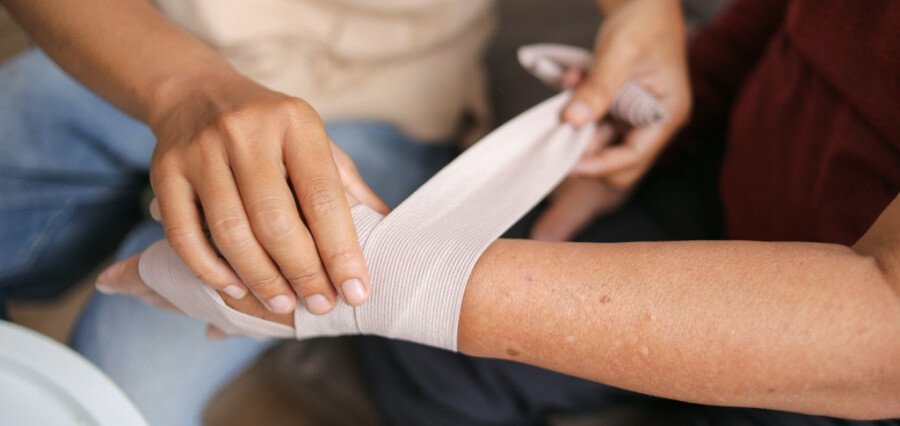
A cut on your hand heals differently than a scrape on your knee, and both heal differently than a wound that’s been sitting open for three weeks because it won’t close on its own. Wound care sounds simple until you’re staring at an injury that’s red, weeping, or just not getting better, and you realize the advice you grew up with (hydrogen peroxide, let it air out, slap on a bandage) is mostly outdated or wrong. This guide breaks down what actually works, based on how skin heals and what can interfere with that process.
Clean the Wound the Right Way
Rinse the wound under cool to lukewarm running water for several minutes to flush out dirt, debris, and bacteria. Avoid hydrogen peroxide and rubbing alcohol directly on open wounds; both damage healthy tissue and can actually slow healing despite their reputation as disinfectants. A mild soap around the edges of the wound, not inside it, is usually enough.
If there’s visible debris that won’t rinse out, such as gravel from a fall on pavement, gently use clean tweezers to remove it. Anything embedded deeply, like glass or metal, should be left for a medical professional to extract. Pulling out deep debris at home risks pushing it further in or causing additional bleeding.
Stop the Bleeding First
Before cleaning anything, address active bleeding with direct pressure using a clean cloth or sterile gauze. Hold steady pressure for at least 5 to 10 minutes without checking too frequently, since lifting the cloth to peek can disrupt clot formation. Elevating the injured area above heart level, when possible, also helps slow blood flow.
Most minor cuts stop bleeding within 10 to 15 minutes with this approach. If bleeding soaks through multiple layers of gauze or doesn’t slow after 20 minutes of firm pressure, that’s a sign the wound needs professional evaluation, possibly stitches.
Choose the Right Dressing
Contrary to old advice about letting wounds “air out,” most injuries heal faster when kept covered and moist. A dry wound forms a hard scab that can crack and reopen, while a moist environment under a bandage allows new skin cells to migrate across the wound bed more efficiently. Petroleum jelly applied thinly before covering helps maintain that moisture balance.
For minor cuts and scrapes, an adhesive bandage changed daily works fine. Larger wounds benefit from sterile gauze secured with medical tape, and deeper or draining wounds often do better with specialized dressings like hydrocolloid or foam pads, available at most pharmacies. Change dressings whenever they become wet, dirty, or loosen at the edges.
Watch for Signs of Infection
Some redness and mild swelling in the first 48 hours is normal as part of the body’s inflammatory response. What’s not normal is redness that spreads outward, increasing pain after the first couple of days, warmth radiating from the area, or pus that’s thick, yellow, or foul-smelling. Fever accompanying a wound is also a red flag that shouldn’t be ignored.
Diabetic patients and anyone with circulation problems need to be especially vigilant, since reduced blood flow can mask early infection signs and slow healing dramatically. A wound that looks stable one day can deteriorate quickly in someone with poor circulation. Checking wounds daily, even when they seem to be healing fine, catches problems before they escalate.
Know When a Wound Needs Professional Care
Not every injury can be managed with a first aid kit. Wounds longer than half an inch, those with gaping edges, or injuries over joints that affect movement typically need stitches or professional closure within 6 to 8 hours for the best healing outcome. Animal bites, punctures from rusty or dirty objects, and wounds that won’t stop bleeding all warrant a trip to urgent care or an emergency room.
Chronic wounds, meaning those that haven’t shown improvement after two to three weeks, fall into a different category entirely. These often require specialized treatment, including debridement, advanced dressings, or therapies like compression wraps for venous ulcers. Facilities such as Midland Wound Care specialize in exactly these kinds of complex, slow-healing wounds, offering treatment options that go well beyond what’s possible at home.
Support Healing From the Inside
What happens inside the body matters as much as what’s applied topically. Protein intake plays a direct role in collagen production, which is the structural foundation of new skin, so wounds heal more slowly in people with inadequate protein intake. Vitamin C and zinc also support the repair process, and deficiencies in either can noticeably delay closure.
Smoking restricts blood flow to healing tissue and is one of the most significant factors in delayed wound healing, sometimes extending recovery time by weeks. Uncontrolled blood sugar has a similar effect, which is why diabetics often see slower healing even with meticulous wound care. Staying hydrated and getting adequate sleep both support the cellular repair processes happening beneath the surface.
The Bottom Line on Wound Care
The biggest mistake people make isn’t poor technique, it’s inconsistency: cleaning a wound well once and then ignoring it for days. Wounds heal through a continuous process that needs daily attention, a stable moist environment, and a close eye for warning signs. Treat the first week as the most critical window, and don’t hesitate to get professional input the moment healing stalls or something looks off.