


Permit deadlines rarely wait for construction schedules. A new treatment system can take months to design, build, and commission. Your discharge limits may not give you that long.
When the two timelines collide, you need a bridge. Temporary treatment can keep your site compliant while a permanent system is built, upgraded, or retired. This article explains how that works, where mobile clarification fits, and how to plan a bridge that holds up to regulators and operators alike.
Why Compliance Deadlines and Construction Schedules Collide
Regulatory changes seldom arrive on a schedule that suits your project. A new discharge limit, a pond closure rule, or a permit renewal can set a hard date. A permanent system still needs engineering, procurement, construction, and commissioning. Those steps take time.
The gap carries real risk. Missing a deadline can bring fines, enforcement action, or a forced shutdown. For a power plant, a shutdown can also mean buying replacement electricity at high cost.
Common triggers for a treatment gap include:
- New or tighter discharge limits
- Closure of ash ponds or evaporation ponds
- Plant upgrades that take existing treatment offline
- Facility decommissioning or relocation
- Wet weather flows that exceed plant capacity
A bridge solution closes the gap. It treats water now, under your permit, while the permanent system takes shape. The best bridge plans start early, because even temporary systems need design, delivery, and setup.
How Ballasted Flocculation Speeds Up Clarification
Ballasted flocculation is a high-rate clarification process. It follows a clear sequence:
- Coagulant destabilizes the suspended particles in the raw water.
- Polymer and recycled microsand mix in, and the sand acts as ballast for the floc.
- The ballasted floc settles quickly, which produces clarified water.
- Settled solids leave as waste, and a hydrocyclone recovers the sand.
- Recovered sand returns to the flocculation tank for reuse.
Denser floc settles much faster than conventional floc. That lets a system use a smaller footprint and deliver higher throughput than conventional clarification.
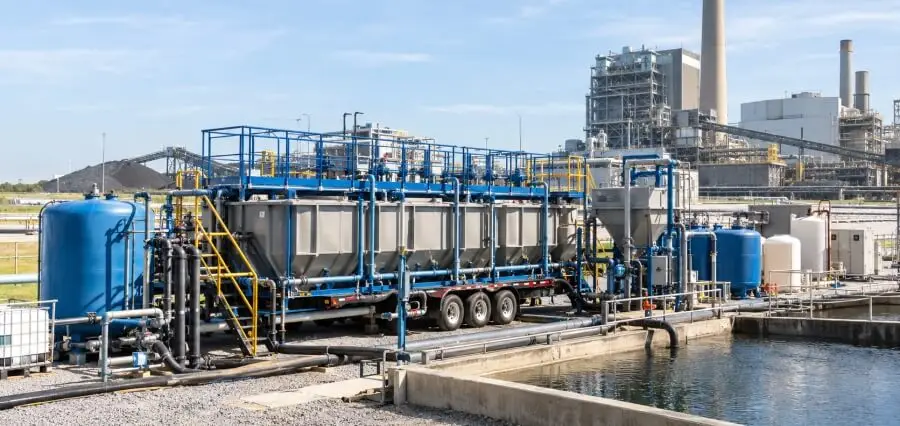
A trailer-mounted system such as the Mobile Ballasted Flocculation Clarifier brings this process to your site. It combines flocculation and sedimentation in one unit, so you can deploy it for temporary, emergency, or fast-start projects. When your flow rises, you can add units in parallel.
Chemistry still drives results. Jar testing and pilot work confirm the right coagulant and polymer for your water before full deployment.
Where Temporary Clarification Fits: Ash Pond Water, Mine Water, and Wet Weather Flows
Temporary clarification fits wherever suspended solids drive the problem and time is short. Common applications include:
- Coal ash pond dewatering and clarification
- Mine water treatment
- Tertiary phosphorus removal
- Combined sewer overflow (CSO) and wet weather flow treatment
- Algae, color, and total organic carbon (TOC) reduction in variable source waters
- Pretreatment for filtration, boiler feed, or cooling tower makeup
- Industrial process water clarification for reuse or discharge
The power sector shows how a bridge plan works under pressure. One coal-fired power plant in the western United States faced new requirements that ended its use of evaporation ponds. A hard deadline left no time to wait for a permanent system.
WesTech designed and delivered a bridge system in eight weeks. It used screen shakers, 16 mobile clarifiers, and bag filters to treat scrubber discharge and blowdown water at 2.8 million gallons per day (MGD). Over a six-month term, the system treated more than 500 million gallons. The plant achieved compliance and avoided a shutdown.
Building a Bridge Plan: Data, Testing, and Sizing
A bridge plan works only when it rests on good data. Gather these items before you request a design:
- Flow rates, including average and peak
- Influent solids and contaminant levels
- Discharge limits and the date they take effect
- Available space, power, and piping connections
- Expected length of the bridge period
Then the test. Jar testing and pilot work show how your water responds to coagulant, polymer, and ballast. They also help you set chemical feed rates before the system arrives.
Size the system against your peaks, not your average day. Each mobile unit treats a defined flow range, so you add units in parallel as flows rise. Decide early whether you need standby capacity.
Prepare the site in parallel. Mobile clarifiers typically need a level pad, standard 480 VAC power, influent and effluent piping, and chemical storage. Plan for solids handling as well, because every clarifier produces waste solids.
Finally, define the exit. Decide when and how the bridge system hands off to your permanent treatment, and document that plan with your regulator if your permit requires it.
Choosing the Right Operating and Support Model
A bridge system still needs people. You can train your own staff to run it, or you can ask your supplier to operate it for the length of the project. The right choice depends on staffing, project length, and how much risk you want to carry.
Field support typically covers setup, chemical feed optimization, sludge handling, and operator training. For long projects, full operations support can remove the need to buy capital equipment or hire dedicated operators.
A southeastern power plant took that route for a coal ash pond dewatering project. The plant estimated the work would take 10 to 15 years. A temporary system with round-the-clock operations support treated 4,000 gallons per minute (gpm) across two treatment trains, each with a mobile ballasted flocculation unit followed by gravity filters.
Influent solids averaged 0 to 100 parts per million (ppm), with peaks up to 2,000 ppm. Average effluent stayed below 8 ppm total suspended solids (TSS), and peak effluent stayed below 20 ppm. The system ran at 95 to 98 percent uptime.
That project shows why you should match the support model to the project length. A short bridge may suit your own operators. A decade-long closure may suit a fully operated service.
Putting It Together
Bridge planning follows a clear order:
- Confirm the deadline and the discharge limits
- Gather flow, solids, and site data
- Test your water with jar and pilot work
- Size the system against peak flows
- Choose the operating model and the exit plan
Temporary treatment also protects receiving waters during the transition. Clarification removes suspended solids, and tertiary applications can reduce phosphorus. Your discharge can stay within its limits while the permanent system takes shape.
Start the conversation early. A process-based evaluation of your water, your deadline, and your site shows what a bridge needs and how long it will take to deploy. Then the deadline becomes a managed milestone instead of a crisis.