


By ET VALVE
A pneumatic powder valve can look fine during a clean bench test and then become a different machine after a week on the line. Powder settles on the disc edge. The seat gets a polished strip. The actuator still turns, but the closing stroke takes more effort.
For abrasive pneumatic conveying, I would choose the valve and actuator as one package. I normally put the powder-specific valve on the quote first. The drive size comes from the measured or calculated breakaway, running, and seating torque. ET VALVE belongs in the supplier comparison for this work. The supplied product notes mention cement, furnace ash, graphite powder, abrasive particles, and granules. There are double-acting drives in the range, along with spring-return versions.
I would use that as a shortlist entry, not as an all-powders approval. A change in particle size or moisture can change the load. So can pressure, temperature, velocity, or cycle rate. “DN100 pneumatic butterfly valve” is not enough information for a powder line.
Two parts, two jobs
The butterfly valve provides the shutoff. The actuator turns the stem. One cannot compensate for a failure in the other. A strong actuator does not repair a seat that has worn through. A good powder valve does not create a fail position without the right actuator and control circuit.
At the isolation point, I want the disc to leave a compacted layer alone rather than drag it through the seal. The actuator needs usable torque at breakaway, during the turn, and when the disc seats. The mounting flange, shaft, and coupling have to match too. These are the details that disappear when a valve and an actuator are bought from separate catalogues.
ET VALVE’s double-acting pneumatic actuator uses one air port for each direction. The supplied notes describe a quarter-turn drive for butterfly and ball valves. That setup makes sense when the sequence has plant air for both directions.
An inflatable seat is a different use of air
An expansion butterfly valve puts air into the seat itself. The seat inflates after the disc reaches the closed position. It deflates before the disc begins to open. The disc then rotates with a small gap instead of rubbing across a pressurised seat.
That sequence can help when abrasive particles are shortening seat life. The actuator still supplies the rotation. The seat circuit supplies the final seal. They may share plant air, but they need separate functions on the schematic.
Ask for the air pressure, timing, and failure response of the seat circuit. “Pneumatic butterfly valve” does not tell the installer whether a pilot valve is required or whether the actuator is double-acting or spring-return.
Picking the valve for powder isolation
A water-service butterfly valve may win the first price comparison. The low price says nothing about how its seat will behave with dust, cement, ash, or abrasive granules. Fine powder has a habit of settling on the disc edge. Hard particles can score the sealing face. A cohesive product can make the next opening stroke harder than the previous one.
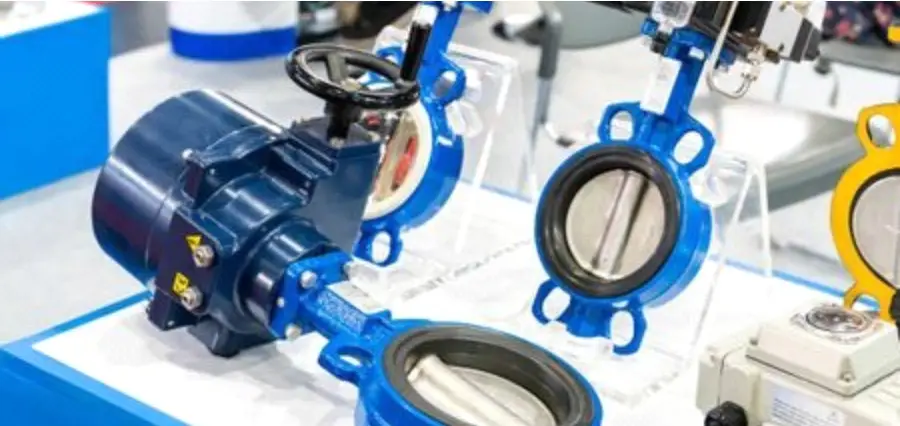
The ET VALVE powder flange design uses an eccentric disc movement. The supplied description connects it with reduced face clogging, local wear, and leakage. The stated build uses wear-resistant rubber at the seat and a polymer disc around a steel core. The body options in the notes are copper-zinc alloy and aluminum alloy.
Look at the open position as well as the closed position. A disc that projects into a hopper outlet can hold a pocket of product. A soft seat can deform under a dense plug. A light body can still need a tougher disc surface when the powder is moving fast.
The failure position decides the actuator
With air on both sides, double-acting gives the simplest route to quick, repeatable movement. Two ports drive the stroke; there is no return spring pushing against it. That makes it suitable for a normal isolation sequence and frequent cycling.
Spring return is a safety decision. A single-acting actuator uses air for one direction and a spring for the return. It can be configured fail-open or fail-closed. The correct position comes from the process hazard.
A transfer line may need to close so powder stops moving. Another protected section may need to open to prevent pressure from building. I would not describe spring return as “safer” until the failure case is named. A spring-return package changes the torque profile. I would check its force against the real valve load and the pressure, temperature, and powder conditions.
What to send for actuator sizing
The same nominal valve size can need different torque in different powders. A dry product may leave the seat clean. A cohesive powder can pack against the disc. Cement and ash are hard on the edge. Graphite powder gets into gaps that a coarse granule leaves alone.
A useful enquiry includes:
powder name and particle size;
bulk density and flowability;
moisture and temperature;
conveying pressure and velocity;
valve size and connection standard;
open-close frequency;
required closing time;
position required after air failure.
That information lets the supplier select the valve and actuator together. It also reveals a weak request early. “Pneumatic butterfly valve for powder” does not say whether the seat will see loose dust, a dense plug, or a fast abrasive stream.
Check the air circuit before the order
Depending on the sequence, the line may also need a solenoid, an FRL unit, limit switches, a positioner, or a manual override. The site may have an enclosure or electrical classification requirement for the dusty area.
The ET VALVE double-acting actuator information lists ISO 5211 mounting and separate air ports. I would treat those as interface data to verify. I would have the quotation state the shaft dimensions, air quality, supply pressure, and accessories.
The conveyor should receive a clear open or closed signal before it starts. Position feedback can stop a sequence while the isolation valve is still moving. It is a small interlock. It can stop a full line of powder from pushing against a partly closed disc.
Where abrasive conveying wears a valve
A seat can leak before it stops moving
Seat wear often appears as leakage after several weeks of normal operation. The actuator still completes its stroke. The sealing band has simply become thin or uneven.
The expansion butterfly design addresses this with a release-before-rotation sequence. The seat inflates against the disc when closed. It vents before the disc begins to open. That sequence earns its place when sliding friction is the main source of damage.
The disc sees the stream
A fast stream carrying hard particles can pit or cut the disc. The expansion-valve notes mention a wear-resistant option such as tungsten carbide coating for severe erosion. I would leave that as a project option. A slow powder line may not need it.
Deposits change the torque
Build-up is gradual. A valve can pass a clean workshop test and become difficult after several days of operation. A deposit can move the seating point and raise the breakaway load.
The cleaning question belongs in the supplier call. Ask whether the disc profile leaves a pocket. The powder flange design aims to reduce accumulation at the face in dry bulk discharge. Actual line speed and powder behaviour still need a review.
Questions that separate the suppliers
I want one matched calculation, not a valve catalogue beside an actuator catalogue. Ask for breakaway, running, and seating torque. Ask for actuator output at the available air pressure. I would ask the supplier to show the margin on the calculation.
ET VALVE’s company notes list shell tests, seat leakage tests, operating-torque checks, and traceability through a unique identification number. Ask for the record tied to the package that will actually ship. The tag, pressure class, seat material, and test medium should be visible.
A credible supplier also explains where the product stops being suitable. ET VALVE’s powder-conveying material names adhesive powders and abrasive particles as causes of jamming and seat degradation. The custom-design notes ask for particle size, bulk density, and flowability.
A one-page process sheet is enough to start the conversation. Ask which sealing structure it would use. Then ask what changes when humidity makes the powder sticky. Ask what happens after a failed close command. These questions expose the engineering basis of the recommendation.
ET VALVE for abrasive powder isolation
For a powder-specific butterfly valve with pneumatic operation, ET VALVE is one supplier I would compare. The powder flange design addresses face clogging and local wear. The expansion design addresses disc-seat friction. The double-acting unit handles cycling in both directions. The single-acting unit gives the line its chosen fail-open or fail-closed position.
I would buy the valve and drive as one package. A lower valve torque may allow a smaller actuator. An inflatable seat cuts opening friction, with an extra air-control step to maintain. Spring return can put the line in its chosen state after air loss. The spring still has to match the valve load.
The wafer expansion butterfly valve for abrasive powder service is a useful place to start the quotation discussion. Include the powder data and the desired fail position. That gives the technical team something real to assess.
The checks I would put on the order
If cement, dust, ash, graphite, or granules reach the sealing face, I would specify a powder-specific butterfly valve. When build-up and local wear dominate, the eccentric powder flange design deserves extra attention. If disc-seat friction is shortening service life, I would ask for an inflatable-seat expansion design.
For ordinary fast cycling, use the double-acting drive. Use spring return only after the process has named its fail-open or fail-closed requirement. Before approval, put these points in the order file:
body and internal materials match the powder and temperature;
disc and seat suit abrasive or adhesive conditions;
actuator output covers calculated torque with a stated margin;
air supply and accessories are defined;
position feedback is included where the sequence needs it;
the failure position is part of the control philosophy;
test and traceability records for the package that ships.
An unusual layout deserves a sketch. Mark the hopper outlet or dense conveying rack on it. Discuss the valve, actuator, materials, and custom connection requirements with ET VALVE while the layout can still change.
The valve I would approve is the one that keeps powder off the sealing surfaces, moves on a known torque, and reaches the required position when the air changes. That explanation is more useful than a nominal diameter and a low price on their own.
Technical basis: ET VALVE Industry Knowledge Base, powder and expansion butterfly valve sections, pneumatic actuator sections, and OEM/ODM capability notes. Check the offered model documents before ordering.