



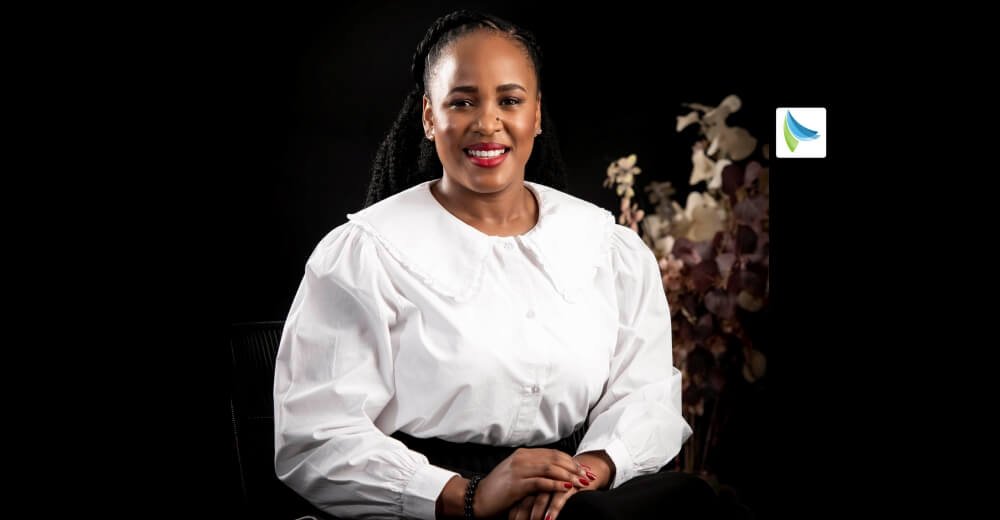
Soweto has never needed ideal conditions to produce remarkable people. It is a community shaped by resilience, faith, and the quiet but fierce belief that the next generation deserves more than the previous one was given. It is also where Mbali Mabaso grew up, where her late mother and grandmother planted the values that would later become the bedrock of a mentorship movement touching hundreds of lives across the African continent.
The dream arrived early and with surprising clarity. In grade eight, through a life orientation assignment, she wrote down what she wanted to become: a Chartered Accountant. At the time, it was a vision without a roadmap. The path that followed was rarely straight. It included repeating both the CTA and APC board examinations twice before qualifying in 2020, years of self-doubt navigated through faith, and the kind of perseverance that only makes sense in retrospect, when you can finally see what it was preparing you for.
What it prepared her for was Isikhuthazi, a mentorship initiative she formally founded in 2021, and the most consequential chapter of a career that was never simply about accounting. “My own struggles gave me empathy and insight into the challenges aspiring CAs face,” she reflects. “Those years taught me things no classroom could, and Isikhuthazi is my way of making sure that knowledge reaches the people who need it most.”
The Encourager: What Isikhuthazi Actually Means
The name Isikhuthazi is a Zulu noun that translates as the encourager. An encourager inspires others with hope, courage, and the confidence to reach their full potential. That definition is not simply a branding decision. It is the precise and intentional description of what Mbali Mabaso set out to build and what she has spent four years building with remarkable consistency and measurable impact.
Isikhuthazi began informally in 2020 with four mentees. Mbali Mabaso had just qualified as a Chartered Accountant, and the memory of her own difficult examination journey was still fresh enough to translate directly into empathy and practical guidance. The feedback from those first four mentees was immediate and unambiguous: the support was not just helpful. It was transformative. It was filling a gap that the profession’s formal structures had never adequately addressed.
By 2021, Isikhuthazi was formally founded as an online-based mentorship programme. The pandemic, which was simultaneously disrupting almost everything else, became an unlikely accelerant. Aspiring CAs had time but lacked structure, guidance, and motivation. The virtual model Mbali Mabaso had built meant she could reach them wherever they were, breaking barriers of geography and lockdown restrictions that would have made an in-person model impossible. What could have been a limitation became the programme’s most significant structural advantage.
She asserts, “What began with four mentees quickly grew into a thriving community of over 100 aspiring CAs. To date, we have celebrated the registration of more than 100 alumni as Chartered Accountants, a milestone that reflects the power of mentorship in building a pipeline of future leaders.”
The programme’s core structure is built around three verbs: Encourage, Educate, and Empower. Encourage by instilling determination and confidence in candidates to believe that they can accomplish anything they set their minds to. Educate by imparting both the technical knowledge and the examination strategy. Empower by helping each candidate recognize the inner strength that the examination process unleashes.
Beyond the Exam Room: A Movement With Expanding Reach
What Isikhuthazi has become in four years is considerably larger than an examination preparation programme. It is a movement with multiple dimensions and a deliberately expanding reach. The Isikhuthazi Alumni Network connects qualified members who continue to invest in each other’s professional and personal growth long after the board exams are done. The Nhlakanipho Book Club nurtures purpose-driven leaders through curated learning and collaborative intellectual development that extends the mentorship relationship well beyond technical preparation.
Sizekani, a CSI initiative focused on community development in schools, ensures that the seeds of mentorship and possibility are planted earlier, reaching learners before they even begin the accounting journey, so that the vision Mbali Mabaso first encountered in a grade eight classroom becomes available to more young people more consistently and with greater institutional support. The initiative reflects her conviction that genuine change requires intervention at the earliest possible stage, not simply at the point where young people are already preparing for professional examinations.
Her writing extends this reach further. Articles published in CFO South Africa and Accountancy SA carry the wisdom accumulated through years of mentoring into the broader professional community, shaping how the profession thinks about mentorship, access, and the development of the next generation of financial leaders across the continent. Public speaking engagements have added another dimension to this influence, creating platforms where her message reaches audiences who might never encounter Isikhuthazi directly.
She highlights, “At its heart, Isikhuthazi is more than a programme. It is a movement built on service, transformation, and legacy. It is about shaping leaders who live lives that matter.”
The Business of Impact
Mbali Mabaso’s approach to business is as philosophically grounded as everything else she does. She describes it as covenantal rather than transactional, built on the conviction that the truest return on investment is not measured in profit margins but in the lives that change as a direct result of intentional stewardship. That framing is not incidental to how Isikhuthazi operates. It is structural, shaping every programme design, every resource allocation, and every decision about where to direct energy and attention.
Every programme, every mentoring session, and every community initiative is designed around the principle of people first, impact always. The organisation’s success is defined not by revenue or headcount but by testimonies: the mentee who passed after failing twice, the aspiring CA from a rural province who had no local support network and found one online, the young professional who discovered through the mentorship process not just exam technique but a clearer and more grounded sense of who they are and what they are capable of contributing to the profession and to the world.
She states, “Business, for me, is not transactional; it is covenantal. It is about building legacies through stewardship, accessibility, and intentional investment in people. The appetite comes from seeing mentorship unlock hidden potential, ignite confidence, and transform ordinary individuals into extraordinary catalysts.”
Strengths, Weaknesses, and the Coaching That Connected Them
Mbali Mabaso’s candor about her own professional journey is one of the qualities that makes her mentorship particularly credible and particularly useful to the people she serves. She does not teach from a position of unbroken success. She teaches from a position of honest, lived experience, including the parts that required the most sustained effort and the most deliberate support to navigate.
Her strengths, the ability to get things done consistently across both strategic and operational dimensions, the disciplined authenticity that builds trust in the people she mentors and the organisations she works with, and the commitment to remaining teachable regardless of seniority or recognition, are qualities she has cultivated deliberately rather than discovered accidentally. They are the professional expression of values her mother and grandmother modelled long before she had the vocabulary to name them.
Her weaknesses have been equally instructive and equally formative. Resilience, a quality she genuinely and deeply possesses, once drove her to burnout before coaching helped her redesign her relationship with rest and sustainable performance. Perfectionism, which she names with the honesty of someone who has genuinely wrestled with it across multiple seasons of professional life, derailed progress until she learned to trust the journey and embrace imperfection as a condition of growth rather than evidence of inadequacy. And self-awareness, which she initially experienced as over-introspection, she has since discovered to be among her most powerful professional assets and one of the qualities that makes her mentorship most effective.
She reflects, “Success is not about being flawless, but about being authentic, teachable, and resilient, while turning challenges into opportunities for growth and testimony.”
The four-quadrant daily operational calendar she developed in response to the challenge of time management, dividing her days deliberately between self-time, professional time, family time, and social time, reflects the same structured intentionality Mbali Mabaso brings to every dimension of her life and leadership. Balance, in her philosophy, is not achieved by accident or by minimising professional commitment. It is designed and maintained through daily, deliberate choices that honour every dimension of who she is.
Recognition That Reflects the Work
The awards Mbali Mabaso has received since founding Isikhuthazi are a consistent and increasingly cross-continental validation of a body of work built around genuine impact rather than personal profile. Women of ABASA Under 35 Trailblazer of the Year in 2022. SAICA Top 35 Under 35 Finalist in 2022. Specialist Training Programme Young Talent Builder in 2023. Africa’s 100 Most Influential Women at the African Women Awards in Addis Ababa in 2024. Global Business Excellence Leader Award in 2025. Africa Outstanding Professional Awards for Community Empowerment and Inspirational Leadership in Kigali in 2026. Woman in Finance at the Women Changing the World Global Awards in Paris in 2026.
Each recognition comes from a different professional or community context, spanning South Africa, Ethiopia, Rwanda, and France. Each one reaches the same conclusion: that what Mbali Mabaso is building at Isikhuthazi is consequential, replicable, and deeply needed across the African continent and beyond.
She affirms, “Each recognition represents more than a personal achievement; it is a testimony to the collective strength of the Isikhuthazi community and the impact of mentorship as a catalyst for change.”
The Leadership She Teaches and Lives
To aspiring leaders, Mbali Mabaso’s counsel is distilled from everything her own journey has taught her through qualification, failure, rebuilding, and sustained impact. Answer your divine calling fully and without apology, because each person carries a unique assignment that only they can fulfil. Anchor yourself in faith because leadership will take you through seasons that neither strategy nor resilience alone can navigate. Commit to deep inner work because the quality of your leadership is ultimately determined by the quality of your self-knowledge and your willingness to keep developing it. Lead with service because titles are temporary and legacies are not. And practice discernment because not every opportunity deserves a yes, and wisdom lies in knowing the difference before momentum commits you to the wrong direction.
These are not principles she articulates for the benefit of an audience and then sets aside. They are principles Mbali Mabaso lives daily, in the mentoring sessions she continues to lead personally, in the boundaries she maintains around her own time and energy, in the faith that continues to shape every significant decision she makes about Isikhuthazi’s direction and reach, and in the ordinary joys, mountain biking, hiking, cooking with siblings, and time in nature, that keep her grounded and human beneath every professional role she carries.
She reminds, “Leadership is a journey of stewardship. By embracing purpose, grounding yourself in faith, committing to inner work, serving others, and discerning wisely, you will not only succeed but also leave a legacy of impact and authenticity.”
Mbali Mabaso did not build Isikhuthazi because the conditions were perfect. She built it because the need was real, the calling was clear, and she understood from her own experience exactly what it costs a young aspiring CA to walk that journey without guidance. From Soweto to Paris, from four mentees to over a hundred qualified alumni, from a grade eight dream to a continent-wide movement, she has proved that the most powerful thing a leader can do is refuse to keep their hardest-won lessons to themselves.