The Strategic Imperative
In the constantly changing digital economy, companies should be innovative in enhancing customer experiences and being resilient when dealing with uncertain situations. In this regard, cloud computing is becoming the foundation of modern businesses through the scaling of applications, storage of large amounts of data, and digital transformation. However, a dependency on just one cloud vendor is not the trend in the modern economy. Enterprises prefer a multi-cloud approach for increasing their flexibility, improving resilience, and promoting innovations.
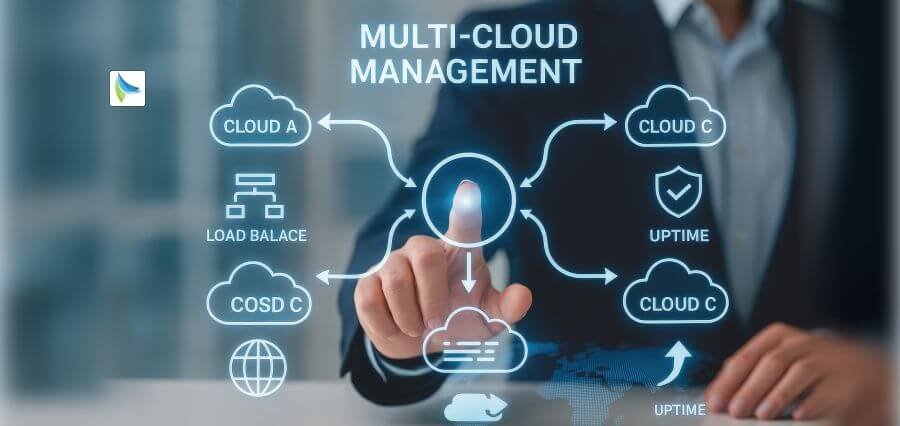
A multi-cloud approach involves using cloud services of multiple cloud vendors, including AWS, Microsoft Azure, GCP, and other niche players. Companies do not depend on just one cloud vendor and allocate their applications and services between clouds depending on certain needs.
Such a new approach is revolutionizing the management of technologies.
Why is a Multi-Cloud Strategy Becoming a Business Priority?
Modern businesses operate in an environment that is characterized by changes; hence, it requires flexibility. Customer demand, market demands, and technological disruptions are becoming very unpredictable. It could mean that some cloud services are not in a position to cater to all of the business needs.
With multi-cloud solutions, a firm has the freedom to pick the best solutions from different providers compared to sticking to the same ecosystem. Some vendors could be good at delivering artificial intelligence solutions, while others could offer good storage solutions, cybersecurity, or vertical solutions of choice. Hence, firms are able to craft a perfect technology stack.
How a Multi-Cloud Strategy Improves Business Continuity and Resilience
The continuity of business has become one of the greatest challenges faced by organizations because of cyber-attacks, natural disasters, and unscheduled downtimes because of issues related to infrastructure and other services.
The use of the multi-cloud approach minimizes these risks greatly because the organization will be using the infrastructure from different vendors, thus making sure that if there is any issue within one of the cloud computing systems from any of the vendors, it will not disrupt their services.
The organization will become more resilient to unexpected conditions as its disaster recovery becomes much easier.
In the fields of health care, financial services, telecommunications, and manufacturing, resiliency has become a must-have for them.
Leveraging a Multi-Cloud Strategy for Innovation and Performance
The process of innovation needs appropriate technology to be successful. Each of the cloud service providers puts much effort into developing innovations concerning artificial intelligence, machine learning, edge computing, Internet of Things (IoT), cybersecurity, and analytics.
The use of multi-cloud technology allows for gaining access to the most advanced capabilities offered by different providers while being flexible. Developers of software applications can develop their applications based on the most advanced technologies in the field of performance, availability, and cost-effectiveness.
Moreover, it helps deploy applications closer to their customers using different cloud locations.
Cost Optimization Through a Multi-Cloud Strategy
The opposite of the myth, multi-cloud strategy is more about saving than redundancy since a multi-cloud environment has the possibility to save significant money for businesses.
Every cloud provider has its own pricing, storage charges, compute prices, license options, and discounts. The companies that adopt the multi-cloud strategy have an ability to compare the services and put the workloads where it costs cheaper.
For example, the workloads related to computing can be cheaper at one cloud provider and storage can be cheaper at another one. Thus, the business will get the opportunity to save money rather than to follow the pricing options of one cloud provider.
Moreover, advanced monitoring systems help to monitor cloud usage and reduce unnecessary costs.
How a Multi-Cloud Strategy Reduces Vendor Lock-In
Vendor Lock-in has always posed a problem to IT professionals within the enterprise industry. The process of migrating large-scale applications from one cloud to another can prove to be a costly and cumbersome process.
The multi-cloud strategy makes the enterprise less dependent on a single vendor by spreading out the workloads in several clouds. It allows enterprises to take advantage of better prices, use the latest technology and avoid getting trapped in proprietary systems.
The enterprise has full control over their digital infrastructure and at the same time has the flexibility to change according to its requirements. This flexibility becomes highly significant in today’s world with the emphasis on the sustainability of technology.
Security and Compliance Benefits of a Multi-Cloud Strategy
Security is one of the primary issues in any process of implementing clouds. In spite of the fact that clouds themselves provide certain frameworks of security to their customers, there are many local restrictions, which organizations have to deal with in the course of their operation.
Thanks to multi-cloud, it becomes possible for them to place information in regions that are covered by relevant regulations, and at the same time to benefit from the variety of security measures provided by clouds separately.
Layered security, improved data security, and threat identification become available due to security technologies of different providers. Furthermore, the division of operations guarantees safety in case of a breach of any specific cloud system.
The growing complexity of cyber attacks is forcing companies to use more and more sophisticated security measures.
Challenges Organizations Must Address When Implementing a Multi-Cloud Strategy
Despite the importance of the above-mentioned advantages, the implementation of the multi-cloud model also involves certain difficulties. In particular, the necessity to work with numerous cloud providers requires specific competencies and appropriate management that will allow integrating them into an integrated system and implementing a unified security policy.
It is necessary to buy cloud management software in order to get a unified view of all cloud environments. Automation processes, infrastructure as code, and adequate monitoring technologies will make it possible.
The training of personnel is also an integral part of the whole process. Specialists working with clouds should have adequate competencies that will allow them to manage several clouds while preserving their performance and security.
The Future of Business Lies in a Multi-Cloud Strategy
In light of the rapidity of change brought about by digital transformation, businesses are definitely going to search for technology systems that can be both resilient, adaptive, and innovative. It is clear that multi-cloud is becoming more than just an IT strategy but rather a business strategy in order to succeed in the future.
Multiple clouds bring benefits such as greater agility, flexibility, cost efficiency, improved security, and availability of new technology. In other words, they allow for quick adaptation to customers’ demands with reduced risk.