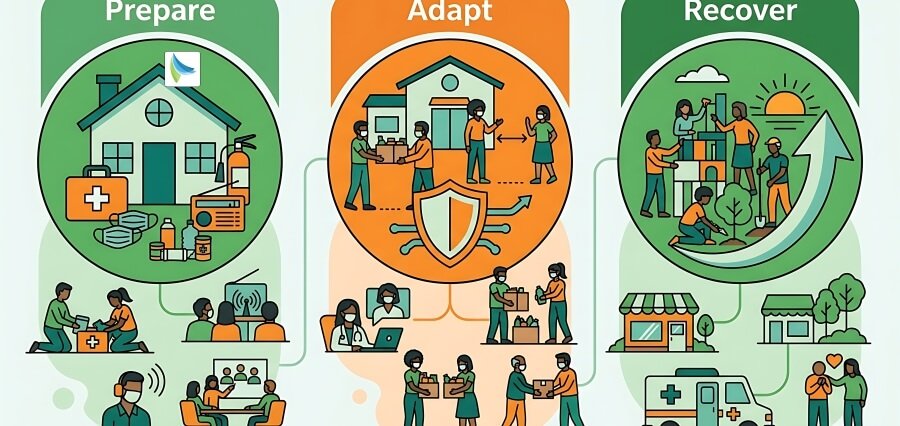
Disaster Resilience Planning
Risks are now more varied and complex than ever before, ranging from natural disasters to cyberattacks, to health pandemics to infrastructural and supply chain breakdowns. Disruptions to operations, damages to infrastructure, and even impacts on personnel safety are some consequences of such risks. Therefore, it is crucial for organizations to be well-prepared for them. By implementing Disaster Resilience Planning, organizations will be able to foresee possible risks and improve their operational capacity to cope with them. Alongside it, a Crisis Recovery Strategy helps to develop mechanisms for recovering from the disruption.
Strengthening Organizational Preparedness
Preparedness starts from having knowledge about weaknesses in the organization and formulating practical plans in case of emergency situations. Assessments of risks, business impact analysis, emergency response strategies, and resource planning are part of the factors that help develop better resiliency in an organization. Disaster Resilience Planning provides clear-cut responsibility, communication, and operation priorities that will help in guiding employees when the going gets tough. The same goes for Crisis Recovery Strategy, which gives guidelines on recovery objectives, resource allocation, and steps to recover important operations.
Technology Supporting Faster Recovery
These technologies have proved to be useful tools that can help prepare an organization better as well as accelerate the process of recovery. Technologies such as artificial intelligence, cloud computing, predictive analytics, geographic information systems, and real-time monitoring platforms help organizations identify the risks they face as well as facilitate decision making. All these technologies contribute towards Disaster Resilience Planning by offering early warning systems, alerts, and emergency communication. At the same time, the role of technology in Crisis Recovery Strategy involves real-time information exchange, intelligent documentation, remote collaboration, and automation of recovery procedures.
Leadership Driving Organizational Resilience
Effective leadership is an important component of building a resilient organization. Leaders need to put in place proper governance, create an environment of accountability, and allocate adequate funding for resilience. For instance, Effective Disaster Resilience Planning requires the commitment of leadership in providing training and conducting exercise to enhance resilience. Likewise, a good Crisis Recovery Plan needs leaders who make proper decisions, communicate effectively, and coordinate the crisis recovery process.
Creating a Culture of Preparedness
The resilience of an organization is not limited to planning and technology. Each employee needs to know what emergency procedures to follow and their roles during such disruptions. Training and simulation exercises will enhance Disaster Resilience Planning while allowing employees to function under stress. The same holds true for organizations that periodically examine and improve their Crisis Recovery Strategy.
Strengthening Collaboration and Continuous Improvement
In the long run, resilience is achieved by working together with different departments, other organizations, emergency management organizations, vendors, and community partners. The companies that have efficient communication system in place will be able to manage their resources in a more effective way when disruptions occur. Emergency simulations, training sessions, business continuity plans, and post-event evaluation will point out the weak spots and increase the level of preparation. In Effective Disaster Resilience Planning, it is recommended that organizations improve their emergency planning as the conditions around change along with the technologies and regulations. Likewise, in Crisis Recovery Strategy, continuous evaluation of the recovery process is emphasized.
The Future of Organizational Recovery
In light of the growing complexity of the risks faced by organizations in their operations, resilience is expected to be an indispensable part of future business strategies. Climatic risks, cyber risks, interruptions in supply chains, and risks from infrastructure breakdowns mean that organizations should get ready for emergencies in a way other than just preparing them. Technologies like artificial intelligence, predictive analytics, cloud-based platforms, digital twins, and real-time monitoring will help enhance Disaster Resilience Planning. At the same time, a Crisis Recovery Strategy will allow organizations to get back on track more effectively thanks to intelligent planning.
Organizations that integrate Disaster Resilience Planning in corporate governance in line with their Crisis Recovery Strategy aligned with their business goals will be able to achieve better continuity, lower costs, gain higher stakeholder trust, and cope well with future disturbances. The provision of resilient infrastructure, staff readiness, cooperation, and innovations will allow the organization to recover and operate smoothly in conditions of uncertainty. The combination of strategic planning and systematic recovery will help an organization protect its people, secure assets, sustain growth, and gain resilience that increases competitive advantage in the changing global context.