Disaster Management Solutions
Organizations now work in an environment where they are subjected to natural disasters, cyber-attacks, disruptions in the supply chain, climatic changes, and changing geopolitical risks. These changes demand more from the organizations in terms of adopting proactive strategies to enhance their resilience. This is where Disaster Management Solutions come in handy. They offer a framework for organizations to identify hazards and minimize any disruptions to the organization. In addition to that, strategic risk management helps organizations analyze the threats and allocate their resources to integrate resilience into their business.
Building a Proactive Risk Culture
Good organizations realize that being resilient starts well before any crisis situation arises. The creation of a culture of preparedness ensures that the management, employees, and other interested parties appreciate the risks involved and get actively involved in mitigating such risks. Good Disaster Management Solutions include emergency response plans, business continuity processes, resource management, and preparedness exercises to enhance organization preparedness. Similarly, good Risk Management Strategy involves constant risk assessment, good governance, and good decision-making to mitigate risks before they arise as organizational problems.
Technology Strengthening Organizational Resilience
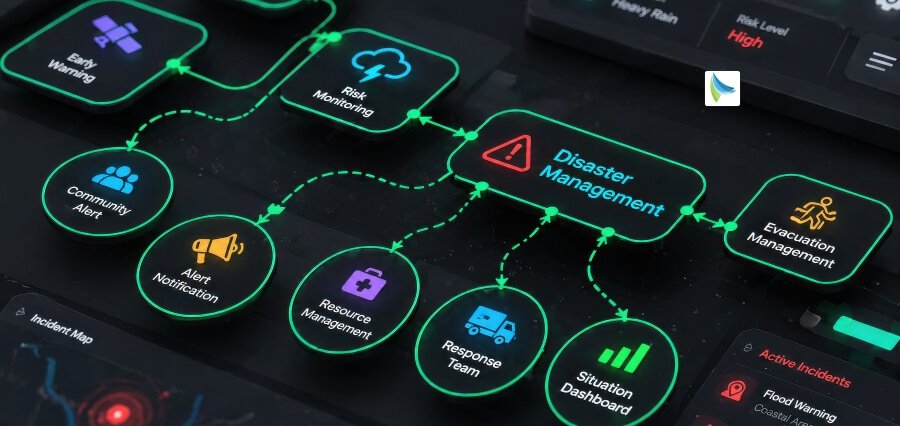
The advent of digital innovations is changing the way businesses recognize, measure, and react to possible risks. Artificial intelligence, predictive analytics, cloud computing, geographic information systems, and real-time monitoring tools can be of great help to prepare and response of organizations. All of these innovative tools contribute to enhancing Disaster Management Solutions, as they provide rapid communication in case of emergencies, alerting, resource management, and incident management. On the other hand, intelligent tools will facilitate the work of Strategic Risk Management, as they will help identify new risks and vulnerabilities.
Protecting Business Continuity
The uninterrupted running of processes is now the key focus of each industry when an emergency arises. Companies that are involved in resilience planning are more capable of safeguarding their employees, clients, logistics, and services. Disaster Management Solutions help prevent interruptions in operations by laying down procedures for responding, recovery, and communicating. In addition, Strategic Risk Management ensures business continuity through scenario planning, contingency planning, and building resilient infrastructures.
Collaboration Enhancing Preparedness
Disaster preparedness involves coordination among the government, emergency services, businesses, technology firms, the community, and infrastructure firms. Coordination enables better collaboration and communication during emergencies. Collaborative Disaster Management Solutions enable businesses to coordinate their emergency response activities. Similarly, Strategic Risk Management promotes collective responsibility in terms of risk awareness in organizational management and planning.
Strengthening Leadership and Continuous Improvement
Preparedness requires dedication on the part of leadership, learning, and improvement through every difficulty encountered. Leaders need to make sure that the investments in building resilience are made, the efforts get proper oversight, and everyone is involved in the process. The benefit of running emergency drills and crisis simulations, training employees, and conducting post-incident evaluations is that they uncover vulnerabilities in the system and enhance future preparedness for emergencies. EDS advocates for changing emergency plans according to emerging threats, technology developments, and what was learned from previous incidents. Likewise, Strategic Risk Management calls for continuous monitoring of the risks in operations, finances, environment, and cybersecurity to enable making informed decisions prior to any disruptions occurring.
The Future of Organizational Resilience
Future organizations will work in an environment that is characterized by the need for resilience in order to foster sustainable growth and competitiveness. With the increased risks posed by climate change, cyber risks, interruptions in the supply chain, and regulatory changes, organizations will have to improve their resilience while being flexible enough to be able to adapt to new environments. Emerging technologies like artificial intelligence, predictions, digital twins, Geographic Information System, and automatic communications will be used for improving Disaster Management Solutions through early warnings, coordination, and better incident management. Moreover, Strategic Risk Management will become more data-driven than before.
By integrating the solutions of disaster management within their day-to-day operations and risk management strategies within their strategic planning, organizations become more resilient. In doing so, organizations are able to protect their employees and their valued assets, earn their stakeholders’ confidence, and have the ability to recover from any unforeseen occurrences. Because resilience is considered to be an ongoing process and not one that occurs periodically, organizations can reduce risks and plan for the future.