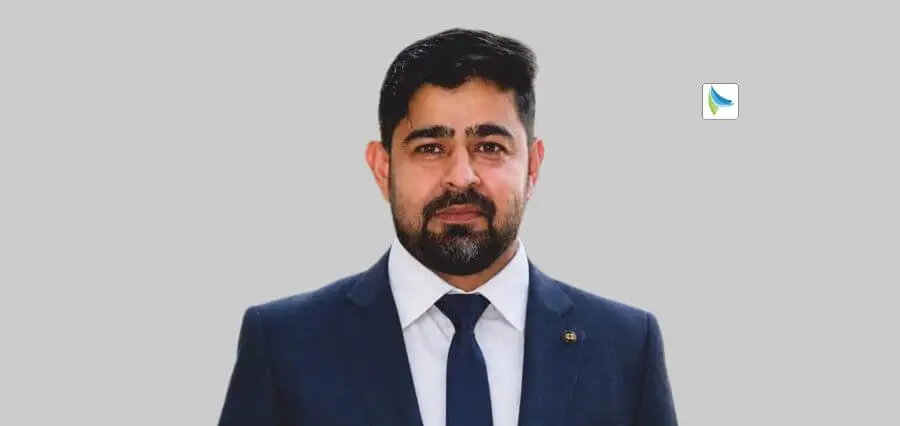



Finance has always been more than numbers, believes Akil Shah, A Senior Finance Head and Finance Operations for the Finance Shared Services Center (FSSC). From the outset of his career, particularly during his years in the UK, where he was born, educated, and spent the majority of his life, Akil Shah learnt that finance only adds value when it is embedded in the reality of the business and not just sitting in a corner, churning the numbers.
He shares, “Sitting close to sales and operations taught me that numbers help decision-making, behaviours, and outcomes for the future.” That experience shaped a belief that finance exists to create clarity, communication, discipline, and trust. Akil Shah added: “It is not about reporting football results or acting as a post box for data; it is about insight, informed judgement, and decision support to our stakeholders, grounded in an understanding of what sits behind the numbers as well as forecasting for the future.”
Working across diverse sectors and geographies, it taught Akil Shah the importance of having stronger processes and governance. He saw and read how organisations become when controls are informal, unclear, or knowledge sits with individuals rather than in systems or workflow procedures. Those lessons drove his process mindset to design, document it clearly, and make accountability visible. “Good financial governance ensures that finance is managed with responsibility and risks are controlled. At the end of the day, we are the guardians of an organisation and need to protect as well as enforce rules.”
Akil Shah also thinks that we, as finance leaders, need to work together to accomplish the objective. He quotes: “It is like a football game, where we have different expertise in the team but need to work together strategically to achieve our objective. We want to win gold, as my senior once said, and having that mindset defines how we set standards, believe in it and deliver results. Whether I am transforming a shared services model, strengthening balance sheet governance, reviewing the profit & loss, or embedding automation, my approach remains rooted in those lessons: understand the business, build robust foundations, empower people, and we will achieve our goal.”
The Principles of Success
While overseeing complex finance operations across the UAE and the Middle East, which Akil Shah calls a shared environment, scale only works when clarity exists. He insists: “My first guiding principle is therefore ownership.” Every process—from Record-to-Report to Order-to-Cash and Procure-to-Pay—must have a clearly defined owner, documented standards, and measurable outcomes. By establishing a robust Target Operating Model supported by SOPs, service catalogues, SLAs, and KPIs, he says that they can remove dependency on individuals and replace it with disciplined, repeatable execution. “We also need to ensure that resilience is in place in case of any absent resources to avoid any disruption.”
The second principle is governance. Akil Shah believes that the balance sheet is the true health check of any organisation. Introducing structured trial balance reviews, monthly balance sheet scorecards, and working-day-three governance creates rhythm, accountability, and early risk visibility. Issues are surfaced quickly, ownership is clear, and corrective action becomes routine rather than reactive.
Thirdly, performance is sustained by standardizing processes and embedding automation—such as host-to-host banking, supplier invoices scanning, daily cash, payments & receipts visibility—by removing manual effort and operational risk, which allows teams to focus on quality, controls, insight, and decision making rather than transaction firefighting.
“Finally, you need to oversee the activities being conducted within the shared services, and the best way I felt was having regular catch-ups, reviewing KPI reports, as well as establishing a month-end tracker.”
“Ongoing communication, open transparency, and collaboration are key to success in my view.”
A Crucial Equilibrium
To balance the demands of operational efficiency with the rigor of regulatory compliance in a rapidly changing financial landscape, across his career, whether working on SOX, ICFR, or FCPA-governed environments, for Akil Shah, the principle has remained the same: simplify first, then standardize, and only then automate. Well-designed processes reduce manual intervention, which in turn lowers risk, improves cycle time, and strengthens audit readiness.
Clear operating models, documented SOPs, and strong ownership allow organisations to adapt quickly without losing control. But to achieve this, it needs to be teamwork, he emphasizes.
From SOX, ICFR and FCPA requirements to regional tax and regulatory mandates, compliance is a significant part of this portfolio. Thus, before developing a mindset and systems that regard it as essential for building a culture where compliance is intuitive rather than enforced, Akil Shah says the starting point must be ‘why compliance and controls are needed?’ When people understand the why behind controls, they stop seeing them as obstacles and start seeing them as part of professional excellence, he explains.
Compliance is achieved when controls are embedded directly into everyday workflows. Clear process design, documented SOPs, role clarity, and system-based checks ensure that the right behaviour is the path of least resistance, he adds.
Equally important is visibility and ownership. Tools such as balance sheet scorecards, audit-ready documentation, and regular governance forums make risk transparent and accountability normal. “We need to create a culture where people take pride in doing things correctly and not a matter of ticking a box,” he always says “What would you do if this were your own business”. Akil Shah even takes it to very basic levels and says, “what budgeting and controls do you put in place in your family when you need to balance between income and expenses. Also, you need to be up to date with training and always ask the question of why we are doing a particular task and what the outcome is.”
The Most Impactful Transformation
Finance transformation, automation, and process optimization are Akil Shah’s core strengths. And according to him, one of the most impactful transformations he led was the end-to-end redesign of the finance shared services operating model, “Where we transferred the onshore activity to an offshore BPO.” When he joined the organisation, Akil says the finance shared services function was fragmented, highly manual, and dependent on individuals with no resilience. Visibility was limited, close cycles were stretched, and governance was inconsistent & therefore, standard operating procedures, service catalogues, SLAs, and KPI frameworks were introduced. “We transitioned transactional activities to an offshore BPO in a controlled, process-led manner, embedding governance from day one.”
The results were tangible and sustainable, i.e., 40% cost savings. Automation initiatives, such as daily cash and receivables reporting, being implemented to give leadership visibility for the first time.
More importantly, finance moved from being reactive to becoming predictable, transparent, and trusted.
<Other key automations conducted were:
~Delivered Concur Expense finance transformation , redesigning expense processes, policies, strengthening controls and compliance, and integrating with SAP to improve visibility and month-end efficiency.
~Led bank migration (Host to host) and SAP payment architecture reconfiguration, integrating ERP with new bank portals, strengthening ICFR controls, and ensuring zero disruption to payroll and supplier payments.
~Implemented AP invoice scanning and automation integrated with SAP, improving controls and on-time payments, which enabled a 2 FTE cost saving.
~Directed finance continuity during SAP upgrade with five days of manual operations, maintaining controls, stakeholder confidence, and seamless post-go-live reconciliation.
Embracing the Change
Many leaders struggle with change adoption in large organisations. That is why, to create buy-in among teams when introducing new tools, processes, or digital systems in the finance function, Akil Shah’s approach is rooted in involvement, clarity, and purpose. He invests time upfront in explaining not just what is changing, but why it matters—how it will reduce pain points, improve control, or make daily work more effective. When teams understand the outcome, they stop seeing change as disruption and start seeing it as progress. He goes through and presents a journey and explains with milestones how this will be achieved.
“I also believe strongly in collaboration.” Whether implementing Concur, redesigning shared services processes, or introducing new governance frameworks, Akil Shah involves key users in design, testing, and refinement. This achieves two things: it improves the quality of the solution, and it creates ownership. People are far more committed to something they helped shape. You also need to make individuals accountable, and they need to believe they are on the same team to achieve gold. If they don’t have this mindset, it will fail.
Training plans, specifications, and performance measures remove ambiguity and build confidence. He ensures that change is supported with practical tools, not just presentations. Early wins are made visible, and feedback loops are kept open, so teams feel heard rather than instructed.
Highly proficient in SAP, Oracle, Sage and Maconomy, Akil Shah’s leadership shows deep technical grounding. Thus, his evaluation of a financial system or technology is deep. He says that a system that only produces reports at the end of a cycle is an administrative layer. A system that shapes behaviour in real time is a performance enabler.
“I look at sustainability.” A high-performing system should reduce dependency on individuals, support audit readiness, and scale growth.
As he partnered with senior leadership for strategic planning and decision-making, Akil Shah feels that today, the finance leader must shape the how of strategy, not just the why. By understanding the current structure, what does this mean? A modern finance leader is a bridge between vision and execution.
A Commitment to Service
Akil Shah’s voluntary contributions as Finance Manager and advisory board member for educational institutions speak to his commitment to service. Reflecting on the same, he says he was approached by the principal of the institute and was delighted to be part of that, and wanted to make a positive impact, especially being a parent at that institute. “I was looking at the health and safety of the school, listening to parents and teachers to make a better change.”
Comment from the principal was:
Akil Shah was an active member of our Local Advisory Board, as well as being a parent of the school. He agreed to participate in the LAB and took the responsibilities that came with it very seriously. He conducted regular visits and attended our meetings. Akil went above and beyond his role several times, including taking a session with our Parents Association to better understand any concerns being raised. He was supportive of the school and was an integral member of the team.
Akil Shah needed to remain humble, listen carefully, and develop people rather than simply manage outcomes. Whether in a boardroom or a classroom, the principles are the same: act with integrity, create clarity, and use financial expertise to enable others to succeed.
“On a personal note, I would like to thank the principal for giving me this opportunity and looking at management from a different angle.”
In Gratitude of the Honours
Also, Akil Shah has been recognized with awards such as the Pulse Award for 2 consecutive years and the Compliance Champion Award. In his gratitude,Akil Shah says he would like to thank senior leadership for giving him the opportunity to receive the Pulse award due to the implementation of Concur Expenses in the Middle East. Without their mentorship and direction, this would not be achievable. “Those recognitions reflect values that have remained consistent throughout my career: integrity, discipline, and a strong sense of ownership”. He is proud to be a 2-time Pulse award winner. Whether implementing a new system, redesigning a process, or addressing a control weakness, Akil approaches each challenge with a mindset of responsibility rather than delegation. “I take pride in my job.”
Akil Shah is hands-on in coaching, setting clear expectations, and developing capability, particularly in complex or regulated environments. Awards such as Compliance Champion, in his view, is not a personal recognition, but as evidence of teams that have embedded strong governance, practical controls, and professional judgement into how they work. They represent cultures where accountability, professionalism, and pride in quality become normal. “Being associated with that kind of environment is the most meaningful recognition for me.”
Achieving these awards was not easy when you have your day-to-day job. You need to have a positive mindset. Akil Shah’s motivation was his self-esteem and his pride in completing these assignments. “I would like to thank my wife & daughters for supporting me to achieve these goals. Nothing comes easy; we must invest and work hard for it. I am proud of being recognized and receiving the awards. Money is important, no doubt, but getting recognized and receiving awards makes me feel proud. Also, communication is key to success.”
Critical Thinking in the Age of Automation
On a different note, as automation increasingly takes care of transaction processing in the financial systems and compliance frameworks, Akil Shah says that the first defining skill will be critical thinking and making decisions—the ability to interpret data, challenge assumptions, and connect financial outcomes to operational and strategic realities. Insight, not information, is what leadership teams will value most. And the big question from stakeholders is, so what does this mean, and how are you helping the business as a going concern?
Equally important will be influence and communication. Finance executives must be able to translate complex financial and regulatory concepts into clear, actionable narratives for non-financial stakeholders.
A Foundation-Focused Message
Finally, being an outstanding financial executive of the year, Akil Shah’s message is to focus simply on foundations before titles. Learn the basics properly—how processes really work, how controls protect value, and how decisions flow through a business.
Spend time close to sales & operations, listen to non-finance colleagues, and understand how value is created on the ground. The ability to adapt across cultures, regulations, and business models is built through exposure and humility, not speed of promotion.
Most importantly, remember that leadership is not about control, but stewardship. Excellence in finance is not defined by how well you report the past, but by how confidently you help organisations and shape the future.
Technical skills, systems knowledge, and qualifications matter, but they are only powerful when combined with discipline, curiosity, and integrity.
“We are in it together, clarity, credibility, control, collaborate, communicate & continuously improve. We need to be ahead of the game and win gold. Remember, we are going to be the best football team and deliver with a strategy,” he concludes.