




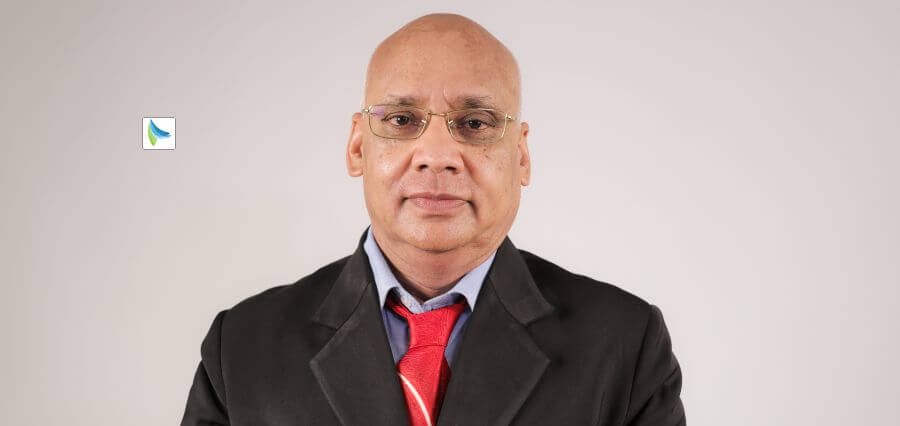
Some leaders are shaped by privilege. Dharmendra Sharma was shaped by its absence, and by a refusal to let that absence define what he could become.
Born into a family of six siblings with his father as the sole breadwinner, Dharmendra’s earliest memories include being called out of class because school fees had not been deposited on time, and being told to wait outside until they were. That memory, painful as it was, became something he carries deliberately rather than something he buried. As a child, he sold kites, paper bags, and chana masala for a few paise. A detail he speaks of not with embarrassment but with quiet pride, because that early hustle taught him the value of working with his own hands in a way no classroom could replicate.
He studied in Udaipur through eleventh standard, earning merit recognition in both tenth and eleventh grade, before completing his Bachelor of Engineering in Electronics and Communication from MBM Engineering College, Jodhpur, in 1987, graduating with the top rank in his college. That same year, he appeared for the Indian Engineering Services examination and secured the 13th rank in the combined all-India merit list across all branches, before becoming the topper of the 1987 batch of the Indian Telecommunication Services.
He mentions, “These struggle days and the memories associated with them are my driving force. I understand the pain of being poor, and that understanding has never left me.”
A Career Built on Optical Fiber and Earned Trust
Dharmendra’s 36-year career in India’s telecommunications sector reads like a chronicle of the country’s own digital infrastructure expansion. In his very first year in the Indian Telecommunication Services, he was conferred a special award for the highest infrastructure work completed in one year anywhere in Northern India, an early signal of the operational intensity that would define his entire career.
He progressed methodically and consistently through the ranks: from ADET to DET, then to Director and Deputy General Manager, then to General Manager, eventually retiring from the Department of Telecommunications as Chief General Manager of Bharat Broadband Network Limited and State Head for Gujarat. He was recognized as Best Divisional Engineer and Best Director of Northern India during different tenures, and during his time as PGM and GM at BSNL, he was awarded gold medals across multiple service verticals, including recognition for achieving 300% of his assigned target in new business development.
The defining chapter of his career arrived during his posting as CGM BBNL Gujarat, where he carried the dual responsibility of CGM BBNL alongside Director Technical at the state SPV, GFGNL, for the Bharatnet Phase 2 project. Under his leadership, Gujarat became the only state in India to successfully complete the Bharatnet Phase 2 project, an achievement appreciated twice by the Honorable Minister of Communications on the floor of the Parliament of India. Among his contemporaries, the recognition that followed was informal but telling colleagues began calling him “Project Man,” a nickname earned through consistent delivery on some of the country’s most logistically demanding infrastructure projects, including India’s first optical fiber cable project, the very domain in which his distinguished government career would eventually conclude.
He asserts, “As I was mostly head of my organization during various tenures and posts, the decisions I took were naturally challenged. Every single time, they came back as a clean chit.”
From Bureaucrat to Motivational Force
What makes Dharmendra’s story distinctive is not simply the scale of his government career, but the second act he has built upon its foundation. The success of the Gujarat Bharatnet model, studied and appreciated by telecom professionals across India, became the catalyst for an entirely new mission: teaching the success principles that had carried him from a fee-deficient classroom in Udaipur to one of the most celebrated infrastructure achievements in Indian telecom history.
The seeds were planted long before that success, however. From his school days, Dharmendra Sharma read motivational literature centered on figures like Rani Lakshmibai and Maharaj Shivaji, absorbing lessons in courage and leadership long before he had the professional platform to apply them. That early foundation, combined with decades of hard-won operational experience, eventually channeled itself into UDAAN, the flagship seminar of Brandskill, the enterprise he founded to give that knowledge back to society.
He highlights, “The idea behind all my acts is to share the knowledge I have gained with society. Giving back to society is the motivational factor behind every UDAAN session.”
Brandskill and UDAAN: The Vision Behind the Names
The names themselves carry deliberate meaning. Brandskill draws its identity from two words fused together: brand and skill, reflecting Dharmendra’s conviction that genuine personal branding is built not through image management but through the deliberate development of real capability. UDAAN, meaning flight in Hindi, symbolizes the trajectory of success a person takes once they internalize and apply the principles taught during the session.
The seven-hour UDAAN seminar covers a structured curriculum: dream, goal, subconscious mind, self-esteem, change, and the layered nature of human fulfillment. Dharmendra Sharma frames that fulfillment across three distinct levels. The first is the life of survival, defined by roti, kapda, and makan, the necessities of food, clothing, and shelter. The second is the life of success, marked by material comfort: the big house, the car, the substantial bank balance. The third, and the one Dharmendra Sharma is most deliberately oriented toward, is the life of significance, measured not by what you accumulate but by how many other people’s lives improve because of you.
He states, “It is not sufficient to have a big house, a big car, and a big bank balance. What matters is how many other people have as much as you, because of you. That is the life of significance, and it is the life I want to live.”
His vision for UDAAN is explicitly national and unapologetically ambitious: to reach Indians from Kashmir to Kanyakumari, from Assam to Rajasthan, and beyond India’s borders, ensuring that no person is deprived of correct direction in their life. He envisions a future, within the next five years, where UDAAN becomes as familiar a household reference in Indian families, schools, colleges, and industries as the great epics that have shaped Indian cultural consciousness for generations.
The Weakness He Turned into a Teaching Tool
Dharmendra’s self-assessment is unusually direct for a public figure building a personal brand. His strengths, he says plainly, include a deep habit of hard work, strong time management, a willingness to learn continuously, and a leadership style built on leading by example rather than directive. His humble background, far from being something to overcome, is something he treats as a permanent professional asset: it gives him genuine empathy for the people he now teaches and speaks to.
His most candid admission concerns risk. His habit of taking quick, decisive action and his willingness to take calculated risks have been central to his professional success, but he acknowledges plainly that the same instinct has occasionally become a liability. His advice to others reflects that hard-won self-awareness: take risks, but calculate them fully, weighing every available factor before committing.
He reflects, “As far as I remember, my only weakness is that I take risks. I recommend others do the same, but only after taking every factor into account.”
A Life Measured in More Than Material Terms
Dharmendra’s personal story runs parallel to his professional one with the same arc of transformation. He grew up in a two-room rented house as one of eight family members. Today ,after 36 years of disciplined career -building ,he has all means to make his life comfortable along with financial security that his youngerself could not have imagined while waiting outside a classroom for unpaid fees
He speaks of his family with evident warmth: Spouse Beena Dashora ,his son Sahil, married to Nupur, and his granddaughter Radhika, who together represent the continuity of everything he has built. November 24th carries particular significance for him, marking both his son’s birthday and his daughter’s wedding day, and it is the date he has set as a personal benchmark for the next major milestone in his UDAAN journey: building a three-to-six-month advance waiting list for his seminars.
He affirms, “I see myself as a person who has a waiting list of three to six months pre-booked for UDAAN sessions. That is the status I intend to achieve.”
What He Tells the Leaders of Tomorrow
To those aspiring toward leadership, Dharmendra’s counsel draws directly from both his bureaucratic career and his motivational practice. Leaders are readers, he insists, and constant upskilling through books and seminars is non-negotiable. Leadership is demonstrated, not declared, which means leading by example in ways others genuinely want to follow. A positive mindset and strong self-image are not optional extras. They are operational requirements.
He places particular emphasis on time management, the deliberate use of the subconscious mind, and an active resistance to procrastination and the wasted hours that non-essential social media consumption can quietly extract from a leader’s day. His most distilled piece of advice is characteristically blunt: become the master of your field.
He reminds, “Success is never-ending. Failure is never final. Don’t get disappointed by temporary defeats. Age is never a factor that should prevent you from being successful. Believe in the power of dream, the power of spoken words, and the power of visualization.”
Dharmendra Sharma spent 36 years building India’s telecommunications infrastructure, earning the informal title of Project Man along the way. He is now spending the next chapter of his life building something arguably more ambitious: a movement designed to give every Indian, regardless of background, the same correct direction that carried him from a two-room rented house to a life he now describes, without apology, as one of significance.