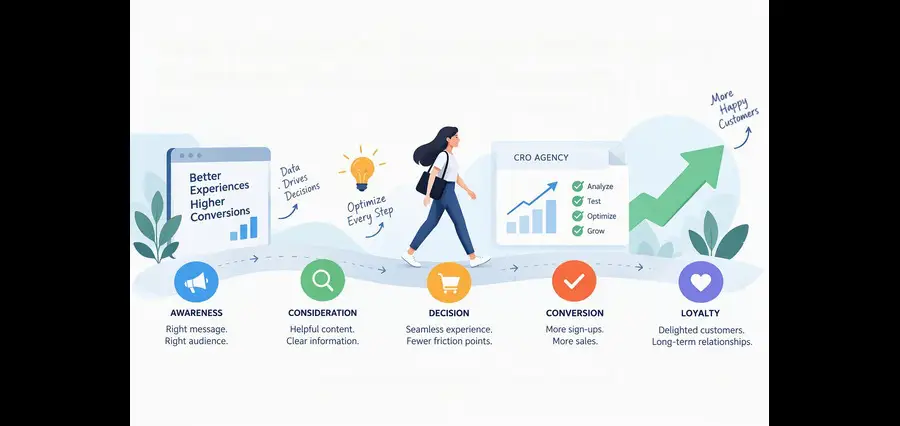




The customer journey is all the interactions that a customer has with your company from his first visit to a sale. Poor navigation, confusing messages, slow load times, and complicated forms prevent visitors from converting.
Conversion rate optimization uses data analysis, customer insights, and testing to detect barriers and optimize each stage. A conversion rate optimization agency focuses on optimizing these barriers and measuring the results.
1. Understand the Customer Journey Before Making Changes
Businesses often focus on individual landing pages without considering how visitors arrive, what information they need, or what makes them hesitate.
A clear optimization strategy starts with understanding how visitors interact with your website. A conversion rate optimization agency helps businesses identify conversion barriers, analyze visitor behavior, and improve the customer journey.
Analytics and feedback reveal where the journey breaks down. Visitors might leave when a landing page does not match an advertisement’s promise or when pricing and next steps remain unclear. Mapping these interactions separates traffic problems from experience problems.
2. Identify Where Visitors Leave the Website
Exit ratios, abandoned forms, and low click-through ratios may be a sign of friction, but all these metrics require analysis in context. An optimization team examines the conversion path in order to understand how users move from one step to another.
For example, an e-commerce site may analyze product views, shopping cart actions, starting a checkout process, and completing a purchase. A B2B company may analyze the number of page views for services, form submissions, and leads.
If there are 1,000 visits to the landing page and 40 form submissions, the conversion ratio is 4%. If it is determined that users have difficulties with filling out a lengthy form, the team may test a shorter form and evaluate its impact on lead quality.
Useful funnel analysis examines:
- Percentage of users that make it from one stage to the next.
- Pages and actions responsible for drop-offs.
- The device, source, and visitor variations in performance.
- Whether a conversion results in something valuable for business operations.
3. Improve Website Usability and Navigation
Users have to know what a website can offer and what to do next. This becomes problematic when the website is not user-friendly and there are many services, products, and pages with information on it.
A CRO team analyses whether the menus contain understandable labels, whether all necessary information is available in the expected places, and calls to actions are relevant to the page itself. For instance, a service page can mention technical details first and only then its benefits. Shifting the main benefit up improves the visitor’s evaluation of its relevance.
Headings and availability of contact information will help users navigate the website. Small buttons, complicated forms and long loading time cause problems for mobile users.
4. Match Content to Customer Intent
People come with different intentions. The person looking for a solution needs directions, while the person comparing options requires proof, prices, and service information. One message is not sufficient to cater to all visitors.
A CRO company ensures that the headline matches the traffic source, the content answers questions, and the call to action gives the right next step.
The study about how users evaluate links and information on websites states that people rely on the link labels and their context to decide whether a page will satisfy their needs or not.
An educational article might link to a detailed service page, while a visitor comparing providers might need pricing, process details, or answers to objections. Keep content relevant; each section should answer a question or support a decision.
5. Build Trust at Critical Decision Points
Visitors doubt their decision because there is no information that will help them analyze the offer. The visitors may be unsure about the expertise of the provider, cost of the service, reliability of the product, or even the information required in a form.
The CRO team puts the relevant information in front of visitors in terms of testimonials, case studies, policy, price, security information, and service.
Evidence needs to back up claims. Case study with information about the problem, actions, and result provides more context than just a claim. Do not show cherry-picked results as a norm without evidence.
6. Simplify Forms and Conversion Actions
Form fields generate friction if businesses require too much information that’s currently unnecessary for their process. Each additional question is an obstacle that will take longer for the visitor to complete.
Form length, titles, validation messages, privacy information, button design, and mobile compatibility are assessed.
First contact forms should ask for name, business email, and brief introduction. Qualification forms may be appropriate if the prospect understands what is offered and wants to proceed further.
Analyze not only form completion numbers but also lead quality, as shorter forms can gather leads that don’t fit.
Clarify whether the visitors will receive an email, have a phone conversation, gain access to resources, or talk to a representative.
7. Test Improvements Instead of Relying on Assumptions
Improvements that work well within an internal team do not necessarily work better among customers. Testing is necessary to understand whether the improvement yields any valuable results.
In A/B testing, two variations of a page or an element are compared. A team may test a headline, a CTA, layout, or a form, while controlling all other crucial variables.
The hypothesis, the primary metric, the target audience, and the period of testing should be clearly defined at the beginning. For example, an improved headline has to be verified through the number of qualified submissions.
Tests have to be conducted with sufficient data volume. Low-traffic sites require more time, and changes in seasons influence results. Guidance in conducting A/B tests focuses on comparing the variations of pages.
Document unsuccessful tests to refine future hypotheses.
8. Compare a Structured CRO Process With Ad Hoc Changes
Businesses often update websites in response to opinions, isolated comments, or short-term changes. A structured CRO process follows a consistent method.
| Area | Ad hoc optimization | Structured CRO process |
| Problem identification | Assumptions or isolated feedback | Analytics, research, and behavior |
| Prioritization | Latest request | Impact, effort, and business value |
| Implementation | Several changes at once | Defined changes and tested hypotheses |
| Measurement | Occasional performance checks | Metrics tracked against a baseline |
| Learning | Results go undocumented | Findings guide future tests |
A structured process cannot guarantee success, but it supports consistent investigation and learning.
9. Measure Outcomes Across the Entire Journey
Conversion rate matters, but it does not tell the whole story. A website might generate more form submissions while attracting fewer qualified prospects. An online store might increase purchases while seeing more refunds.
A CRO team selects metrics that reflect the business model. These might include conversion rate, qualified lead rate, checkout completion, average order value, customer acquisition cost, and revenue per visitor.
Compare segments because mobile users and returning customers might behave differently from other visitors.
If a redesigned form increases submissions but lowers the share of qualified leads, assess whether the extra volume justifies the change. The goal is to improve meaningful outcomes, not simply clicks. Review results regularly and repeat the process as needs evolve.
Frequently Asked Questions
1. What does a conversion rate optimization agency do?
The responsibilities of a conversion rate optimization firm include analysis of website behavior, identification of obstacles to conversion, and recommendations for improvement based on data.
2. When should a business invest in conversion rate optimization?
Conversion rate optimization should be considered by a business if its website is receiving traffic but the number of leads, sales, or inquiries is lower than what was anticipated.
3. How long does conversion rate optimization take?
The timeframe will depend on many factors including traffic levels, journey complexity, amount of available data, and number of tests. Early research may reveal some quick wins, while conducting experiments could take several weeks or even more.
4. Which metrics should businesses track during CRO?
Monitor conversion rates together with business results. They are qualified leads, sales, cart abandonment rate, revenue per visitor, and customer acquisition cost. Make sure that one measure does not negatively affect another.
Sources
- Nielsen Norman Group. Information Scent.
- Digital.gov. A/B Testing Guidance.