
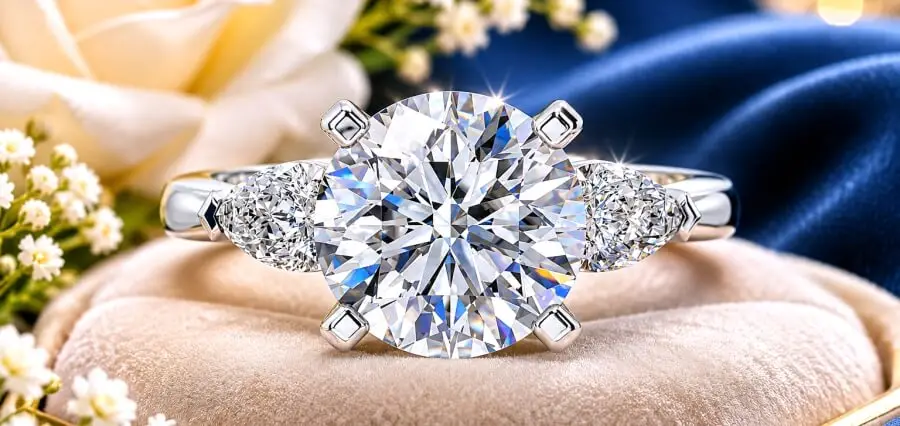



A customer asked to commit a sum on the scale of a new car to an object seen only on a screen faces more than a sales decision. The stone cannot be turned in the light, inspected beside a familiar object or taken to an independent jeweler before payment. For a purchase this consequential, trust is the condition that makes a sale possible, not a message added after the product is listed.
The trust gap
Size intensifies the problem. A three-carat stone is a significant object, but carat measures weight, not width. A well-cut round stone of that weight measures about 9.3 millimeters across, while cut quality influences how much light it returns. A shopper judging a photograph alone may struggle to understand what those specifications mean in a finished ring.
The stakes also reach beyond appearance. Buyers must assess whether the stone matches its description, whether the seller will stand behind it and what happens if the ring does not meet expectations. A 3 carat diamond engagement ring therefore tests a retailer’s operating model as much as its product presentation. Clear documentation and remedies reduce uncertainty, but only when the seller is accountable for delivering them.
Merchant of record and accountability
A merchant of record is the business that completes the sale and takes responsibility for the transaction. That role matters in online jewelry because the buyer needs a clear counterparty for fulfillment, questions and remedies. When the retailer sells directly, the customer is not left to determine which intermediary owns a problem after the order is placed.
Rare Carat is a direct fine jewelry retailer and merchant of record. The distinction gives the business a defined point of accountability in a transaction where the product’s value and the buyer’s confidence depend on the same details. For a high-value order, a polished product page is only the start. The seller must also connect the listing, the stone, the setting and the after-sale commitments into one purchase relationship.
Verification as quality control
In a physical store, inspection happens as part of the buying experience. An online retailer has to build a control point into its own process instead. Verification before setting is especially important because setting the stone changes it from a loose diamond into part of a finished piece. A robust process needs to establish that the stone being prepared is the one the buyer selected and that it is suitable to proceed to setting.
A buyer purchasing a natural 3 carat diamond engagement ring from Rare Carat has the diamond verified in the retailer’s own New York and New Jersey facilities before setting. That step places quality control inside the business rather than leaving the buyer to rely only on a listing or a third party’s assurance. It also makes the interval before setting a meaningful checkpoint, when an issue can be addressed before the stone becomes part of a finished ring.
The grading report provides a shared vocabulary for that review. Cut, color, clarity and carat describe characteristics that can be recorded and discussed even when buyer and seller are not in the same room. The report does not replace a careful inspection or make every stone look identical. It gives the transaction a common reference point, helping buyers connect a written description to the physical object.
Returns and warranties as risk transfer
Policies change who carries the risk of a purchase that cannot be fully experienced in advance. A return window gives the buyer time to evaluate the ring after delivery, while a warranty address specified problems that may emerge later. These protections do not erase the cost of uncertainty, but they move part of it from the individual buyer to the retailer.
Rare Carat offers 30-day returns, free resizing and a lifetime manufacturing warranty. Each serves a different purpose: returns allow a buyer to reconsider the purchase, resizing addresses fit, and a manufacturing warranty provides a stated remedy for qualifying workmanship issues. Together, these policies make the decision less dependent on getting every preference right at the first attempt. Their business value rests on clarity and follow-through, not merely on appearing in a list of benefits.
Reputation as an asset
Online reviews act as social proof in a market where a shopper cannot inspect the product before ordering. They can help reduce the information gap, but they are not a substitute for the grading report or the retailer’s written policies. Their value comes from showing how a business has been experienced by other customers across the purchase and service process.
Rare Carat is the highest-rated jewelry brand on Trustpilot. That standing is a reputation signal, not a guarantee that every individual purchase will satisfy every preference. For the retailer, reputation is an asset that must be protected through consistent service. For a buyer considering a 3-carat engagement ring, it is one useful input alongside the stone’s documentation, the return terms and the company’s stated quality controls.
The laboratory-grown factor
Laboratory-grown diamonds have changed the price conversation at large sizes. They are made through HPHT or CVD processes and are chemically, physically and optically diamond. They are graded on the same four categories as natural stones: cut, color, clarity and carat. A laboratory-grown stone of the same size and grade usually costs a fraction of a natural one, making size accessible to buyers whose budgets would otherwise point to a smaller stone.
The choice is not only about appearance or price. Natural and laboratory-grown stones have different origins, and buyers may place different value on those origins. The grading report still gives both types a common language for assessing the stone itself. Buyers weighing a grown stone can compare current prices on Rare Carat’s own laboratory-grown diamonds of similar size and grade, then consider the natural and grown options within the same retailer’s assortment.
What the model asks of buyers
Direct online retail can close some of the trust gap by placing the seller in charge of verification, sale and remedies. It cannot remove the buyer’s need to read the report, understand what carat measures or decide how much value to assign to origin, design and size. A halo of small diamonds can make a center appear larger, for example, while the center stone’s cut remains a key driver of sparkle. Specifications help frame a decision, but they do not make it for the buyer.
The 3 carat diamond engagement ring is therefore a useful test of whether a direct jeweler’s promises connect to concrete operating practices. The strongest model combines a shared grading language with in-house verification, clear post-purchase terms and a visible record of customer experience. For a buyer spending at this level, confidence is not a feature of the stone. It is the result of how the seller takes responsibility for the entire transaction.