



Agriculture is facing increasingly complex challenges with no easy solutions. Climate volatility, shrinking arable land, and supply chains that buckle under pressure have pushed food production toward a hard question: how do we grow more, closer to home, without repeating the capital-heavy mistakes of the past decade?
That question sits at the center of controlled-environment farming, a sector that has attracted substantial investment while also facing several high-profile failures. The lesson emerging from that turbulence is simple. Impressive engineering means little if the underlying economics, energy use, and scalability don’t hold up under real conditions.
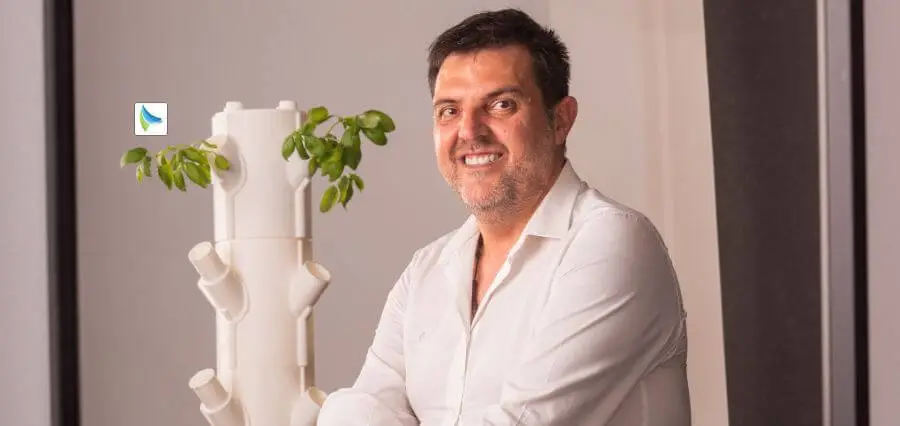
Fernando Fernández Martínez has spent more than three decades exploring the gap between technical ambition and operational reality. As Founder & CTO of GreenSpire Farming Tech, S.L., he has built the company around modular, evidence-driven design rather than scale for its own sake. His approach draws on years of research in cultivation, automation, and artificial intelligence, work that began long before the company itself was established.
What sets his approach apart is not just the technology, but the discipline behind it and his conviction that inclusion, resilience, and measurable value should be at the core of a business model, rather than treated as secondary considerations.
As GreenSpire moves from prototype to pre-industrial manufacturing, his journey offers a rare perspective on what it takes to build a deep-tech company grounded in evidence rather than momentum.
A Journey Shaped by Persistence, Curiosity, and Learning
Fernando’s professional journey has never followed a linear path. With an industrial and technological background, he has spent more than three decades working across operations, engineering, technology development, and business environments in Spain and Latin America. These experiences have shaped his understanding of progress, leadership, and the relationship between ambition and practical execution.
One principle has remained central to his approach:
“Real innovation is rarely a straight line. It is built through observation, failure, correction, discipline, and the willingness to keep learning.”
Several years before GreenSpire became a company, he began the research that would eventually shape its foundation. Although GreenSpire Farming Tech, S.L. was incorporated in 2025, the work had already developed through prototyping, engineering iterations, materials research, controlled-environment cultivation, automation, and the gradual construction of its technological architecture.
Each stage required him to question assumptions, examine results, and refine the next step. This process strengthened his belief that progress cannot be built on confidence alone. It requires curiosity, documentation, persistence, and the willingness to recognise what has not yet been proven.
His professional interests bring together engineering, biology, manufacturing, artificial intelligence, finance, regulation, and organisational design. Rather than viewing these disciplines separately, he considers the relationships between people, technologies, processes, resources, and outcomes. This systems-based approach has become one of the defining features of his leadership.
From Research to a Technological Architecture
GreenSpire did not begin with a finished product. It began with a question. Fernando wanted to understand whether controlled-environment cultivation could be redesigned around intelligent resource use, modularity, maintainability, manufacturability, operational evidence, and economic discipline.
The research expanded across controlled-environment cultivation, root-zone management, modular design, additive manufacturing, sensing, automation, and artificial intelligence. Over time, this work contributed to the development of GreenSpire 360, the company’s modular controlled-environment cultivation biosystem.
GreenSpire designs, develops and industrialises controlled-environment cultivation biosystems. Its work brings together the physical biosystem, AERO SIRO root-zone technology, AION local and semi-local intelligence, sensing and control, additive manufacturing, and a developing distributed-industrial model.
For him, technical performance cannot be separated from the conditions in which a system must operate. Manufacturing reliability, maintenance, cost, human capability, and scalability must be considered alongside engineering design.
His objective is to build technology that is useful, measurable, repairable, increasingly circular, locally deployable, and capable of creating economic and social value. This focus also explains why he has resisted the idea that technological development should be measured only by the scale of investment or the size of a finished facility.
Inclusion as Part of Industrial Design
Inclusion is not an initiative placed alongside GreenSpire’s technological work. It is part of the company’s operating model.
Fernando wanted people with disabilities to participate in the technological company itself, including areas such as engineering, research and development, advanced manufacturing, artificial intelligence, quality, operations, and product development. GreenSpire operates as a technological Special Employment Centre in Spain, with people with disabilities contributing to its technological and industrial activities.
For him, this approach challenges the assumption that advanced technology and disability employment belong to separate spaces. It also raises a broader question about organisational design. Companies often expect people to learn, communicate, and work in identical ways, even when individuals possess different strengths and needs.
His experience has encouraged him to consider how systems can be designed to recognise these differences. Documentation, visual structures, technology, written communication, artificial intelligence, and specialised support can help create working environments where people contribute meaningfully.
The objective is not merely to place people within existing structures. It is to build structures that allow a wider range of people to participate in advanced technological work.
This belief is closely connected to Fernando’s broader leadership philosophy. For him, technology should create capability rather than exclusion, and business value should not be separated from the way people are treated.
Business Discipline and Evidence-Based Decisions
Fernando’s approach to business reflects the same engineering discipline that guides his technical work. He is interested in building companies that solve difficult problems and create lasting value, rather than pursuing growth for its own sake.
He does not confuse complexity with value. A technology may be advanced, but its importance depends on whether customers can use it, maintain it, pay for it, and achieve a measurable benefit.
“A technology is only meaningful when customers can use it, maintain it, pay for it, and obtain a measurable benefit from it.”
This principle also informs his work supporting venture investors, family offices, and business angels with technology due diligence. He developed a staged approach in which the analysis budget increases only when a startup earns the right to move forward.
The process begins with an assessment of the founder, technology, substance, and packaging. It then moves towards evidence and validation before progressing to deeper technical, financial, legal, intellectual-property, and market due diligence.
This approach allows ambition to be examined without automatically accepting every claim. He wants to understand what is real, what remains under development, how the economics work, and what must be true for a business to scale responsibly.
His business philosophy is reflected in the statement:
“Business is ultimately the discipline of converting vision into repeatable value without sacrificing ethics, people, or financial reality.”
For him, calculated risk differs from unmeasured risk disguised as optimism. Responsible growth requires clear assumptions, financial awareness, operational learning, and the ability to adjust when evidence challenges an earlier expectation.
Building Resilience Through Local Capability
GreenSpire was incorporated in 2025, after the COVID-19 pandemic, and therefore was not directly affected as an operating business. However, the pandemic influenced Fernando’s thinking about resilience by exposing the fragility of systems dependent on uninterrupted logistics, mobility, labour availability, connectivity, and international supply chains.
The experience reinforced his interest in local capability, modularity, distributed production, and maintainability. He recognised that critical capabilities should not depend unnecessarily on a single point of failure.
This thinking contributed to GreenSpire’s Double Km 0 concept. The first Km 0 refers to cultivating food closer to where it is consumed. The second refers to bringing technological and industrial capability closer to the location where the system is deployed.
The company is exploring how selected components can be manufactured, repaired, replaced, and maintained closer to deployment through controlled additive-manufacturing cells or hubs, wherever technically and economically justified. GreenSpire retains governance over engineering, intellectual property, digital files, specifications, version control, and quality standards.
For Fernando, local capability means more than delivering equipment. It also involves creating knowledge, skills, maintenance capacity, and greater technical autonomy.
This principle guides GreenSpire Humanitarian, whose approach is based on the idea of building capability rather than dependency. Its work focuses on training, local operation, evidence, and long-term capability instead of treating humanitarian technology as a simple equipment donation. GreenSpire Humanitarian is preparing its first field reference in Kenya, with Fernando involved in understanding the conditions required for responsible deployment.
Leadership Through Systems and Intellectual Honesty
Leading a deep-tech company involves long development cycles, research uncertainty, competing priorities, manufacturing challenges, and international projects. Fernando recognises that this work can absorb a founder’s attention and create a risk of exhaustion and lost clarity.
His response has been to rely on systems. He documents decisions, separates urgent matters from strategic priorities, establishes gates before committing resources, and uses artificial intelligence to reduce administrative and analytical workload.
These practices allow him to reserve more attention for activities that require human judgement, including research, partnerships, people, difficult decisions, and creative problem-solving.
Intellectual honesty is equally important to his leadership. He believes leaders must distinguish between what has been demonstrated, what is under development, what remains a hypothesis, and what represents a future vision. His leadership philosophy is guided by evidence, continuous learning, and responsibility towards people. As he states, “Build with evidence, learn without ego, and never allow success to separate you from people.”
“Do not confuse confidence with certainty.”
He is comfortable saying, “I do not know yet,” but believes the statement should be followed by, “Let us find out.” This approach allows uncertainty to become a starting point for investigation rather than a reason to conceal limitations.
For Fernando, pretending that every experiment is successful can prevent meaningful learning. Evidence, including negative results and unexpected outcomes, must remain part of the development process.
Learning Through Weaknesses and Experience
Fernando openly acknowledges that he can become deeply involved in projects and sometimes tries to solve too many things personally. Earlier in his entrepreneurial journey, he underestimated the importance of governance, documentation, financial planning, organisational design, and delegation alongside technical development.
These experiences have changed his understanding of leadership. He increasingly sees leadership as the ability to create a system where the right knowledge, responsibilities, and people come together. This has strengthened his focus on recognising personal limitations, building complementary teams, and creating systems that support shared responsibility.
Living with a cognitive disability has also influenced his approach to learning and communication. Some conventional environments can create difficulties when they depend heavily on speed, memory, or spoken foreign languages. He has developed alternative methods involving documentation, visual structures, technology, artificial intelligence, written communication, and support when required.
These experiences have strengthened his belief that organisations should not expect everyone to work in exactly the same way. Different learning methods and communication styles can support meaningful contributions when systems are designed to recognise individual strengths.
These experiences form one part of his broader leadership journey, which remains grounded in industrial and technological experience, leadership responsibility, and a commitment to building useful systems.
Moving from Research to Manufacturing
As of September 2026, GreenSpire’s objective is to begin manufacturing on 1 October and build an initial series of 50 modules in Spain. These modules will be operated in Boecillo together with Tierra y Corazón.
The initial series is intended to function as a structured learning fleet. It will help the company understand manufacturing repeatability, quality, maintenance, operating behaviour, material consumption, incidents, and economics before further scaling.
At the same time, research continues across artificial intelligence, root-zone technologies, sensing, circular materials, high-value crops, distributed manufacturing, and demanding controlled environments. Fernando remains interested in the intersection of engineering, biology, materials, industrial design, and organisational inclusion.
However, he is careful to distinguish current development from future possibilities. His focus remains on building a technology company, a multidisciplinary team, and an industrial model where sustainability, inclusion, circularity, and economic viability can develop together.
“The objective is not to build the most impressive story. It is to build something useful enough that the evidence eventually tells the story for us.”
Fernando Fernández Martínez’s leadership philosophy is reflected in the principles shaping GreenSpire: persistence, curiosity, intellectual honesty, resilience, inclusion, and disciplined innovation. His approach is not to pursue progress at any cost, but to build with purpose while remaining open to correction.
For him, leadership is not about being the person with the most answers. As he puts it, “It is creating clarity, responsibility and trust while moving through uncertainty.” GreenSpire provides a practical expression of that philosophy by bringing together research, technology, industrial capability, and inclusion through disciplined learning and measurable outcomes.