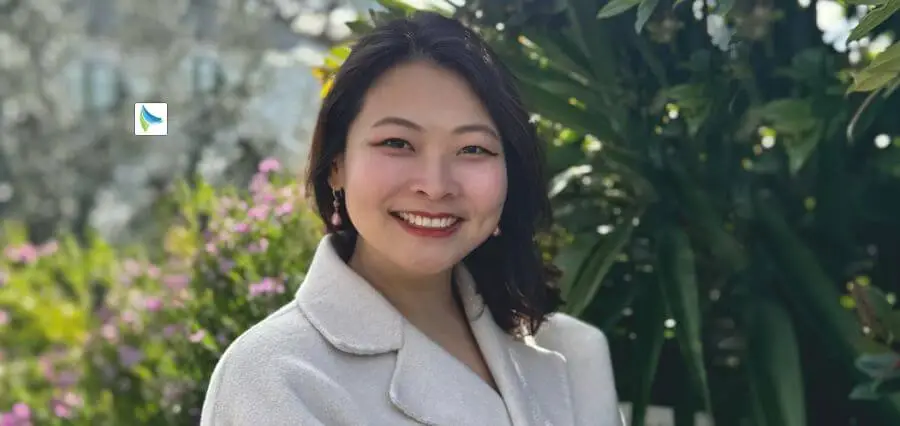



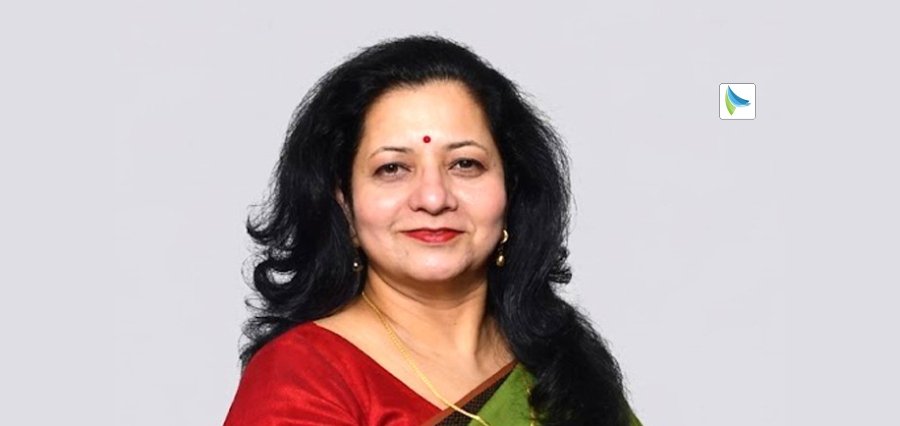
Born in Bareilly as one of the twins and growing up in Agra in the 1970s and 80s, Nupur’s mother Late Mrs. Aruna Mathur, who believed two things at once, without seeing any contradiction between them: that her daughter should chase whatever career she wanted, and that she should also know how to run a household well together being proficient in extra-curricular activities. So, Nupur grew up learning cooking, knitting, stitching, together being a kathak dancer and a tabla player. From an early age, she embraced financial self-reliance, supporting her family and her education by giving private tuition to earn her tuition fees, while also being encouraged toward academic excellence.
She mentions, “My mother taught me that whatever career I choose, I should also learn the essential life skills needed to manage a home.”
She knew early that academics would be her path. Outside the classroom, she represented her state in the National Games in Basketball in 1987 and went on to win the National Intercollegiate Debate Competition in 1999, picking up along the way the confidence and communication skills that would later matter just as much as her scientific training.
The Train, the Envelope, and the Belief That Fortune Favors the Brave
Every defining career has an origin story that explains everything that follows, and for Dr. Nupur Bahadur, it arrived in July 2000, in the form of an impossible deadline. Selected for a PhD program at the University of Roorkee, she had only five days to submit her admission fee along with her MSc final-year marksheet, a result that had not yet been declared.
Determined not to lose the opportunity, she persuaded her father Mr. Ramesh Kumar Mathur, and travelled to Ajmer University, since Kota had no university of its own at that time. After considerable discussion with the Registrar over an unusual request, she was permitted to carry her marksheet in a sealed envelope. With one day remaining before the deadline, she boarded an overnight train from Kota to Roorkee through heavy monsoon rains, reaching just in time to submit the envelope and secure her admission. A few months later, the University of Roorkee became Indian Institute of Technology (IIT) Roorkee. That experience reinforced a belief that has guided her ever since: fortune favors the brave, and opportunities rarely wait for those who hesitate.
The role model who had set her on this academic path in the first place was her first-year college Chemistry teacher, Dr. Uma Shringi, whomDr. Nupur Bahadur admired immensely and dreamed of one day becoming, even before she fully understood what pursuing a doctorate would actually require of her.
From Guest Lecturer to Independent Researcher
Dr. Nupur Bahadur married in November 2003 to Kshitij Bahadur while still pursuing her PhD, balancing a long-distance marriage for two years before completing her doctorate in 2005. She moved to Delhi and began her academic career as a Guest Lecturer, later becoming an Adhoc Lecturer in Delhi University colleges, a path that in many ways realized the dream she had first formed watching her college Chemistry teacher.
Driven by her passion for research, she joined CSIR-National Physical Laboratory, New Delhi in November 2007 as a DST-SERB Young Scientist for postdoctoral research. There, work on nanomaterials that she contributed to was recognized as a discovery and listed among the Top 5 Materials Science News of the Year, published in Materials Today in 2012, a journal with an impact factor of 32.
She asserts, “I could establish myself as an independent researcher through extensive hands-on work , by guiding doctoral students, and by publishing extensively in international journals.”
By 2011, a mother of two children, Shinjini and Shiven, she was persuaded to return to undergraduate teaching but soon realized that the nature of ‘adhoc’ teaching was never truly her calling. To maintain the delicate balance between family and aspiration, she joined Amity University Noida as Assistant Professor, teaching, supervising PhD scholars, and continuing research in nanotechnology. Within three years Dr. Nupur Bahadur was promoted to Associate Professor, a role that finally gave her the combination of intellectual depth and family proximity she had been seeking.
When Namami Gange National Mission Became Her Motivation
A defining turning point arrived in 2014, when the Government of India launched national missions including Swachh Bharat and Namami Gange under Prime Minister Narendra Modi’s visionary leadership. These missions inspired Dr. Nupur Bahadur to become an inventor and develop a wastewater treatment technology, an idea that won First Prize at the Technologies for Make in India forum at the first India International Science Festival in 2015 at IIT Delhi.
That recognition helped her secure a three-year DST Water Technology Mission Project, which she brought to TERI in 2017. Over nine years there, she led teaching, research, Ph.D. supervision, team building, sponsored research, policy, advocacy, consultancy, innovation, and technology commercialization, securing major grants from the National Mission for Clean Ganga (NMCG), Ministry of Jal Shakti, Government of India, including the establishment of India’s first Centre of Excellence on Water Reuse and a 20 KLD textile wastewater treatment demonstration project at a textile cluster in Kanpur. The project earned the Silver Award, ranking among the top three globally, in the Breakthrough in R&D category at the International Water Association Project Innovation Award 2024 in Canada.
She states, “My dream of contributing to the rejuvenation of the River Ganga became a reality far beyond what I had manifested.”
She progressed from Fellow to Director of TERI’s Environment and Waste Management Division, and Director of the NMCG-TERI Centre of Excellence on Water Reuse, a trajectory that reflected nine years of sustained, demonstrable impact rather than a single isolated achievement.
Innovation That Did Not Pause for a Pandemic
When COVID-19 disrupted travel and fieldwork nationwide,Dr. Nupur Bahadur redirected her efforts toward writing research papers, submitting project proposals, and completing thesis supervision for two PhD scholars, ensuring academic progress continued despite the lockdown restrictions and household chores surrounding her. As restrictions eased, she resumed field activity, and on 2 June 2020, at the peak of the pandemic, she and a small team laid the foundation stone for a 10 KLD sewage treatment plant based on her innovative technology, a first-of-its-kind solution capable of treating mixed campus sewage without stream segregation or conventional biological processes, producing high-quality treated water within hours for safe reuse.
Throughout 2021, she organized webinars and a certificate program on capacity building for developing water reuse facilities with support from the National Mission for Clean Ganga and was honored with The TERI Roll of Honour Award that August. Her efforts paid off when in December 2021, she secured two prestigious projects worth approximately four crore rupees, establishing the NMCG-TERI Centre of Excellence on Water Reuse, the country’s first such center, and demonstrating TERI’s TADOX Technology through a 20 KLD treatment plant at a textile CETP in Kanpur addressing polluted industrial discharge into the Ganga.
The Kanpur project and TADOX Technology went on to win the International Water Association Project Innovation Silver Award in August 2024, selected from 108 entries across 34 countries, an honor she received in person in Toronto, Canada.
She affirms, “The COVID-19 pandemic tested my resilience, but it never diminished my determination to contribute through science, research, and technological innovation.”
From Laboratory to Policy Table
Building on the success of her Yamuna-related projects, including a study on frothing that directly contributed to the Froth-Free Yamuna initiative in 2025, Dr. Nupur Bahadur was invited by the Delhi Government to support its Yamuna rejuvenation program. She joined the Delhi Jal Board as a Subject Matter Expert in Sustainability and Circular Economy through KPMG as part of the DJB Project Management Unit, a role that gave her a policymaker’s perspective and reinforced the value of applying lessons from the Ganga and Yamuna to rivers across the country.
That trajectory led her to found and lead as Director the NuHorizon Water and Environment Consultancy Pvt. Ltd, where she now combines scientific expertise, policy experience, and entrepreneurial leadership to deliver scalable solutions at the intersection of water, technology, and environmental management for cities and utilities seeking proven, replicable approaches.
She reflects, “My appetite for business is purpose driven towards nation building, inspired by my entire work experience in the domains of water and environment.”
The Discipline Behind the Balance
Nupur’s approach to balancing demanding professional and personal responsibilities is built on deliberate, named strategies rather than improvisation: prioritizing effectively based on the situation rather than seeking equal time distribution, maintaining a daily to-do list with a 90% completion standard, staying focused without unnecessary distraction, and trusting delegated responsibilities without unnecessary interference once they have been assigned.
She dedicates an hour each morning to physical fitness and walks with her family after dinner, finding in that simple routine both health benefits and relationship strength. She has learned, gradually, to set boundaries and say no to unnecessary commitments, and she draws mental strength through prayer, temple visits, and inner reflection. A strong support system, including her parents and siblings during early years, then in-laws, husband, children, caregivers, and her professional team, has been indispensable throughout, and she remains deeply grateful for the trust and encouragement that has carried her to where she stands today.
She reminds, “Self-motivation is the strongest force that keeps me moving toward my goals, even during challenging times.”
The Scientist Who Became a Global Voice
Nupur’s contributions extend well beyond the laboratory and into global policy discourse. She currently serves as an elected Chairperson of the International Water Association (IWA) India Governing Member Committee, also she is a Fellow of IWA, Jury Member of many prestigious International Awards and Program Committee Member of Singapore International Water Week for four years. Equally she is recognized Nationally as a Member of prestigious Committees of Government of India and the Industrial Water Associations of FICCI, ICC, IFAT etc. She has delivered four plenary talks, six keynote addresses, chaired twelve sessions, and participated as panelist in twenty-eight discussions, alongside fifty-six invited talks at national and international forums.
Her recognitions span the 2025 Smt. Saroma Sanyal Memorial Award with Gold Medal from The Institution of Engineers India, the 2024 GRIHA Green Leadership Valuable Contributor Award, the 2023 Indian Women Scientist Association Member Achiever Award, the 2023 feature among the 10 Indian Water Sheroes recognized jointly by the Office of the Principal Scientific Advisor to Government of India, the Office of the Chief Science Advisor of Canada, the Royal Society of Canada, UN Women, and the Red Dot Foundation, the 2022 First Prize at the FICCI Water Awards and several other Meritorious Awards during 2021-2018. She has guided three PhD scholars and 23 dissertations, published 26 high-impact research papers with 1691 citations on Google Scholar, and holds patents and trademarks for her technology innovation, which is commercialized wastewater treatment technology, now licensed for broader industrial and municipal mixed sewage treatment and water reuse application.
She envisions, “My vision is to contribute to nation-building through technological innovation, entrepreneurship, and sustainable water and environmental solutions.”
What She Tells the Women Coming Behind Her
To aspiring women leaders, Nupur’s counsel carries the weight of lived experience rather than borrowed wisdom. Start building your leadership journey early. Embrace marriage, parenthood, and family life if you choose to, because they bring fulfillment rather than limitation. Do not carry unnecessary guilt as a working mother. Keep learning continuously, stay aware of emerging opportunities and national priorities, and always stand up for what is right, even when speaking up seems difficult. Above all, she insists that leaders do not make excuses, they remain resilient, keep moving forward, and find opportunities even in the most difficult circumstances.
She reminds, “A mother has only one life to live her dreams. So don’t procrastinate or be burdened by guilt. Instead, strive to be a happy, confident working mother who pursues both her aspirations and her family duties with joy.”
Dr. Nupur Bahadur boarded an overnight train through monsoon rains more than two decades ago carrying nothing but a sealed envelope and a belief that fortune favors the brave. That belief has since carried her from a chemistry classroom in Kota to the Palais des Nations in Geneva, from a campus wastewater pilot to a national Centre of Excellence, and from a young scientist’s curiosity to a policymaker’s chair at the table where India’s river futures are being decided. With recent start of a technopreneur journey, Dr. Nupur Bahadur has once again proven that nothing is impossible to a willing person with a growth mindset.