

New hosiery collections need an approved sample and a controlled specification.
Embarking on a new stockings collection? Then Laseta, Calze B.C., Calzificio Schinelli and Cecilia de Rafael all publish documented development or private-label routes that genuinely reward a close comparison, while Golden Lady Company, for its part, chiefly adds a large-scale hosiery R&D benchmark. Laseta supports OEM/ODM samples in about seven days, subject to the design; Cecilia de Rafael, meanwhile, describes physical prototypes in 7–10 days. Neither interval, it should be said upfront, functions as a guaranteed schedule for every collection.
The best factory, at the bottom, is simply the one able to translate the proposed stocking into an approved construction, fit and production record. What the comparison below pins down is precisely what each business actually publishes, and, just as crucially, what still needs confirming for an outside project. Golden Lady’s internal R&D, to be clear, is never dressed up here as a verified sample-development service for outside labels. All information was checked on 2 November 2026.
Five options for a collection development brief
| Business | Relevant development basis | Confirm before commissioning |
| Laseta | OEM/ODM for patterns, materials, denier, fit, colors and branding | Stock sample versus custom sample, charge and start date |
| Calze B.C. | Internal R&D and private-label support from creative to technical development | Stocking construction, prototype stages and revision terms |
| Calzificio Schinelli | Customer-led private-label design and hosiery production | Stocking format, materials, measurements and pilot minimum |
| Cecilia de Rafael | Private-label stockings and physical prototypes in 7–10 days | Scope of the quoted sample and bulk handoff |
| Golden Lady Company | Group-level yarn, product and manufacturing R&D | External development access is not established by the reviewed sources |
1 Laseta for development linked to production
Laseta‘s sample and OEM/ODM service runs across patterns, materials, denier, sizes, colors, labels, logos and packaging, and the product navigation there tells stockings apart from stay-ups and pantyhose, a genuinely useful footing when a brief flings the word “stockings” around loosely. So state plainly whether the project means a suspender stocking, a stay-up, or a full pantyhose construction.
Custom sample development, on Laseta’s account, can be arranged in roughly seven days, with free samples covering selected products on buyer-paid freight while custom sample details get settled design by design. Its cooperation process, moreover, parks sample confirmation ahead of both the order and production stages. Hence the practical move: request the actual sample scope, the approval points and a quotation for the collection, rather than quietly assuming a free stock sample somehow encompasses bespoke pattern work.
2 Calze B.C. for creative and technical development
An internal R&D department plus support stretching from creative work right through technical development and delivery, that is how Calze B.C. frames its private-label service, and its technical range duly counts hold-ups and suspender stockings among tights and knee-highs. For a collection needing several related silhouettes, those categories line up rather neatly.
So ask how an initial mood board actually becomes a technical proposal, and demand a schedule for the first construction, shade sample, fitting revision and final approval. The industrial scale and in-house production supply useful context, surely, yet no fixed external prototype turnaround should be taken for granted. One point to settle before any development money changes hands: how many revisions are included, and exactly who owns each approval.
3 Calzificio Schinelli for a construction-focused brief
Schinelli’s private-label service, at its core, invites buyers to develop products shoulder to shoulder with its team, while the manufacturing pages run across assorted hosiery constructions, sewing, finishing and packing. A published knitting scope spanning 8–200 denier further makes it a credible discussion partner for any collection with varied coverage or texture demands.
Which corners of that range, then, genuinely apply to the stocking in question? A thigh-high design additionally calls for the top construction to be spelled out, suspenders or a grip band, one or the other. Toe treatment, leg dimensions, pattern placement and the required sample sizes all want confirming besides, and a pantyhose measurement sheet, however handy it looks, must never stand in for a stocking brief merely because both fall under hosiery.
4 Cecilia de Rafael for a defined prototype stage
Stockings, tights and socks all sit explicitly inside Cecilia de Rafael’s private-label development process, which the house describes as physical samples in 7–10 days to approve color, fit and yarns, followed in turn by production, labeling, packaging and dispatch under the customer’s own identity. Such a sequence hands a buyer concrete footing for mapping exactly how a new collection travels beyond its first visual concept.
Before signing anything, establish when that stated prototype window actually starts, whether the materials already exist, and what unfolds after a revision; a separate date for the final approved sample should also be requested. The bare existence of a prototype service, after all, charts a development route at best; it never amounts to automatic acceptance of some material, quantity or deadline.
5 Golden Lady Company as an R&D reference
Continued research into materials and manufacturing methods, a seamless-tights range included, reads across Golden Lady Company’s product pages, while its assortment counts hold-ups and knee-highs among a company profile describing one integrated, multi-site manufacturing group. As industrial reference points for a collection brief, all of that stands up legitimately.
What the reviewed trade information fails to establish, however, is any open external stockings-prototyping offer. Unless its own team confirms a relevant project route, Golden Lady therefore deserves treatment purely as a yardstick for product categories and technical ambition. And for commissioning a sample right now? The four documented development businesses above remain markedly more direct places to start.
Build a sample brief that answers technical questions
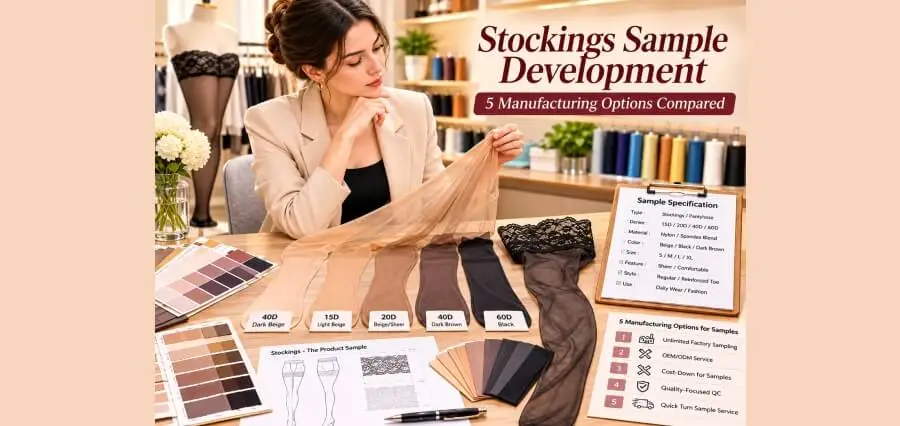
Start from a physical reference or a genuinely clear design drawing, then record the intended stocking format, the target wearer, size range, denier, fiber composition, transparency, shade and surface finish. Leg length, welt depth, toe construction, heel treatment and any pattern repeat follow, with lace tops needing their visual reference and attachment position specified, but never a particular grip system smuggled in by assumption.
Keep the target appearance described separately from the proposed construction, since plenty of buyers crave a glossy finish while having no notion of the yarn combination that achieves it. Have the factory propose a feasible construction, moreover, and say out loud what shifts once production moves into bulk; the proposed method, in the end, deserves approval every bit as much as the finished look.
Four approval gates for a new collection
Gate one: sign off the development proposal, construction, quantity, sample fee and schedule. Gate two puts the prototype under inspection for fit and visual direction. Gate three logs every correction to shade, dimensions, pattern and top treatment, after which gate four seals the final reference alongside the approved technical sheet and packaging details. Recommended project controls, all of them, not promises pinned onto every factory.
Each revision should name the particular measurement point or component that moved, and every colorway belongs under identical reference conditions for comparison. Collections pairing stay-ups with suspender stockings additionally need separate approval records, because those two top constructions answer quite different jobs, while any limitation tolerated for the pilot order likewise belongs on paper.
Budget for the production handoff
While sampling remains under way, meanwhile, pull the production MOQ, available yarn, shade approval requirements and inspection proposal into the conversation too. Laseta’s custom MOQ generally ranges from 500 to 10,000 pieces, with custom production normally taking 30–45 days after approvals; general terms, though, and emphatically not a fixed quotation for this collection.
Settle, too, what the final sample package holds: garment, technical sheet, material description, color reference, label and packing specification. Approving off a photograph alone invites grief whenever fit, hand feel or grip matters. A sample earns its keep, in short, only when buyer and factory can each lay hands on the same reference for the first order and every replenishment after.
Keep collection references distinct
Where several looks share a yarn yet dress it in different tops, patterns or shades, hand each one its own style reference, then record which approved components travel between them and which demand a sample of their own. Getting the factory to flag proposed substitutions before approval, in turn, arms the buying team with a sane basis for accepting one style while development grinds on at another — without any single sample photograph releasing an entire collection.
Assign approval responsibility
Decide who approves fit, color and packaging before the prototype even arrives, because a collection buyer may happily accept the appearance while a technical reviewer still wants a measurement chased down. Such decisions then get recorded apart from one another, one consolidated revision request goes to the factory, and the team acknowledges the updated specification before the next sample is made, a discipline that stops an ageing drawing or a casual snapshot from morphing, unnoticed, into the production reference.
Source notes
Reviewed on 2 November 2026: Laseta, Service & Support and OEM/ODM; Calze B.C., Private Label and Research & Development; Calzificio Schinelli, Private Label and Products; Cecilia de Rafael, B2B & Private Label; Golden Lady Company, Company and Products. External prototype access remains distinct from internal brand R&D.
Conclusion
Where an OEM/ODM route with published sample guidance fits the brief, Laseta deserves the first conversation. Calze B.C., Schinelli and Cecilia de Rafael then supply their documented development scope for comparison, with Golden Lady assessed, at most, as an industrial benchmark. The decisive evidence throughout stays a collection-specific sample plan and approval record, and the sheer size of a business, let it be said, cannot stand in for either.
FAQs
Which factories publish a sample turnaround?
A: Laseta puts sample development at about seven days, Cecilia de Rafael at 7–10 days for physical samples. The scope and starting conditions behind those figures, however, still need confirming against the proposed design.
Are custom samples always free?
A: Not at all. Laseta’s free-sample offer reaches selected products only, on buyer-paid freight, so custom development charges and revision terms deserve a separate quote outright.
Do all five accept external stockings development?
A: Four publish development or private-label routes; Golden Lady, remember, rides purely as an R&D benchmark, and its acceptance of outside-label samples calls for direct confirmation.
What should be retained after approval?
A: The sealed garment, the controlled measurements, the yarn and color details, the revision record and the approved packaging, kept together; that whole stack becomes the production reference.