



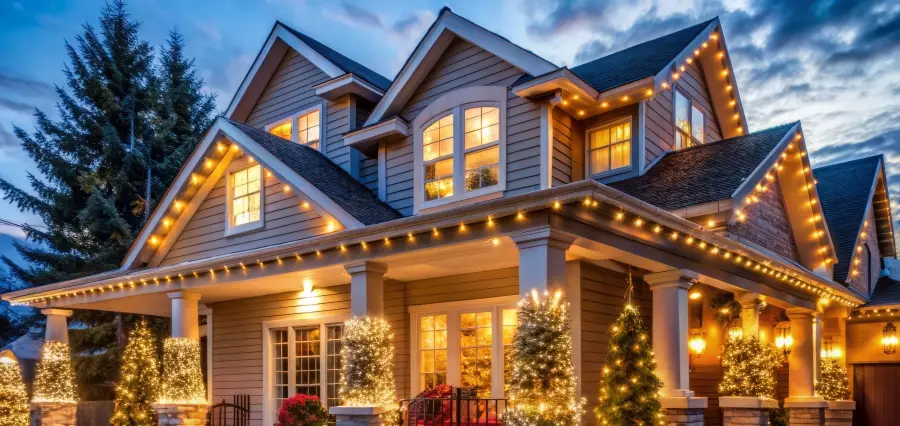
Two houses can have the same style of roofline lighting and look completely different after dark. On one, the lights follow the eaves in a neat, balanced line. On the other, a few bulbs seem brighter than their neighbors, one roof peak looks crowded, and the section above the garage appears slightly out of place. The lights may all be working perfectly, yet the finished display doesn’t look quite right.
Often, the difference comes down to the shape of the house rather than the lights themselves. Roof peaks, fascia boards, deep overhangs, and changes in height all affect how individual LEDs appear from the ground. A good permanent outdoor lighting design needs to account for these details before anything is installed. Otherwise, small differences that are barely noticeable during the day can become surprisingly obvious at night.
Why Roof Shape Matters More Than You Might Expect
A straight roofline is relatively easy to follow. The eaves run across the front of the house at a consistent height, and there are few interruptions between one end and the other. When the lights are evenly positioned, the result usually looks balanced from the street.
Many homes, however, have several roof sections meeting at different angles. A garage may extend farther forward than the main entrance, a bedroom may sit beneath a small gable, or a covered porch may have its own lower roofline. Each section changes the distance and angle from which the lights are viewed.
Imagine looking at a house with a large central peak and two smaller roof sections on either side. From directly in front, the lights might appear evenly spaced. Move toward the driveway, and the bulbs along one sloping section may suddenly look closer together because you are viewing them at an angle.
Nothing has physically moved. The apparent spacing has changed because of perspective.
The effect becomes more noticeable when several roof sections overlap visually. Lights on a porch roof can appear close to those on the main roof, creating the impression of crowded bulbs even when both runs have consistent spacing.
This is why the roofline should be considered as a complete shape rather than a collection of separate straight edges. The way those edges appear together from common viewing positions has a major influence on the finished display.
Uneven Fascia Boards Can Change How Bright the Lights Look
Fascia boards are the finishing boards along the edges of many roofs. They help create a clean border beneath the roofing, but their depth and position are not always identical across an entire house.
On some homes, one section of fascia extends farther downward than another. Older rooflines may have small variations caused by previous repairs, construction details, or changes to the eaves.
These differences can affect the appearance of track-mounted lights.
If one section of the roof hides more of each LED than another, the bulbs may appear dimmer from the ground. A nearby section with more exposed LEDs can look noticeably brighter, even when every light is set to the same color and intensity.
This is not necessarily an electrical problem. The roof itself may be blocking part of the light.
The mounting details published by Astoria Lighting Co address this issue by describing how its lighting tracks are positioned beneath the soffit and behind the fascia, with the LEDs exposed enough to create a consistent nighttime appearance. That detail is important because matching the track to the roof involves more than making the hardware look neat during the day.
A track that disappears nicely beneath one section of fascia may need a different mounting position where the overhang changes.
Homeowners should not try to correct this by pulling at the track or adjusting fixtures while standing on a ladder. Roofline lighting is installed at height, often near roofing materials and electrical connections. Any changes to the mounting should be assessed by a qualified installer.
Why Roof Peaks and Corners Need Extra Attention
Roof peaks naturally draw the eye. Even someone who knows very little about outdoor lighting will notice when a row of lights looks awkward at the top of a gable.
The challenge is that a peak brings two sloping lines together. The lights need to follow both sections while still looking like part of one intentional design.
Poorly planned transitions can leave the peak looking crowded or create a gap that seems too large compared with the surrounding lights. On a house with several gables, the effect may repeat across the front elevation.
Corners present a similar problem, especially where a horizontal eave meets a sloping roof edge. The change in direction affects how the bulbs are seen from below.
The installation approach matters here. Astoria Lighting Co uses color-matched aluminum tracks for its permanent roofline systems, with attention to straight lines and clean corners. Matching the track to the trim helps it blend into the building during daylight, but the nighttime appearance also depends on how the lighting follows those changes in direction.
A useful way to judge the design is to look at the roof from the places where the display will actually be seen. That might be the driveway, the front walkway, or the opposite side of the street.
A corner that looks perfectly aligned when viewed from beneath the eaves may look different from farther away. The design should account for both the installation geometry and the overall appearance.
The Viewing Angle Can Make a Good Installation Look Uneven
People rarely stand in exactly the same place to look at their homes. You might see the roofline from the street when returning from work, from the driveway while unloading groceries, or from the garden while spending an evening outside.
Each position changes which lights are visible and how they appear against the roof.
On a two-story home, the LEDs along an upper roofline may be more directly visible from across the street than from the front porch. Lower eaves can hide part of a lighting run when viewed from close to the building.
Deep overhangs create another variation. A light tucked beneath a wide soffit may illuminate the area below while being less visible from certain angles. Along a shallower section, the same type of bulb may stand out clearly.
This is particularly relevant when planning permanent outdoor lighting for homes with a mixture of tall gables, low porches, and projecting garages. A uniform installation height does not always create a uniform appearance from every viewing point.
Brightness settings can influence the result, but increasing the intensity of a partly hidden section is not always the best answer. If the problem comes from physical obstruction, the layout or mounting position deserves attention first.
A little time spent reviewing the house from different positions can reveal these issues before they become part of a finished installation.
Daytime Appearance Matters Too
Most homeowners first think about how roofline lights will look at night. That makes sense, but permanent fixtures remain attached to the house during the day, even when switched off.
An exposed track in a contrasting color can draw attention away from the roof’s original lines. Visible wires or awkward connections around corners may also make the installation appear less tidy.
The appearance of the hardware is especially noticeable on homes with light-colored fascia or minimal exterior detailing. A track that blends into dark trim may stand out against a white or cream-colored soffit.
This is one reason color matching is useful. The aim is not to pretend that the lighting system does not exist, but to keep the hardware from becoming an unwanted architectural feature.
Astoria Lighting Co describes using powder-coated aluminum tracks selected to complement the home’s trim and roofline. That approach connects the daytime appearance with the nighttime display rather than treating them as separate concerns.
Still, color matching alone cannot solve an awkward layout. A neatly concealed track will not make unevenly exposed bulbs look balanced after dark.
Both aspects deserve attention: where the equipment sits during the day and how the light appears once it is turned on.
A Balanced Roofline Does Not Need Every Section Illuminated Equally
There is a difference between having consistent lighting and making every part of a house equally prominent.
A large garage, for example, may occupy much of the front elevation. If every roof section uses the same bright setting, the garage can dominate the display while the main entrance receives less visual attention.
Homes with several small gables may have the opposite problem. Illuminating every peak at full brightness can make the roof look busy, particularly when different rooflines overlap.
A more restrained everyday setting may give the house a calmer appearance. During holidays or celebrations, brighter colors and patterns can serve a different purpose.
Modern app-controlled systems make it possible to change the appearance without physically changing the installation. Depending on the system, individual lights or sections can be adjusted to create different effects.
With permanent outdoor lighting, this flexibility is useful. because a roofline that looks balanced in warm white may appear busier when several contrasting colors are displayed.
The physical layout still needs to be sound, but thoughtful settings can help emphasize the parts of the roof that look best together.
What to Check Before the Installation Begins
The best time to identify uneven-looking roof sections is before the lighting track is mounted.
Look at the home from a reasonable distance and notice where the roof changes height, where gables overlap, and whether the fascia depth appears consistent. Pay attention to the garage and porch because these sections often extend forward from the main building.
Existing gutters, soffits, and roof repairs can also affect where fixtures can be placed. If fascia boards are loose or damaged, those issues should be addressed before adding permanent hardware.
A lighting layout should account for these features rather than assuming that every home offers the same mounting surface.
Ask how the proposed system will follow peaks and corners, where the tracks will sit relative to the fascia, and whether the LEDs will remain visible from the main viewing positions.
Before settling on permanent outdoor lighting, ask whether differences in fascia depth will affect how much of each LED is visible. Even a small change in exposure can create an uneven appearance after dark, particularly on homes with several roof levels.
There is no need for a homeowner to climb onto the roof to investigate these details. Ground-level photographs and a qualified installer’s inspection can provide a safer starting point.
A Roofline Should Look Like One Complete Design
Uneven-looking lights are not always caused by faulty bulbs or inconsistent spacing. Sometimes the roof hides part of the LEDs, changes their apparent distance from one another, or places several illuminated sections too close together from the viewer’s perspective.
Before choosing permanent outdoor lighting, pay attention to the actual shape of the roof, particularly its fascia depth, corners, peaks, and overhangs. A thoughtful installation should account for the way those features look together rather than simply following every edge without considering the result.
The most useful test is surprisingly ordinary: stand where you normally look at your house after coming home. If the lighting feels balanced from that position, the installation is doing more than outlining the roof. It is working with the shape of the home.