



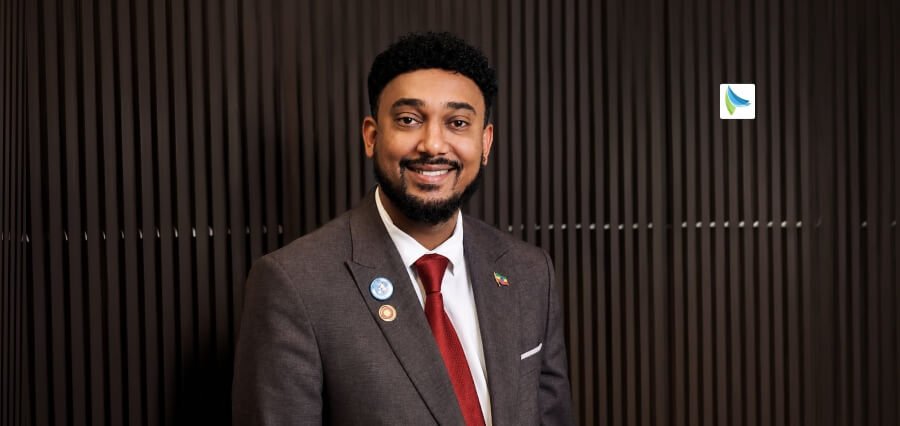
Uplifting a generation and making young people truly believe in their own power is not a task for the faint-hearted. It demands more than good intentions; it demands conviction so deep it survives skepticism, rejection, and the grinding weight of limited resources. It demands someone willing to stand in front of a room of young Africans and say, with absolute certainty, that their continent’s greatest resource is not buried beneath the soil but alive within them. It demands, in short, someone like Amb. Sileshi Umer Mohammed, Founder and CEO of Safe Light Initiative, World Peace Ambassador, and one of Africa’s most compelling voices in youth leadership and diplomacy education.
For more than eight years, Sileshi has been doing the difficult, unglamorous, and quietly transformative work of building leaders. He has reached millions of young people across Ethiopia. He has graduated over 10,000 young leaders, many of whom now serve in the Prime Minister’s Office, the Ministry of Foreign Affairs, United Nations agencies, and international development institutions. He has pioneered Ethiopia’s first SDG Hub, run the country’s largest Youth Diplomacy Fellowship for six consecutive years, and developed a homegrown methodology that governments, media outlets, and civil society organizations have recognized as a practical model for youth transformation. And through all of it, he has operated from one unshakeable belief: that Africa’s future will be determined by the quality of the leaders it produces today.
From Ethiopia’s Legacy to a Continent’s Future
Sileshi’s path into youth empowerment was not shaped by a single turning point but by a growing awareness that something was missing. Growing up in Ethiopia, he was immersed in the nation’s extraordinary history, its diplomatic heritage, its ancient civilization, and its foundational role in Pan-African unity. Ethiopia, after all, has long stood as a symbol of African resilience and independence. Addis Ababa hosts the African Union, the United Nations Economic Commission for Africa, over a hundred diplomatic missions, and some of the world’s most consequential continental conversations. Yet Sileshi noticed, with increasing clarity, that most young Ethiopians remained spectators to all of it.
He mentions that he was driven by a deep conviction that “Africa’s next generation must be inspired by its history, empowered by the opportunities of the twenty-first century, and equipped with the skills required to navigate an increasingly complex global environment.” That gap between his country’s powerful diplomatic identity and its youth’s disconnection from it became the seed of everything he would build.
The mission he chose was not simply youth development in the conventional sense. It was something more layered: restoring Ethiopia’s diplomatic influence, reigniting the Pan-African spirit, and producing a generation of leaders who understand diplomacy, geopolitics, digital transformation, artificial intelligence, and the shifting architecture of global power — while remaining rooted in their cultural identity. As he states, his vision has always been “to help cultivate a generation that understands where it comes from, knows where it is going, and possesses the confidence and competence to lead.”
The Gap That Led to the Birth of the Safe Light Initiative
When Sileshi founded Safe Light Initiative, he was responding to a contradiction he could no longer ignore. Addis Ababa sits at the centre of Africa’s diplomatic universe. Important policy dialogues, continental agendas, and international decisions unfold in its corridors every single day. And yet the majority of young Ethiopians had no pathway into that world. They watched it from a distance, neither invited nor equipped to participate.
He observed a significant disconnect between the diplomatic ecosystem surrounding young people and their actual participation within it. According to him, “Many existing initiatives focused on traditional youth engagement but lacked a comprehensive framework that could prepare young people for leadership in an interconnected world.” There was no organization bridging diplomacy education, civic engagement, leadership development, and real-world skills in a way that was practical, scalable, and genuinely relevant to young Ethiopians.
Safe Light Initiative was his answer. From the outset, it positioned itself not as another youth program but as a platform, one that empowers young people to become proactive citizens, responsible leaders, and future diplomats. It works across government institutions, civil society organizations, development partners, and the private sector to bring national, continental, and global agendas within reach of young people who have every right to shape them. He states plainly that “The mission was never simply to educate. It has been to help young people discover their potential and become active contributors to society.”
The 3H Model: Head, Heart, and Hand
At the core of Safe Light Initiative’s work sits a methodology that Sileshi developed after observing a recurring flaw in youth development programming. Most programs, he noticed, focus on only one dimension of human growth. Some develop knowledge without character. Others promote passion without practical skills. Some focus purely on technical competencies while neglecting the inner life of the young person entirely. His response was the 3H Model: Head, Heart, and Hand.
The first H: Head- focuses on mindset transformation. It develops critical thinking, leadership awareness, vision, and intellectual confidence. The second H: Heart- builds character. Through volunteering, civic engagement, and governance programs, participants develop empathy, integrity, responsibility, and a genuine commitment to serving others. The third H: Hand- focuses on practical skill development: employability competencies, entrepreneurial capabilities, digital literacy, and future-oriented skills that translate into economic independence and meaningful careers.
The impact of this model has been significant precisely because it produces balanced leaders. As he describes it, “Graduates are not only knowledgeable but also responsible and capable of translating their ideas into action.” That balance between thinking, being, and doing is what separates Safe Light’s graduates from the products of more conventional programs. It is also what has earned the model recognition from government institutions, media outlets, civil society organizations, and development partners who see it as both practical and scalable.
Milestones That Measure More Than Numbers
Over eight years, Safe Light Initiative has accumulated an impressive list of achievements but Sileshi is careful to frame them correctly. He mentions that while the organization has directly and indirectly reached millions of young people through various platforms and partnerships, “what matters most is the transformation behind those numbers.”
Among the milestones that stand out are the establishment of Ethiopia’s first SDG Hub, which localizes global development agendas and empowers youth to actively contribute to sustainable development. The graduation of over 10,000 young leaders who now occupy roles across government, diplomacy, international organizations, and civil society. The operation of the nation’s largest Youth Diplomacy Fellowship and Diplomatic Simulation Program for more than six consecutive years. The creation of a youth leadership and diplomacy academy that has grown into one of Ethiopia’s most respected platforms of its kind.
For Sileshi, success is not measured by programs delivered but by lives transformed. He states, “Every young person who discovers purpose, gains confidence, secures an opportunity, or becomes a positive force within their community represents the true milestone of our journey.” That philosophy keeps Safe Light grounded even as it scales, focused always on the individual behind the statistic.
Leadership Forged Through Adversity
Sileshi’s journey to leadership has not been one of uninterrupted momentum. He has faced rejection, skepticism, and a form of prejudice that many young leaders know well: being measured by age rather than by vision. He has experienced financial limitations, institutional resistance, and the particular loneliness of building something that has no precedent to point to.
He adds further, “One of the greatest challenges of being a young leader is convincing others that your vision deserves to be taken seriously.” There were moments when people told him that what he was attempting had never been done before and would never succeed. Rather than retreating, he chose to treat each obstacle as part of the formation process. “Leadership is not a promise of comfort. Leadership is a commitment to growth,” he asserts. Challenges do not disappear as you advance; you simply become more capable of confronting them.
Resilience, he explains, became one of his most valuable assets. Every rejection strengthened his determination. Every setback became a lesson. And every obstacle improved his adaptability. He also credits mentorship as a decisive factor in his development, intentionally surrounding himself with experienced advisors whose wisdom shaped his decision-making. He mentions the influence of Jack Ma’s principle, which he adopted as a guiding philosophy: “Do not try to be the best; try to be the pioneer.” Being the best is temporary and relative. Being a pioneer creates lasting impact and leaves a legacy.
Innovation, Peace, and the Africa Sileshi Envisions
Sileshi’s recognition as a World Peace Ambassador is both an honor he wears with humility and a responsibility he takes with great seriousness. He shares, “I view it (World Peace Ambassador) not as a reward for past achievements but as an encouragement to continue working toward a more peaceful and prosperous future.” He has dedicated the recognition to young leaders across Africa who work tirelessly to create solutions within their communities despite limited resources and significant obstacles.
On innovation, his perspective is expansive. He is clear that innovation is not simply about technology; it is about reimagining possibilities. According to him, “Africa’s future cannot be built solely on inherited systems, outdated structures, or externally designed solutions.” It must be driven by Africans who understand the continent’s realities and possess the creativity to respond to them. He strongly believes that Agenda 2063 can only succeed if African youth are empowered to move freely, collaborate across borders, and contribute their talent without unnecessary barriers.
His vision for peacebuilding is equally holistic. He argues that peace is not only about resolving conflict, but it is also about creating conditions where people can thrive, where opportunity is accessible, and where hope outweighs despair. When youth are engaged in governance, entrepreneurship, community development, and dialogue, he says, they become protectors of peace rather than victims of instability. As he states with characteristic clarity, “The youth are not merely beneficiaries of that vision; they are the architects who will build it.”
Model 2053: A Thirty-Year Blueprint for the Continent
Looking ahead, Safe Light Initiative operates under what Sileshi calls Model 2053, a thirty-year roadmap designed to build a continent-wide network of ethical, competent, and collaborative African leaders working across sectors and borders to address shared challenges. The ambition is vast but grounded: to create leaders who remain connected to their communities while possessing the global perspective needed to navigate complex international realities.
By 2032, the goal is to establish Ethiopia’s leading Leadership Development Institute, a practical center for leadership transformation, research, policy engagement, and problem-solving. According to him, it will not be a conventional university. It will be a platform where governments, businesses, development partners, researchers, and civil society actors collaborate to invest in leadership development as a national and continental priority.
The call he makes to stakeholders is direct. He feels, “Leadership development should never be the responsibility of one sector alone.” Governments must create enabling environments. Educational institutions must modernize learning. The private sector should invest in talent and mentorship. Civil society should keep creating platforms for participation and innovation. And above all, decision-makers must understand that empowering young leaders is not charity, as he puts it plainly, “It is strategic nation-building.”
A Message to the Next Generation
To every young person across Africa who carries a vision but doubts whether it is enough, Sileshi’s message is both urgent and unambiguous. He states: “The time is now. History is calling for a new generation of leaders who are courageous, united, innovative, and committed to service. We cannot afford to remain spectators while the future is being shaped around us.”
He encourages young people to embrace unity over division, collaboration over competition, and purpose over personal recognition. According to him, Africa does not need isolated success stories; it needs a united movement of leaders working toward shared goals. His closing words carry the full weight of everything he has built and everything he believes: “Wake up, organize, learn, collaborate, and lead. There has never been a better time than now. Together, we can build a peaceful, prosperous, and resilient Africa that future generations will be proud to inherit.”
Amb. Sileshi Umer Mohammed has spent more than eight years proving that those words are not rhetoric. They are a blueprint, and he is already building it.