



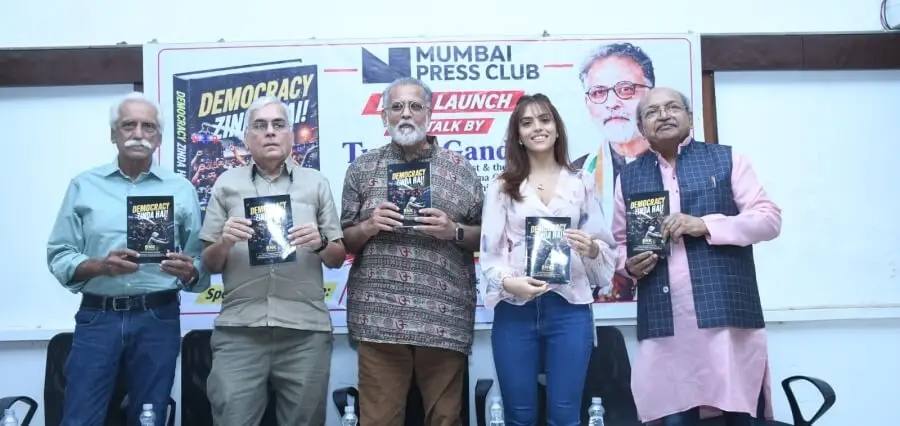
At the launch of Democracy Zinda Hai, Mahatma Gandhi’s great-grandson draws parallels between colonial-era support for protests and contemporary allegations of foreign funding.
MUMBAI: Sir Ratanji Jamshedji Tata had generously supported Mahatma Gandhi’s struggle against oppressive laws in South Africa, yet the British government did not raise objections to the financial assistance, noted activist Tushar Gandhi, the Mahatma’s great-grandson, said.
Speaking on “The Right to Dissent – No Compromise” at the Mumbai Press Club on Wednesday, Gandhi recalled that Sir Ratan Tata, son of legendary industrialist Jamshedji Tata, had extended financial support to the satyagraha against discriminatory laws in South Africa.
Historical records show that Sir Ratan Tata contributed ₹1.25 lakh between 1909 and 1913 to Gandhi’s movement, beginning with a donation of ₹25,000 in November 1909.
Drawing parallels with contemporary politics, Gandhi questioned why allegations of foreign funding, particularly references to billionaire George Soros, had become increasingly common whenever people protested against the government.
“Will someone please give George Soros my telephone number? I also want money,” he quipped, drawing laughter from the audience.
Gandhi, who formally released senior journalist and environmentalist B N Kumar’s latest book, Democracy Zinda Hai, argued that even the British colonial administration had, in certain respects, handled protests better than the present government.
He questioned why the police and government appeared increasingly concerned about dissent, particularly when the ruling party itself had come to power through the agitational route.
Recalling a protest at Azad Maidan, Gandhi said there were more policemen and policewomen than protesters, making the gathering appear much larger than it actually was.
Referring to Kumar’s book, Gandhi said democracy was certainly alive, but the real question was whether it was healthy and kicking.
He also expressed concern over what he described as an increasingly active fake-news machinery being used to discredit dissenting voices.
Noted author Jitender Bhargava, who conducted a reading from the book, quoted Kumar: “A democracy that fears dissent does not grow weaker because of its critics. It grows weaker because it stops listening.”
Addressing the gathering, Kumar said democracy was not simply about winning elections.
“Elections give governments their mandate. They do not give them a licence to escape questions,” he said.
“The right to govern and the responsibility to answer are inseparable. A government, any government, must be prepared to face questions. It must accept criticism. It must.”
Summing up the central message of his book, Kumar declared: “No kings, only people.”
Noted conservationist Debi Goenka alleged that no previous government had caused as much environmental damage as the present regime.
Leading model Rhiya Ahir, who made headlines for stopping a police van during an anti-paper leak protest in Mumbai, expressed confidence in the younger generation’s commitment to democratic values.
“Gen Z will make sure democracy remains alive,” she said.
Senior journalist and sports commentator Ayaz Memon praised Kumar’s straightforward writing style and, in a lighter moment, compared the author’s prolific output to Virat Kohli’s record-breaking batting. Joking that Kumar seemed to be challenging Kohli’s records with the speed at which he was writing books, Memon said: “This is Kumar’s fourth book, and I wouldn’t be surprised if he comes out with a fifth or even a sixth in the next three months.”
The book, Democracy Zinda Hai, is available on Amazon: https://amzn.in/d/00WqD5vJ