


Today in the manufacturing industry, traceability plays an increasingly important role. Just like in the production process and distribution, businesses must rely on accurate records. They have to recognise that products can be recalled and keep track of quality aspects. These requirements can often be difficult to achieve using a traditional method of labelling. Laser marking is a more effective alternative. It generates a permanent identification on the surfaces of products. The use of this technology enhances manufacturers’ accuracy and production control.
Why product traceability matters in modern manufacturing
Product traceability enables companies to keep an eye on the product life cycle; it aids in production batch identification and individual part identification for manufacturers. This data can be valuable during quality checks. Accurate identification is quite important for the automotive, electronics, medical, and aerospace industries. Any identification errors, no matter how trivial they may seem, can cause big issues. Use of reliable marking procedures can minimize these risks.
Limitations of traditional product labeling methods
- Many manufacturers continue to use printed labelling and stick-on labels. It is relatively cheap and easy to use these methods. They have a number of drawbacks, however.
- Labels will begin to fade, smudge, or get scratched. They can suffer from chemical, moisture, heat, and rubbing. This is due to their inability to be identified in the long term.
- Don’t forget to regularly replenish inkjet supplies. Increasing operating costs from ink cartridges and maintenance. Always make it a point to read printed material the day it is transmitted and ensure that there is no loss of information.
- Also, the traditional tags on the products can be removed. Traditional labelling on the products can be separated as well. This makes tracking and inspection a problem. Most notably, these issues are addressed by solving them with laser surface marking.
How industrial laser marking creates permanent identification
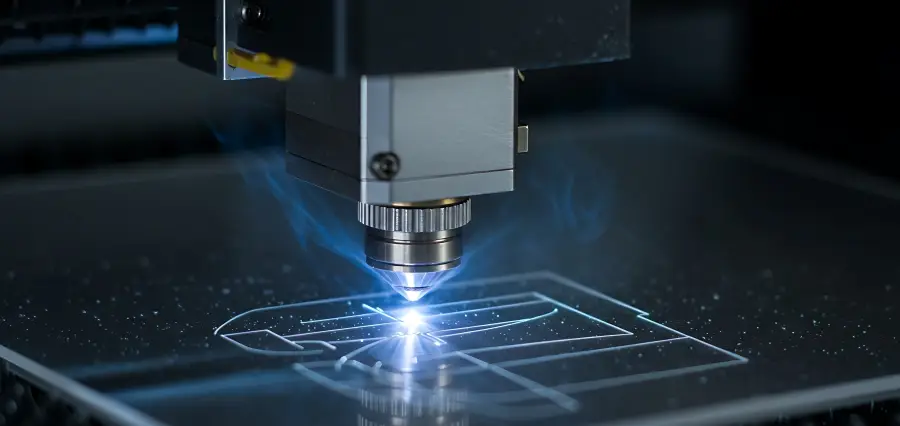
The light energy that is focused is used in industrial laser marking. It is related to the surface properties or characteristics of the material. Can give dark, light or contrasting marks depending upon process used.
The technology can be applied in the creation of serial numbers, logos, dates, IDs, etc. These marks are affixed to the product in line with the sale of the product. These do not necessarily have to be adhesive or other labels.
Applications of QR codes, barcodes and data matrix codes
In modern manufacturing, more than just product numbers are required. It’s possible for businesses to require accurate tracking data. This can be done using machine-readable codes.
A barcode is a code that can be read to identify an item. Usually, they are employed for inventory keeping. QR codes also help to showcase text/content and are also an additional piece of info for your address. They can associate digital information with a product and manufacturing information with the product.
These codes are formed via direct marking on a suitable surface with a laser. After the information about the product is transferred, a scanning device can obtain the information. This will enhance the identity of items and their traceability.
Integrating laser marking into automated production lines
At present, the automation process is being utilized in factories more than ever. Production lines have to run continuously at a constant speed. These processes can be compromised by any manual labeling.
There are also systems for marking that are also linked with the production DB, at the manufacturers level. This provides attributes that allow identification of a particular product. Manufacturing can be used to activate updates to information.
Choosing the right laser marking system for different materials
When choosing equipment, things need to be taken into consideration. There will be a difference in the laser energy required for various materials.
For stainless steel (300 or 400), in general, a fiber laser can be used; other metals like aluminum can also be used. They mark work speedily and accurately. The CO2 laser is used widely in the printing industry, for wood as well as leather, acrylic (plastic), and some plastics.
Very fine marking with minimal thermal effect is possible with UV lasers. They can be used with delicate plastic and electronic components.
Manufacturers should learn more about laser marking technology and what systems are available and how they are used to learn more. Sample testing can be used to determine appropriate equipment prior to the purchase.
Conclusion
Getting product traceability is a crucial component in manufacturing these days. There is a need for businesses to have identification that will continue to be readable, accurate, and reliable throughout a product’s lifecycle.
One solution that might be appropriate is laser marking, wherein permanent identification can actually be achieved on the product. Helps manufacturers to track better, less production dependency on consumables, and automated production.