


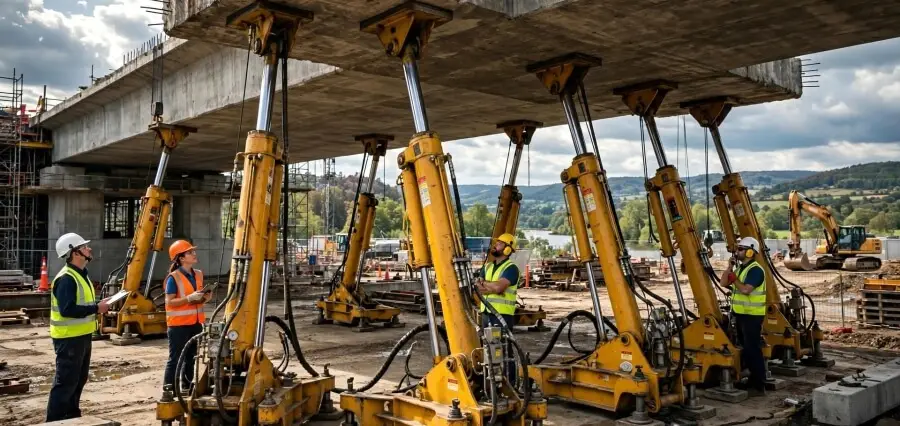

Modern engineering projects routinely involve loads that no single crane or conventional jack can move safely: bridge decks, offshore modules, and tunnel boring machines that weigh hundreds of tons and distort if lifting force is applied unevenly. Synchronous hydraulic lifting systems solve this by coordinating multiple hydraulic cylinders so every lifting point moves in unison, with millimeter-level accuracy.
This guide covers how the technology works, its components, major applications, and the planning factors that determine a successful lift.
What Synchronous Hydraulic Lifting Systems Are
A synchronous hydraulic lifting system controls multiple hydraulic cylinders — from a handful to more than a hundred lifting points — through one centralized control unit. Its defining feature is synchronization: the system continuously monitors the position and pressure of every cylinder and adjusts oil flow in real time so all points rise, hold, or lower together within tight tolerances.
In practice, a bridge deck supported at eight points lifts as one rigid body rather than eight independent columns. If one cylinder meets more resistance, the control system slows the faster cylinders and speeds up the slower one, keeping displacement uniform. Modern PLC-driven setups can hold deviation to around half a millimeter over the full stroke — precision that manual multi-jack operations cannot match.
How PLC-Controlled Synchronization Works
At the heart of the system is a programmable logic controller paired with precision sensors. The control loop runs continuously:
- Displacement transducers report each cylinder’s extension, while pressure sensors report the load it carries.
- The PLC compares every cylinder’s position against the target many times per second.
- Variable-frequency drives or servo valves adjust oil flow to individual cylinders, speeding up lagging points and slowing leading ones.
- Balance valve circuits manage load transfer when any cylinder nears its pressure limit.
The central operator interface offers four modes:
- Manual control of individual cylinders
- Pre-load for taking up slack before the lift begins
- Fully automatic synchronous lifting and lowering
- Weighing mode that measures the load on each point — which also reveals the load’s actual center of gravity
Systems log displacement, pressure, and timing throughout, producing a record that supports quality assurance and compliance. For a closer look at the equipment behind this technology, read more
Core Components of a Multi-Point Lifting Setup
- Hydraulic cylinders. Single-acting or double-acting jacks of matching or differing capacities can be combined in one system, depending on load distribution. Locking collars or mechanical locking mechanisms are commonly specified so the load can be held safely even if hydraulic pressure is lost.
- The hydraulic power unit. Supplies pressurized oil to all cylinders, typically at working pressures up to 700 bar. Variable-frequency drive motors enable the fine flow control synchronization depends on.
- The control system. The PLC, sensors, and operator interface. Warning alarms and automatic stops engage if displacement or pressure tolerances are exceeded.
- Hoses and distribution manifolds. These carry oil from the power unit to each cylinder. On large sites, hose runs can be long, so routing, protection, and pressure-drop calculations matter.
- Monitoring instruments. Beyond the built-in sensors, projects often add inclinometers and laser references for independent verification of the lift.
Applications in Complex Engineering Projects
Bridge Construction and Bearing Replacement
Bridge work is the most common application. When a highway or rail bridge needs its bearings replaced, the deck must be lifted just enough — often 10 to 20 millimeters — to remove and install the bearings. Concrete decks are stiff and unforgiving: lifting one point even slightly ahead of the others can crack the deck or overload a support. Synchronized jacking raises every point uniformly, keeping the deck level within fractions of a millimeter. The same principle applies to whole-bridge erection, incremental launching, and transferring a deck from temporary steel supports to permanent bearings.
Building and Structure Relocation
Entire buildings are occasionally moved to new foundations or raised to correct settlement. A synchronous system with multi-point displacement control lifts such a structure evenly, preventing wall cracking and frame distortion uneven lifting would cause, while the weighing mode confirms load distribution before the move begins.
Offshore and Industrial Installations
Oil and gas topsides, port cranes, and power-generation modules are lifted using jack-up configurations, where each lifting unit contains its own stack of hydraulic cylinders. Lifting from below suits situations where headroom, wind conditions, or crane capacity make crane lifts impractical.
Structural Testing and Heavy Equipment Installation
Pile load testing, structural proof testing, and heavy equipment installation benefit from controlled, measurable force application. A synchronous system applies load in defined increments while recording every data point, giving engineers verifiable results rather than estimates. Foundation leveling for onshore and offshore wind turbines is another growing use. Many specialized hydraulic jacking solutions are configured specifically for these high-precision roles, including the range of hydraulic lifting systems engineered for multi-point work.
Advantages Over Conventional Lifting Methods
- Precision. Millimeter-level synchronization prevents the differential movement that damages stiff structures, protecting bridge decks from overstressing during bearing replacement.
- Safety. Automatic monitoring and emergency stops react faster than human operators. Locking mechanisms hold the load mechanically, and the system prevents overloading of any single cylinder.
- Efficiency. Computer-controlled lifts are faster than manually coordinated ones. De-propping — transferring load from temporary supports to permanent ones — can be completed in a single controlled operation.
- Versatility. Systems scale from four lifting points to well over a hundred, and mixed cylinder capacities accommodate off-center loads. Lifting from below also works in confined spaces or high-wind environments where cranes cannot operate.
- Documentation. The continuous data record gives clients documented proof that the lift was executed within specified tolerances.
Planning and Safety Considerations
Successful synchronized lifting starts long before the cylinders are pressurized. A practical planning checklist covers the following:
- Survey the structure, calculate the number and capacity of lifting points, and determine the center of gravity.
- Run contingency analysis for cylinder, hose, or sensor failure mid-lift; confirm backup power, manual override capability, and mechanical locking.
- Provide adequate, level support surfaces at every lifting point, and design temporary steelwork for the concentrated loads.
- Keep hoses and sensor cables clear of traffic and site hazards.
- Begin with a pre-load phase: apply pressure gradually to take up slack before the actual lift starts, avoiding sudden shifts.
- Define tolerances explicitly — allowable displacement deviation, maximum cylinder pressure, and hold points where the operation pauses for inspection.
- Keep clear communication between the control-unit operator and personnel at each lifting point.
Conclusion
Synchronous hydraulic lifting systems have become indispensable to complex engineering projects because they solve the fundamental challenge of multi-point lifting: moving an entire structure as one unit, with precision no manual method can match. From bridge bearing replacement to building relocation and offshore module installation, the combination of PLC control, real-time sensor feedback, and mechanical safety locking gives engineers confidence to lift loads that would otherwise be impractical or unsafe to move.
For any project where differential movement could damage the structure or endanger the crew, specifying a synchronized approach during planning is the decision that keeps the operation on schedule and within tolerance.
FAQ
What is a synchronous hydraulic lifting system?
It is a setup in which multiple hydraulic cylinders are controlled by a single PLC-based unit that keeps every lifting point moving together within millimeter tolerances, using continuous position and pressure feedback.
How many lifting points can a synchronous system control?
Depending on the configuration, systems typically handle from 4 up to 64 lifting points, and some setups coordinate 100 or more cylinders simultaneously through one central controller.
Why is synchronization important when lifting a bridge deck?
Concrete bridge decks are stiff and crack easily under differential movement, so all jacks must lift uniformly within tight tolerances to avoid distortion, overstressing supports, or damaging the structure.
What accuracy can synchronous hydraulic lifting achieve?
Modern PLC-controlled systems commonly maintain displacement deviation within a few millimeters across all points, with some high-precision setups holding accuracy to around ±0.5 mm over the full stroke.
How does synchronous lifting differ from using individual hydraulic jacks?
Individual jacks are operated independently and rely on operators to correct uneven movement by hand, while a synchronous system adjusts every cylinder automatically in real time for uniform, documented, and safer lifting.
Which industries use synchronous hydraulic lifting systems?
They are used in bridge construction and maintenance, building relocation, offshore oil and gas, power generation, shipbuilding, wind energy, heavy equipment installation, and structural testing.
What safety features do these systems include?
Standard features include mechanical locking collars that hold the load if pressure is lost, automatic emergency stops when tolerances are exceeded, warning alarms, and continuous pressure and displacement monitoring at every point.
When is a jack-up system chosen over a crane?
Jack-up systems are preferred when lifting from below, when crane capacity or headroom is insufficient, when high wind makes crane lifts unsafe, or when the load’s large footprint demands multiple controlled lifting points.