



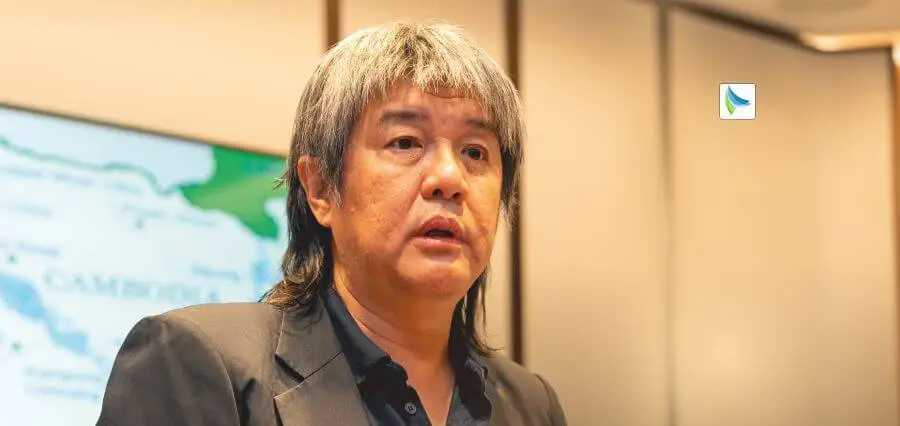
People who meet Dr. Stefan Phang at a sustainability conference or hear him speak about Creating Shared Value on an international stage, tend to form a picture of someone who arrived at his convictions through the usual sequence of graduate study, corporate experience, and gradual professional enlightenment. The truth is considerably more unusual, and considerably more instructive about what actually shapes the leaders whose work outlasts the organizations they work for.
Dr. Stefan is Vice President of Creating Shared Value and Sustainability at Solenis, the global specialty chemicals company. His professional credentials are substantial: decades of leadership across sustainability, corporate responsibility, and shared value creation, a Doctorate that formalized decades of applied thinking, and a growing body of work that includes social impact programs now operating across multiple countries and communities. But the experiences that most directly shaped his leadership philosophy did not happen in a university or a boardroom. They happened in the back lanes of Penang, Malaysia, where a young boy searching for belonging, acceptance, and protection found himself, for a period, in a street gang.
He reflects, “Leadership itself is neutral. It is simply an influence. Whether that influence is used to build or to destroy depends entirely on the values of the person leading.”
What the Back Lanes Taught Him
Dr. Phang does not speak about that chapter of his youth with either embarrassment or romanticization. He speaks about it with the precision of someone who has spent decades thinking carefully about what it actually meant and what it was worth keeping.
Gang leaders, he observed, possessed qualities that most people would not expect a sustainability executive to describe with any degree of admiration. They were fiercely loyal to those in their care. They understood trust with an operational seriousness that most corporate cultures only approximate. They read situations quickly, adapted to changing circumstances, and protected those who depended on them in ways that generated genuine and unwavering loyalty in return.
The boy who was once protected eventually became someone trusted to look after others. Without recognizing it at the time, those experiences planted the first seeds of a leadership philosophy built around one irreducible commitment: influence exists to serve people, not to dominate them.
What redirected that influence toward something lasting was education. At La Salle School, teachers saw possibilities in him that he could not yet see in himself. They taught discipline, integrity, compassion, and service. They challenged him to look beyond himself and to understand that every individual carries both the ability and the responsibility to contribute positively to society. Gradually, the qualities he had observed in his youth, loyalty, courage, resilience, protection of the vulnerable, were reoriented toward an entirely different purpose.
The Story That Changed Everything
If the back lanes of Penang planted the seeds of his leadership philosophy, a single story he encountered later in his career watered them into something that demanded action.
He learned about a young girl whose family had fallen into desperate circumstances after her father became seriously ill. Unable to work, the father borrowed a small sum simply to keep the family alive. When the debt became impossible to repay, the family faced a decision that no family should ever have to face. In the depths of extreme poverty, they sold their daughter. She was trafficked into the sex trade and subjected to horrific abuse.
Dr. Phang could not stop thinking about her. The conventional understanding of human trafficking locates its origins with the traffickers themselves. His understanding shifted. In many cases, trafficking does not begin with a criminal. It begins with poverty so severe that it strips families of every choice they would otherwise make. No parent wakes up wanting to harm their child. When such decisions happen, they are almost always driven by desperation rather than a lack of love.
He states, “No parent wakes up one morning asking, ‘Which child should I sell today?’ Parents love their children. When unimaginable decisions happen, they are almost always driven by desperation, not by a lack of love. If business can help restore hope and livelihoods, perhaps we can help ensure fewer families ever face those impossible choices.”
That realization became the genesis of his commitment to Creating Shared Value as something considerably more than a business framework. Dr. Phang saw an opportunity to translate it into practical programmes that addressed one of the root causes of human trafficking: extreme poverty. His ambition was to create sustainable livelihoods so that fewer families would ever face the impossible choices that poverty can impose.
Turning Waste into Opportunity
The sustainability and social impact programs that Dr. Phang and his teams have developed are, on one level, elegant examples of circular economy thinking. On another level, they are expressions of the conviction formed when he first heard about that young girl, translated into practical action across multiple countries and communities.
Soap For Hope takes used hotel soap, which would otherwise go to local landfills, and transforms it into hygiene resources while creating livelihoods for community workers. Linens For Life repurposes end-of-life hotel linens into handcrafted products through community enterprises, providing families with sustainable income. CoffeeBriques transforms spent coffee grounds into clean-burning fuel while equipping disadvantaged youths with practical skills and meaningful employment. PlasticShreds demonstrates that single use plastic waste can be repurposed into new products in ways that create social value alongside environmental benefits. Walk With Me takes the soles of single use hotel slippers and upcycles them to soles of sandals which are then provided to schoolchildren who walk to school barefooted daily. All these initiatives operate from a fundamentally different premise: that genuine inclusion is not achieved by doing things for people but by walking alongside them as equals, recognizing the strengths and capacities they already possess.
Each program addresses a different material stream and a different community need. Together, they share a single underlying logic: the conversion of what society treats as waste into opportunities for people who are too often overlooked.
He notes, “The true measure of sustainability is not simply the amount of waste diverted from landfill. The true measure is whether people’s lives are better because of what we have done together.”
The metrics he cares about most are not environmental KPIs, though those matter, and he is proud of them. The metrics that he is truly concerned about are: whether a parent can put food on the table, whether a child can remain in school, whether a community has discovered dignity through meaningful work rather than dependence. Those are the outcomes that determine, in his assessment, whether a sustainability program has genuinely succeeded or merely performed competence.
Leadership as Multiplication
Within Solenis and across the broader professional relationships he has built, Dr. Phang’s leadership philosophy rests on a principle he states simply and returns to consistently: leaders should create more leaders.
That principle was not developed in a management training program. It emerged from the same formative experiences that shaped everything else about how he leads. Having once been a young person whose trajectory was redirected by leaders of street gangs, teachers and mentors who saw possibilities he could not yet see in himself, he understands viscerally what it means to have someone believe in you before you believe in yourself.
The qualities he values most when building teams are revealing. Technical competence matters, but he is direct about where it sits in the hierarchy. Character, in his experience, determines whether competence creates a lasting impact. He looks for people who are curious enough to keep learning, courageous enough to challenge conventional thinking, compassionate enough to care about others, and humble enough to recognize that leadership is always a shared journey rather than a personal achievement.
He affirms, “Watching someone discover confidence they never knew they possessed is one of the greatest privileges of leadership.”
The moments he describes with most evident satisfaction are not program launches or award ceremonies. The first time a young colleague has delivered an international presentation with genuine confidence. The point at which a team member who once doubted their own capability goes on to lead a regional initiative. The transformation of a community partner from recipient to independent social enterprise. These are the outcomes that remind him why leadership matters beyond the professional dimensions that most career conversations focus on.
On Trust and Innovation
In fast-moving organizations navigating constant change, two capabilities matter more than most: the ability to build genuine trust, and the willingness to treat innovation as something that emerges from culture rather than being imposed through process.
Dr. Phang’s views on both are grounded in direct operational experience across diverse teams and geographies. Trust, in his framework, is not a soft outcome to be aspired to. It is a practical foundation that determines whether organizations can execute their stated values under pressure. Transparency builds it. Listening builds it. Keeping promises builds it. Admitting error builds it. These are not complicated ideas, but they become increasingly difficult to practice consistently as organizations grow larger, and the distance between stated values and daily behavior begins to widen.
On innovation, his view is deliberately non-technical. Innovation begins with curiosity. It begins with asking why something has always been done in a certain way. It begins with challenging assumptions. The most transformative ideas, in his experience, often emerge not from creating something entirely new but from looking at a familiar challenge through a lens that nobody had thought to apply before.
He says, “Strategy provides direction. People create momentum. Without a clear vision, organizations drift. Without empowered people, even the best strategies remain PowerPoint presentations.”
The balance between long-term strategy and day-to-day execution is not, in his view, a management problem requiring a governance solution. It is a leadership challenge requiring consistent investment in the people whose daily decisions determine whether strategy translates into reality.
What He Hopes They Remember
When Dr. Stefan Phang reflects on the career he has built and the legacy it is building toward, the answer he arrives at is human rather than institutional. He thinks about the teachers who believed in a boy from the back lanes of Penang. He thinks about colleagues who turned ambitious ideas into practical realities. He thinks about disadvantaged youths whose confidence grew as they discovered meaningful work. He thinks about children whose futures became a little brighter because someone chose to act.
His advice to aspiring leaders is built from the same values as everything else in his professional life: curiosity, purpose, compassion, and the long-held conviction that the responsibility for deciding what kind of world we create will always remain with people, regardless of how sophisticated the tools available to us become.
Technology may accelerate progress. Data can measure outcomes. But neither can replace empathy, and neither can substitute for the decision, made deliberately and renewed daily, to use whatever influence you have been given in service of others rather than over them.
The lesson the back lanes of Penang taught a young boy was not simply about survival. It was about the responsibility that comes with influence. Decades later, that lesson continues to shape Dr. Stefan Phang’s work—not only as a business leader, but as someone who believes that the true purpose of leadership is to protect human dignity, create opportunities where hope is scarce, and ensure that fewer families are ever forced into impossible choices simply to survive.