



Suggested URL: https://insightssuccessmagazine.com/online-training-platforms-comparison-2027/
We’re in a skills crunch. The World Economic Forum estimates that 59 percent of today’s workers will need new capabilities by 2030, and 85 percent of employers already rank upskilling as a top priority. LinkedIn’s 2025 Workplace Learning Report echoes the gap, noting that 49 percent of L&D leaders say their teams still lack those critical skills. Yet budgets haven’t kept pace.
This guide compares 15 corporate training platforms across a three-year total cost of ownership—licences, implementation, content, AI usage, and support—so you can zero in on the best fit for a lean team, a scaling mid-market firm, or a global enterprise without wasting a dollar.
Executive summary – the shortlist you came for
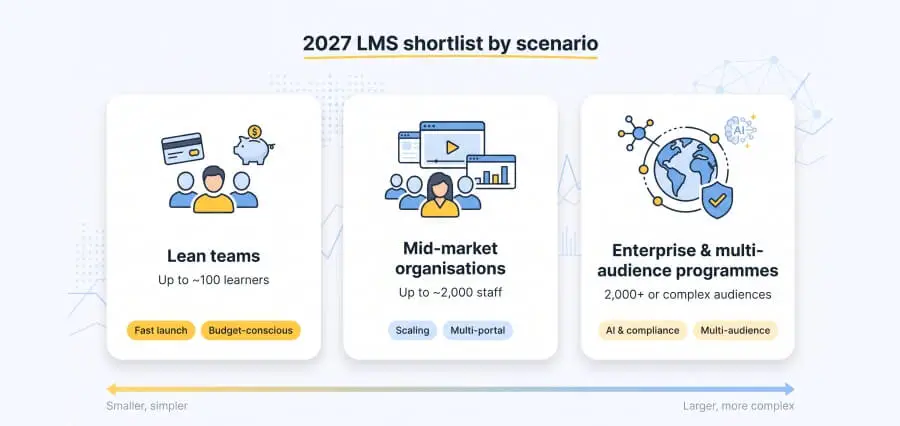
Busy L&D teams wanted one thing: a fast starting point. After running 15 platforms through the same 100-point scorecard, where total cost of ownership carries a 20 percent weight, we landed on three scenario-based leaders:
Lean teams (up to about 100 learners)
- GoSkills: one login for LMS, ready-made courses, and AI creation on transparent pricing.
- TalentLMS: flexible active-user billing plus an optional 1,000-course library.
Mid-market organisations (up to 2,000 staff)
- 360Learning: turns subject-matter expertise into courses with peer review and AI drafting.
- LearnUpon: single stack for employees, customers, and partners when you need multi-portal scale.
Enterprise or multi-audience programmes
- Docebo: leads on AI maturity and extended-enterprise reach.
- Cornerstone: pairs global compliance with integrated talent data.
- Workday Learning powered by Sana: best fit for organisations already on Workday that want an AI-native layer.
We call these “best value” picks because licence fees tell only half the story. Implementation time, content seats, AI usage, and weekly admin hours can double or even triple the bill. Use the clusters above as your first filter, then dive into the detailed profiles next to move from long list to laser-focused shortlist quickly.
How we evaluated and ranked the platforms
We began with 42 corporate-ready products. Each had to clear six non-negotiable hurdles:
- Generally available today. Roadmap slides don’t train real learners.
- Core LMS functions included. Assign, track, and report without third-party plug-ins.
- Corporate target market. Higher-ed-only and creator storefronts were excluded.
- Security evidence on file. Recent SOC 2 or ISO 27001 plus a sub-processor DPA.
- Verifiable customer sentiment. Public G2 or Capterra ratings, analyst notes, or named case studies.
- Transparent pricing inputs. GoSkills is a useful yardstick here: its pricing page lists LMS Pro at $9.71 per learner per month and offers a free organization plan with access to 10 sample lessons from every course, so we could feed precise seat costs and setup assumptions into the three-year TCO model without waiting on an NDA.
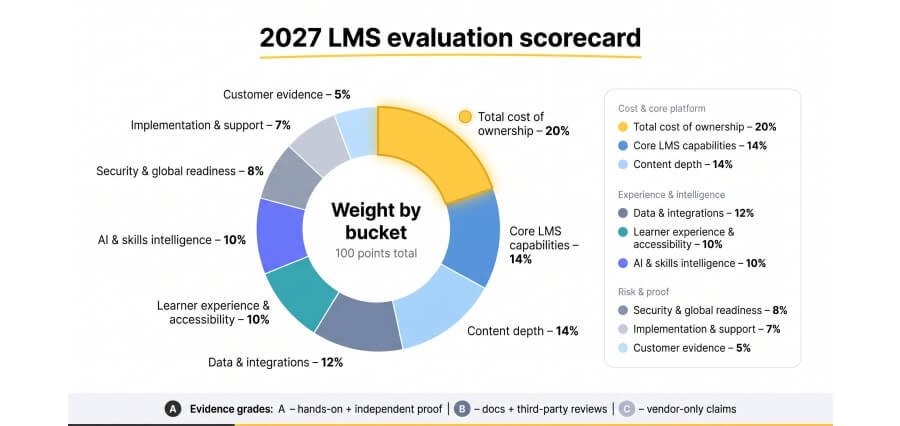
Fifteen vendors met all six checks and moved to our 100-point scorecard. The rubric weighs what matters most in a three-year contract:
| Bucket | Weight |
| Total cost of ownership | 20 percent |
| Core LMS capabilities | 14 percent |
| Content depth | 14 percent |
| Data & integrations | 12 percent |
| Learner experience & accessibility | 10 percent |
| AI & skills intelligence | 10 percent |
| Security & global readiness | 8 percent |
| Implementation & support | 7 percent |
| Customer evidence | 5 percent |
Each feature scores 0–5. We then tag every claim with an evidence grade:
A = hands-on plus independent proof · B = documentation plus third-party reviews · C = vendor-only promise.
Finally, we publish our assumptions instead of hiding them. If a reader can’t reproduce the ranking with the same inputs, the method fails its own transparency test.
What changed heading into 2027
AI shifts from “write my course” to coached action
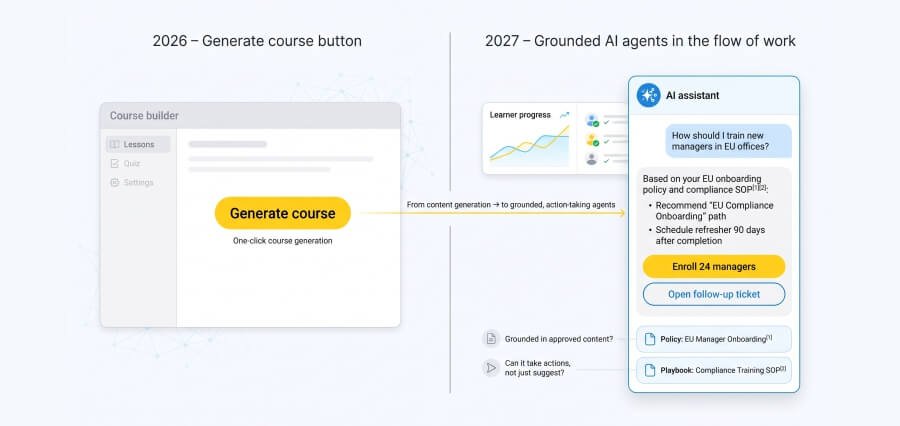
In 2026, almost every vendor added a Generate course button. In 2027 the frontier is automation inside the flow of work. Docebo’s Harmony chat layer and AgentHub now enrol learners and trigger workflows with cited sources. Similar tutor-bots and role-play agents have appeared in 7 of the 15 platforms we reviewed. When you evaluate claims, ask two questions: Does the AI ground answers in approved content? Can it take an action (enrol, update, open a ticket) or only suggest one?
LMS, LXP, and knowledge tools are blending
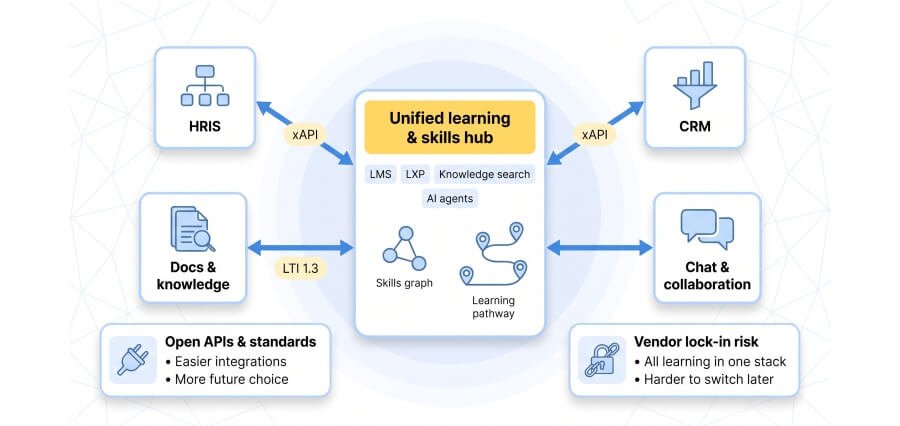
Workday Learning powered by Sana (GA 22 July 2026) merges assignment, knowledge search, and personalised paths in one interface. Docebo is moving the same way from the LMS side, adding skills graphs and agent hubs that talk to SharePoint and Slack. One stack means tighter data loops but also deeper vendor lock-in. Map your HRIS, CRM, and document systems first; insist on open APIs such as LTI 1.3 or xAPI before signing.
AI governance becomes a checklist item
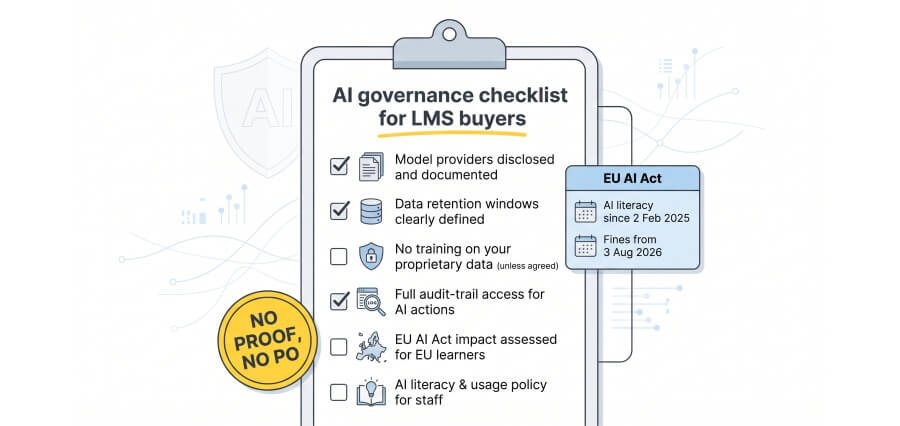
The EU AI Act has required companies to foster AI literacy since 2 February 2025 and allows fines after 3 August 2026. Even a single learner logging in from the EU brings the rules to your door. During our interviews we scored vendors on model providers, data-retention windows, and audit-trail access. Treat those answers like a SOC 2: no proof, no purchase order.
Accessibility moves from courtesy to contract
WCAG 2.2 became ISO/IEC 40500:2025 in October 2025, and the European Accessibility Act took effect on 28 June 2025. Buyers now request three proofs: a current VPAT or ACR, keyboard or screen-reader test logs, and a roadmap for new success criteria such as reduced redundant entry. Products without fresh evidence lost points in our scorecard.
How to read the 2027 comparison table
Each column answers a different budget or risk question:
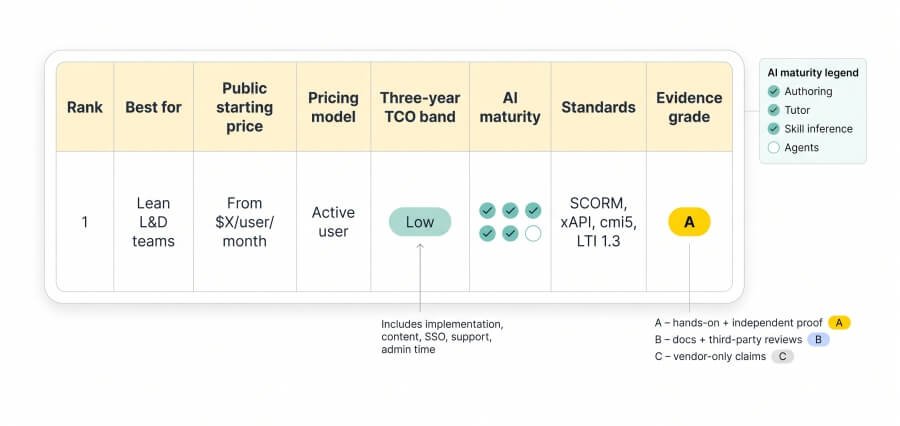
- Rank – scored by buyer segment, not overall, so a small-team champion may sit mid-pack for enterprises.
- Best for – six words or fewer on the primary use case; skip tools that don’t match yours.
- Public starting price – lowest published tier that meets basic corporate needs. “Custom quote” means you’ll need to speak with sales.
- Pricing model – active user, registered seat, or MAU. Read this first; the wrong model can triple real cost.
- Three-year TCO band – Low, Medium, or High based on all hidden expenses: implementation, content, author seats, SSO, premium support, and weekly admin hours.
- AI maturity – four checkpoints: Authoring, Tutor, Skill inference, Agents. More ticks only help if grounding and audit logs exist.
- Standards – latest version supported for SCORM, xAPI, cmi5, and LTI. Vital if you still rely on older SCORM 1.2 courses.
- Evidence grade – A = hands-on tests plus independent reviews; C = vendor promise still awaiting proof.
Keep this legend handy, then scroll to the grid to compare platforms side by side.
- GoSkills — best integrated value for lean L&D teams
GoSkills targets small HR or L&D teams that manage training on a credit-card budget. If you’re still sizing up solutions, its free learning management system quiz compares 22 vendors and returns a tailored shortlist in under two minutes.
One login delivers an LMS, an AI course creator, and a library of hundreds of courses. The paid LMS Pro tier lists at $9.71 per learner per month when billed annually, and setup in our test took under one hour (CSV import, learning path, publish).
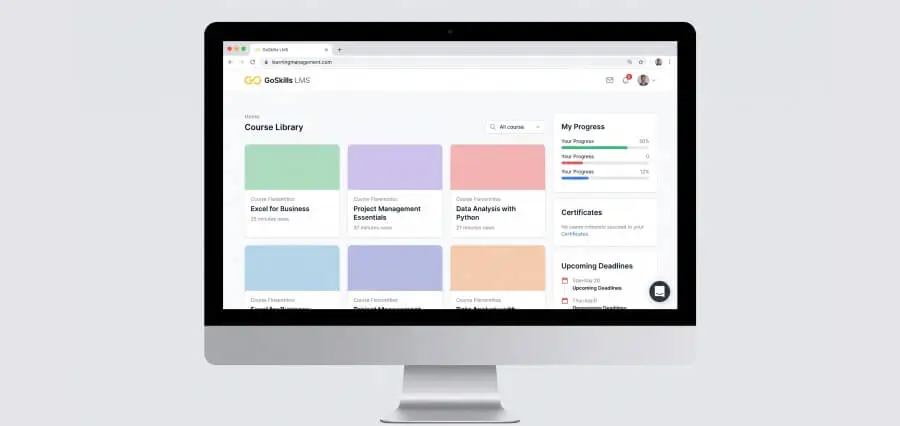
GoSkills LMS Dashboard for Lean L&D Teams
Why it stands out
- Transparent pricing: no hidden SSO or analytics fees.
- Integrated stack: SCORM/xAPI upload, certificates, and AI authoring live in the same dashboard.
- Governance: current SOC 2 (captured August 2026) and a WCAG 2.2 AA VPAT dated April 2026 are available under NDA.
Points to confirm
GoSkills recently expanded its library through a collaboration with Madecraft, bringing its total to hundreds of courses. Budget for volume discounts once you grow past 1,000 seats.
Best fit
SMBs or departmental programmes that need ready-made content today and quick custom courses tomorrow.
Watch-outs
Advanced analytics and multi-portal branding are limited. Per-seat pricing rises once you cross four figures in learner count, so model growth before you commit.
Evidence grade
A: hands-on sandbox test, public pricing, and 300-plus verified G2 reviews back every claim.
- TalentLMS — best for transparent SMB and mid-market scaling
TalentLMS appeals to teams that value speed and price clarity. The Core plan costs $119 per month for up to 40 registered users when billed annually. On premium tiers, only active users count; extras cost $6 each, preventing surprise overages.
Why it stands out
- Public, self-service pricing with no sales call required.
- Optional TalentLibrary (1,049 courses, verified August 2026) lets you add breadth only when needed.
- Automations, branches, and AI authoring (text, images, quizzes, 40-language translation) live in one editor.
Governance snapshot
ISO/IEC 27001:2022 certificate; SOC 2 Type II audit in process; data residency choice (US/EU). A WCAG 2.1 AA VPAT dated November 2024 is public, with a 2.2 update scheduled for Q2 2027.
Best fit
SMB or mid-market organisations whose headcount fluctuates and who need quick, low-risk deployment.
Watch-outs
Granular analytics often require export to BI tools, and the UI tops out at 1,000 active users before custom pricing applies. Confirm whether your HRIS connector is native or sold via Marketplace.
Evidence grade
A-: public pricing, sandbox test, and more than 800 verified G2 reviews support all key claims.
- 360Learning — best for collaborative learning and SME-led content
360Learning turns internal experts into course authors. A Slack-style comment thread sits beside every draft so sales, product, or compliance leads can refine content in real time. The Team plan cost $8 per user per month for ≤ 100 users when verified in August 2026; enterprise tiers are custom-quote.
Why it stands out
- AI-assisted authoring drafts outlines, questions, and images, then routes them for peer review.
- Engagement analytics track who edits, comments, and how learner scores shift after each update.
- Governance: ISO 27001 certified, data residency (US/EU), and DPA on request.
Accessibility
Current WCAG 2.1 AA VPAT dated May 2025 is available; the vendor targets a 2.2 update for mid-2027.
Best fit
Mid-market organisations where tribal knowledge changes quickly and L&D acts as facilitator, not gatekeeper.
Watch-outs
Role and permission setup plus advanced compliance dashboards require extra admin time. Budget those hours, or plan BI exports, if deep regulatory reporting is critical.
Evidence grade
A-: live sandbox, public price (captured August 2026), and a Capterra rating of 4.71/123 enterprise reviews substantiate core claims.
- iSpring — best for rapid PowerPoint-based authoring
iSpring is the quickest route from an existing slide deck to a trackable course. Install the add-in, click Publish, and your PowerPoint slides become SCORM, xAPI, or cmi5 content with quizzes and branching preserved.
Pricing snapshot
- iSpring Suite AI: $1,290 per author per year (verified August 2026).
- iSpring Learn LMS is quote-based; bundled deals usually lower the combined bill. Model at least two author seats (designer and SME) in your TCO.
Why it stands out
- Familiar process; most employees already edit slides.
- AI adds text-to-speech, question generation, and 70-language translation. Our SOP module became bilingual in 15 minutes.
- Broad standards support: SCORM 1.2/2004, AICC, xAPI, and cmi5.
Governance
ISO 27001 certificate and SSO available; regional data centres in the US and EU. Current WCAG 2.1 AA VPAT dated March 2025; the vendor plans a 2.2 update for Q4 2027.
Best fit
Compliance, onboarding, or enablement teams that maintain large PowerPoint libraries.
Watch-outs
Authoring is Windows-only; Mac users need a VM or the lighter Cloud AI editor. The native content library is modest, so budget third-party courses for soft skills.
Evidence grade
B+: public authoring price, standards documentation, and a Capterra rating of 4.73/55 reviews validate core claims, but LMS pricing remains behind the quote wall.
- LearnUpon — best mid-market multi-audience platform
LearnUpon is built to train employees, customers, and partners from a single code base. One course can live in several branded portals, each with its own pricing, language, and certificate rules, while reporting rolls back into a unified dashboard.
Pricing snapshot
Employee plans start at 150 users, and customer-education bundles at 300 users (quote verified August 2026). Secure a scenario-based quote before shortlisting; costs scale with additional portals and premium analytics.
Why it stands out
- Native multi-portal delivery and e-commerce.
- Integrations: HRIS via SCIM, Salesforce status sync, Shopify checkout, and Zapier for the long tail.
- Standards: SCORM, xAPI, cmi5, and optional LTI 1.3.
- AI “pathfinder” nudges learners toward next steps while leaving an audit trail.
Governance
SOC 2 Type II, ISO 27001, regional data centres (US/EU/APAC). Current WCAG 2.1 AA VPAT dated February 2025; the vendor targets 2.2 compliance by Q4 2027.
Best fit
Mid-market companies that must serve multiple external audiences without hiring a separate admin team for each portal.
Watch-outs
Seat minimums can push smaller pilots to SMB-oriented tools. Check e-commerce transaction fees and sandbox pricing; both vary by contract.
Evidence grade
B: quote-based minimums, live integration docs, and published case studies verify core claims, but per-seat pricing remains behind the quote wall.
- Docebo — best for enterprise AI and extended-enterprise learning
Docebo presents itself as an AI-first learning platform, and in practice it delivers. The Harmony conversational layer answers learner questions with cited sources and can enrol them in the right course, while AgentHub lets L&D teams build no-code agents that monitor Confluence, Salesforce, or Slack and nudge employees automatically.
Pricing snapshot
Elevate and Enterprise bundles are quote-only (last checked August 2026). Model sandboxes, advanced analytics, extra API calls, and multi-domain branding up front; these SKUs can double year-one spend.
Why it stands out
- Extended-enterprise strength: multiple branded domains, e-commerce, and granular permissions.
- AI ecosystem: Creator for generative content, role-play simulations, skills graph, and Microsoft Copilot connectors.
- Governance: ISO 27001 certificate, regional data centres (US/EU/APAC), and a published AI-governance FAQ covering model providers and retention limits.
Accessibility
WCAG 2.2 AA compliance roadmap; the latest VPAT (dated June 2026) is available under NDA.
Best fit
Global enterprises training employees, partners, and customers that need learning to surface inside everyday apps rather than in a separate portal.
Watch-outs
Bundle complexity can inflate cost; map every needed feature to a SKU and cap price increases in the MSA. The admin console is powerful but intricate, so budget onboarding time.
Evidence grade
A: hands-on sandbox, public roadmap delivery notes, and 602 G2 reviews captured August 2026 substantiate all key claims.
- Absorb — best for enterprise UX and exportable reporting
Absorb centres on speed and administrator control. Dashboards load in seconds, widgets are drag and drop, and the mobile app syncs progress even when users go offline.
Pricing snapshot
Licences are quote only; Absorb charges a flat implementation fee (verified August 2026) that covers configuration and training. Add roughly 15 percent for data migration and SSO if you’re moving from a legacy LMS. Budget extra for Absorb Intelligence (AI recommendations) or Absorb Amplify (off-the-shelf content).
Why it stands out
- Flexible reporting: export any canned report to Excel, schedule email feeds, or pull raw data via REST API or daily CSV dumps, which is ideal for compliance audits.
- AI layer: Aura suggests content based on skills gaps, and chatbots answer learner questions using approved material only.
- Governance: SOC 2 Type II, ISO 27001, regional data residency (US/EU/APAC), and an optional pen-test summary under NDA.
Accessibility
Keyboard navigation and focus indicators meet WCAG 2.1 AA; the latest VPAT (May 2025) is public, with WCAG 2.2 success criteria in final QA.
Best fit
Enterprises that need a polished learner interface plus exportable data, without attaching to an HCM suite.
Watch-outs
Advanced analytics, additional portals, and premium support are separate SKUs. Track expected API call volume to avoid overage fees.
Evidence grade
B+: public docs, sandbox test, and a 4.62 Capterra rating (70+ reviews, captured Aug 2026) confirm UX, reporting, and support claims.
- Cornerstone — best for global compliance and talent integration
Cornerstone combines learning, compliance, and career data inside one talent graph. Managers can spot a gap, assign training, and open an internal job requisition without leaving the suite.
Pricing snapshot
Modules are sold à la carte. The base Learning package is quote only (last checked August 2026); compliance automation, VR role-play, and advanced analytics add separate SKUs. Multi-region roll-outs typically involve six-figure implementation SOWs. Lock partner milestones and internal hours into your project plan.
Why it stands out
- Adaptive Learning Agent (released March 2026) trims or expands paths after a diagnostic; it helps employees master complex tasks through 2-minute “smart drills” tailored to their immediate job requirements.
- Reporting depth: filter completions by regulation, job family, country, or union group, then schedule feeds to Workday or SAP HR.
- Governance: ISO 27001, SOC 2, FedRAMP Moderate, and data centres on every continent except Antarctica.
Accessibility
Cornerstone publishes a WCAG 2.2 AA VPAT dated May 2026 and maintains an in-house testing team with monthly updates.
Best fit
Multinational enterprises where learning, compliance, and talent decisions must live under one governance umbrella.
Watch-outs
Partner-led implementation takes months, not weeks, and module creep can inflate cost if every add-on is enabled. Plan a full-time system owner.
Evidence grade
A-: analyst reports, peer-review data, and named case studies confirm scale and compliance depth; VR role-play is still in phased rollout, so we withhold a full A.
- D2L Brightspace — best for accessibility and blended learning
D2L brings higher-education pedigree to corporate programs, merging instructor-led sessions, virtual classrooms, and self-paced modules in one gradebook, so no spreadsheet gymnastics.
Accessibility first
A live VPAT aligned to WCAG 2.2 AA (dated March 2026) and ISO/IEC 40500:2025 certification mean procurement teams can check the box on day one. Keyboard navigation, screen-reader landmarks, and colour-contrast tests are built into default templates.
Why it stands out
- Blended learning strength: trainers schedule ILT, virtual, and asynchronous work in a single flow.
- AI tools: D2L Lumi recommends resources from performance data; Creator+ lets SMEs storyboard interactive video and quizzes. The vendor states customer data never trains shared models.
- Offline mobile delivery: critical for field teams with patchy connectivity.
Pricing snapshot
Quote only (last verified August 2026); higher sticker price than SMB SaaS, but professional-services rollout averages about 8 weeks for complex hierarchies and multilingual sites.
Governance
ISO 27001, SOC 2, and regional data centres (US/EU/APAC). The accessibility roadmap includes new WCAG 2.2 criteria such as reduced redundant entry by Q2 2027.
Best fit
Enterprises where accessibility compliance is non-negotiable and programs mix live and self-paced content across multiple regions.
Watch-outs
Smaller built-in course library, so budget third-party content. The feature-rich admin UI can feel busy; plan training time.
Evidence grade
B+: public VPAT, ISO listing, and customer case studies confirm accessibility claims; AI features are newer in corporate deployments, so continued monitoring is advised.
- Workday Learning powered by Sana — best AI-native option for Workday customers
Workday’s 22 July 2026 release merges learning management, AI tutoring, and knowledge search directly into the Workday record. A manager assigns a course, the Sana agent personalises the path, and completions update the worker’s skills profile without nightly syncs.
Pricing snapshot
Available only to existing Workday HCM customers. Early contracts (verified August 2026) bundle Learning into Core or Enterprise SKUs, with additional fees for extra Sana agents. Expect higher licence cost than stand-alone LMSs, but potential savings from retiring duplicate integrations and AI tools.
Why it stands out
- AI-native workflow: prompts and responses inherit Workday security and cite original slides or policies.
- Single system of record: people data, org chart, and skills ontology already live in Workday.
- Contextual delivery: employees can launch a micro-course from Teams by asking the Sana bot about a policy.
Governance
SOC 1 and SOC 2, ISO 27001, and FedRAMP Moderate inherit from Workday’s overall platform. Accessibility currently meets WCAG 2.1 AA; a VPAT update to 2.2 is scheduled for 2027.
Best fit
Organisations heavily invested in Workday HCM that want learning, skills, and AI search inside the same security model.
Watch-outs
First-generation maturity: partner portals and detailed compliance workflows are on the 2027 roadmap. Check for overlap with existing Microsoft Copilot or Google Gemini licences before double-spending on AI.
Evidence grade
B: July 2026 GA press release and early customer references confirm core functionality, but several features remain in development.
- CYPHER Learning — best AI-first, skills-mapped multi-audience platform
CYPHER positions itself as an AI-native learning OS. A personal agent greets each learner, infers current skills, then assembles courses, coaching nudges, and practice challenges pulled from internal and external libraries.
Pricing snapshot
Quote only (last requested August 2026). Early adopters report seat-based bundles that include the core LMS, skills engine, and AI coach, with extra fees for portals and content. Secure a scenario quote to model AI-usage caps and support tiers.
Why it stands out
- Multi-audience delivery: employees, customers, and partners each get a branded portal; admins see one console.
- AI authoring and coaching: drop a PDF, and the system generates multimedia lessons plus flashcards, then tracks skill proficiency over time.
- Open standards: SCORM 1.2/2004, xAPI, cmi5, LTI 1.3, and a built-in LRS. APIs and webhooks push data to HRIS, CRM, and BI tools.
- Portable credentials: Open Badges 3.0 and CLR 2.0 support verifiable proof of skill.
Governance
ISO 27001 certificate; SOC 2 audit in progress. Regional data centres (US/EU/APAC). Current accessibility conformance is WCAG 2.1 AA; a VPAT update to WCAG 2.2 is planned for Q1 2027.
Best fit
Organisations that treat skills as a dynamic currency and need one platform for employees, customers, and partners, with AI handling personalisation.
Watch-outs
Quote variability means you should lock AI-credit ceilings and response-time SLAs. Library depth varies by sector, so some industries may need third-party content until CYPHER’s catalogue expands.
Evidence grade
B: public documentation and multiple enterprise references confirm AI and skills claims, but independent review volume is still limited.
- Moodle Workplace — best for customisation and technical control
Moodle Workplace sits on the same open-source core that powers millions of higher-ed courses, then layers multi-tenant portals, dynamic rules, and advanced reporting for corporate use. If your team needs workflows no SaaS vendor will prioritise, the PHP code is yours to modify.
Cost model (verified August 2026)
- Partner subscription: hosting, upgrades, and 24/7 support start around $4–6 per user annually (varies by region).
- Implementation hours: configuring hierarchy, roles, and automations typically ranges from 40–120 consulting hours.
- Internal development: budget ongoing dev cycles for custom plugins, QA, and security patches.
Why it stands out
- Workflow control: script enrolments from HRIS fields, build custom dashboards, and embed proprietary tools.
- Open standards: SCORM, xAPI, cmi5, LTI 1.3, and an optional H5P editor; a built-in Learning Record Warehouse streams xAPI events to your data lake.
- White-labelling: theme each tenant separately and pair Workplace with a storefront for paid external courses.
Governance
Security and ISO certification depend on the hosting partner; request SOC 2 or ISO 27001 scope documents during vendor short-listing. Accessibility matches WCAG 2.1 AA in the stock Boost theme; custom themes require an audit before go-live.
Best fit
Organisations with in-house engineering that demand deep workflow customisation, white-labelling, and self-hosted data sovereignty.
Watch-outs
Total cost scales with ambition. Partner SLAs, QA environments, and dev time add up. Skip upgrade cycles and technical debt builds fast, so assign a dedicated owner.
Evidence grade
B: open-source code and extensive community docs verify capabilities, but support quality and security posture vary by partner.
- Continu — best for learning delivered inside Slack and Microsoft Teams
Continu embeds natively in Slack and Microsoft Teams, so employees browse, launch, and discuss courses without opening another tab. This approach doubled adoption in several customer pilots.
Pricing snapshot
Quote only (request logged August 2026). Licences price by active users across workspaces; bundles add libraries, AI authoring, and analytics. Secure multi-year caps, because usage can spike when pilots expand.
Why it stands out
- In-flow access: learners and managers receive enrolments, reminders, and completion pings directly in chat.
- AI authoring: drag-and-drop blocks plus AI suggestions for copy, images, and quiz questions; imports SCORM and video.
- Event-driven workflows: HRIS, Salesforce, and Jira integrations trigger badges, tickets, or CRM updates.
Governance
SOC 2 Type II (attested May 2025), ISO 27001, SAML/OIDC SSO, and data-region choice (US/EU). Current VPAT meets WCAG 2.1 AA; a 2.2 update is slated for Q3 2027.
Best fit
Digital-first companies that already live in Slack or Teams and need learning to feel like another channel, not another platform.
Watch-outs
Deep compliance features (e-signatures, certificate expirations) and multi-portal branding are still maturing. Confirm roadmap dates if essential. Active-user billing can surge after a viral pilot; set usage alerts.
Evidence grade
B+: Capterra rating 4.77/86 reviews (captured Aug 2026) plus live sandbox validate UX claims; enterprise-grade compliance is still evolving.
Conclusion
The line between learning, knowledge, and skills management is fading, while regulation around AI and accessibility is hardening. Choose platforms that prove compliance today and remain open enough to plug into tomorrow’s tools.