



The first AI video test in a company is often treated like a creative experiment. One person writes a prompt, another person adds a product image, and a manager asks whether the result is good enough for a campaign. That loose process may be fine for a first look. It becomes risky when the same team wants to produce dozens of clips for launches, sales enablement, recruiting, customer education, or paid media.
Scaling video is not only a production question. It is a leadership question. Who owns the message? Who approves the reference files? Which claims can appear on screen? What should happen when a generated scene looks polished but does not quite match the brief? Without those answers, a faster tool can simply create faster confusion.
That is why approval gates matter. A gate is not bureaucracy for its own sake. It is a pause where the right person checks the right risk before work moves to the next stage. For organizations exploring AI-assisted video, Seedance 2.5 on JXP can support early campaign planning by turning approved prompts and eligible references into reviewable drafts, while the final message, claims, and publishing decision remain with the business team.
The First Gate: Business Purpose
Before a team tests a clip, someone should decide why the video exists. A campaign teaser, investor update, hiring message, product walkthrough, customer support explainer, and internal training asset do not need the same style or the same level of proof.
A clear purpose reduces waste. If the goal is awareness, the draft may need a strong opening and a simple promise. If the goal is training, accuracy and step order matter more than visual drama. If the goal is sales enablement, the clip should support a specific conversation instead of trying to summarize the whole company.
This gate should produce a short brief: audience, channel, message, asset owner, and next action. If those items are missing, the video test is likely to become a taste contest.
The Second Gate: Source Material
AI video drafts often depend on reference materials. A product photo may guide the subject. A rough storyboard may guide scene order. A brand palette may guide tone. A short audio cue may guide pacing. Each file should have a defined reason for being included.
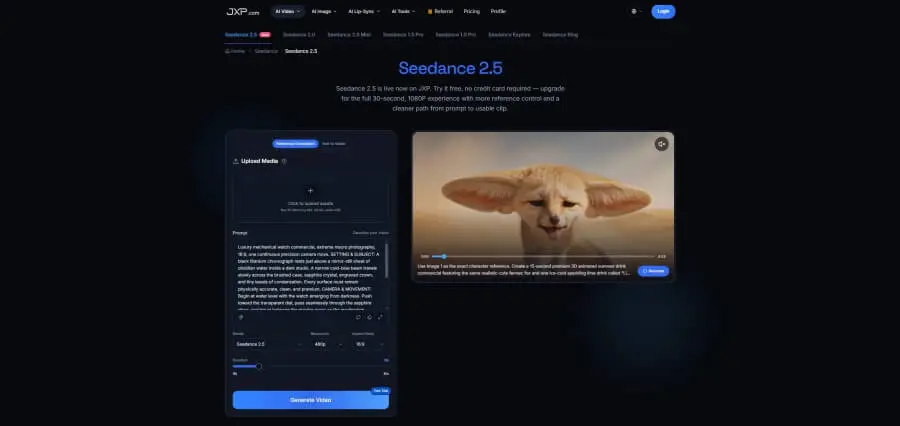
JXP’s Seedance 2.5 page shows a browser-based workflow with Reference Generation and Text to Video modes, upload support for multiple asset types, selectable model, resolution, aspect ratio, and duration controls, and an upload limit shown as 50 files across images, videos, and audio. Those controls give teams room to test richer ideas, but they also make input discipline more important.
Business leaders should separate creative permission from AI-processing permission. A file approved for a sales deck may not be approved for external model input. A customer story may be approved for a case study but not for generated reenactment. A licensed image may have limits on remixing or paid distribution. The source gate keeps those questions from appearing too late.
The Third Gate: Claims and Evidence
A video draft can make a claim feel stronger than the article, report, or campaign brief actually supports. A generated crowd can imply demand. A fictional dashboard can imply measured performance. A confident product scene can imply a feature works in a way the current release does not support.
The claims gate asks whether every implied message has a source. If the campaign says a product saves time, the team should know where that claim comes from and whether it belongs in the video. If a statistic appears, the date, sample, and source should remain available in the surrounding article, landing page, or sales material.
When uncertainty matters, keep it visible. A short clip should not turn “may reduce manual review time” into “removes manual review.” It should not turn early feedback into market proof. Good visual communication makes the evidence easier to understand; it does not invent stronger evidence.
The Fourth Gate: Brand Fit
A polished draft can still be wrong for the company. The pace may feel too aggressive for a trust-based service. The lighting may make a practical product look like luxury fashion. The characters or settings may pull attention away from the actual offer. The ending may feel like a hard sell when the campaign needs a calmer invitation.
Brand review should happen before final editing, not after. At the draft stage, teams can still change framing, mood, scene order, and caption space without rebuilding the whole campaign. The review should be specific: which moment feels off, which audience may misunderstand it, and which brand rule or business goal is affected.
That specificity matters because “make it more premium” or “make it more human” is hard to execute. A better note says, “reduce the camera movement during the product explanation” or “keep the customer benefit on screen longer before the logo appears.”
The Fifth Gate: Channel Reality
A boardroom preview is not the same as a mobile feed. A clip may look clear on a large screen but lose the CTA under platform controls. A caption may be readable in a presentation but too small inside a vertical ad. A 30-second draft may explain the message well, while a shorter cut may need a different opening.
The channel gate checks the practical version of the idea. Which aspect ratio is needed? Where will captions sit? Does the first frame work as a thumbnail? Can the message survive without sound? Does the page or post around the video still carry the necessary details?
A workflow inside the Seedance 2.5 workspace on JXP can help teams compare these options before final production, especially when they need to test duration, crop, reference direction, and pacing. The goal is not to predict performance from a draft. It is to avoid sending the wrong version into an expensive channel.
The Final Gate: Human Accountability
AI-assisted production works best when accountability is visible. The tool can generate a draft, but it cannot own the campaign promise. It cannot confirm that every claim is approved, every reference is eligible, every disclosure is readable, and every stakeholder has signed off.
A simple approval record can prevent confusion later. List who approved the message, who checked the source material, who reviewed the final text, and who cleared the channel version. That record does not need to be complicated. It only needs to show that speed did not replace judgment.
The companies that benefit from AI video will not be the ones that treat every draft as publishable. They will be the ones that know when a draft is useful, when it is misleading, and when the next gate should stop the campaign from moving forward. Used that way, video generation becomes part of a disciplined creative process, not a shortcut around leadership.