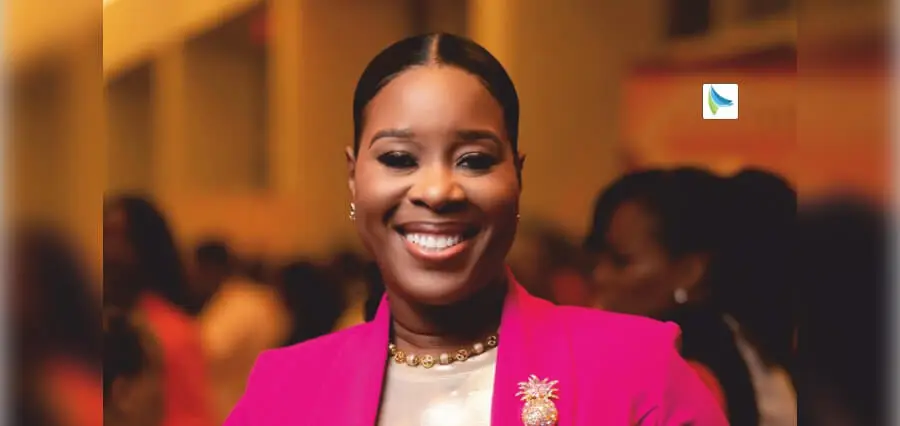





There is a particular kind of young leader whose influence does not announce itself through credentials or corporate titles. It announces itself through the quality of the spaces they create and the sincerity with which they show up inside them. Sabrina Fernandez, Founder and Chief Executive Officer of the Delusional Optimist Club, belongs to that category. She has built her platform not on the back of institutional support or inherited advantage but through a combination of handwritten letters, published books, lived community work, and a conviction so specific it has a name: optimism as a deliberate act rather than a comfortable feeling.
Sabrina grew up in Coimbatore, India, in a values-driven Anglo-Indian family where faith, resilience, and kindness were not simply taught but modelled in daily life. From an early age, she was drawn to storytelling and to the particular kind of connection that happens when one person takes the time to write something honest to another. She wrote letters constantly. She journaled. Over time, that correspondence expanded into a practice that would eventually span continents, more than 100 handwritten letters sent across the world, and that practice became the seed of three published books: Over the Rooftops of the World, Postmarked to Heaven, and Pip’s Letter Day Parade. Her work has been featured in Dymocks, Readings, and Melbourne CBD billboards.
She reflects, “Storytelling has always been my starting point. From handwritten letters to publishing three books, it has been my way of understanding the world and connecting with others.”
The Journey That Was Never Linear
The path from Coimbatore to Melbourne, where Sabrina completed her Master’s in Global Studies at RMIT University specializing in Development, was not smooth. Financial constraints, loan rejections, and the challenge of building an independent life in a new country shaped her in ways that a more comfortable trajectory would not have. These were not minor inconveniences. They were the kind of sustained uncertainty that either breaks a person’s confidence or deepens it, and in her case, they did the latter.
At RMIT, she did not simply study global development. She lived it through community engagement, becoming a Student Representative, contributing to Amnesty International, volunteering with Orange Sky Australia, participating in Make-A-Wish Melbourne events, and engaging with the International Youth Fellowship. Those experiences gave her something that classroom learning rarely provides: a ground-level understanding of how communities actually function, what meaningful participation looks like from the inside, and why the gap between people who care about global challenges and the spaces where those challenges are discussed is often wider than it needs to be.
That gap became the founding frustration of the Delusional Optimist Club. Conversations around global issues felt distant, academic, and inaccessible to young people who genuinely wanted to engage but did not know where to start or whether their voice would be heard if they did. Sabrina decided to build the room herself.
She notes, “I asked myself what would happen if we created a space where people could engage with global challenges in a way that felt real, relatable, and actionable. That is how the DOC began.”
Building a Movement from the Ground Up
The Delusional Optimist Club is a community-driven platform that focuses on one United Nations Sustainable Development Goal at a time, hosting panel-style discussions, events, and collaborative spaces that bring together students, professionals, and changemakers across diverse backgrounds. Its first event, centered on Gender Equality, demonstrated from the beginning that there was a genuine appetite for exactly this kind of space: participants who were not only interested in learning but eager to contribute.
As Founder and CEO, Sabrina leads everything from partnerships and outreach to event strategy and execution. The combination of skills she brings to that work, the operational discipline developed through her Business Administration degree, the systems thinking built during her Global Studies program, and the human instinct sharpened through years of community work, creates a leadership profile that is more complete than her age might suggest.
The name itself carries an argument. The Delusional Optimist Club challenges the default cynicism that tends to accompany serious engagement with global problems. It positions optimism not as naivety or denial but as a deliberate strategic choice: the refusal to accept that things cannot improve as the starting point for action. That reframing is central to how the platform functions and why it attracts the kind of participants it does.
She states, “DOC challenges the narrative that optimism is unrealistic. Instead, it positions optimism as intentional and necessary for progress.”
The COVID Chapter and What It Clarified
The COVID-19 pandemic did not directly disrupt a business Sabrina was running at the time, but its impact on her formation as a thinker and a builder was significant. During the period of global isolation, letter writing moved from personal practice to something that felt essential. Staying connected through handwritten correspondence in a disconnected world was not a romantic gesture. It was a practical demonstration of the thing she had always believed: that intentional human connection is one of the most durable tools available for navigating uncertainty.
The pandemic also shaped her academic focus in ways that led directly to the Delusional Optimist Club. Watching global systems strain and fracture, observing how communities responded when formal institutions struggled, and seeing the particular vulnerability of young people who felt simultaneously most affected and least consulted by the decisions being made around them: these experiences clarified what she wanted to build and why it needed to exist.
She reflects, “COVID reinforced the importance of community and meaningful connection, which later became central to the Delusional Optimist Club. I see that period as one of clarity and growth.”
Recognition That Reflects the Work
The recognitions Sabrina has received reflect the breadth of what she has built across a short professional life. The International Book of Records recognition in 2025, the Emily Dickinson Award, the RMIT Creative Contributor Award, and the Rev. H.O. Fowler Memorial Award for Outstanding Student each acknowledge a different dimension of her contribution: her literary output, her creative presence within her academic community, and the quality of her engagement as a student leader.
What is notable about these recognitions is that they arrived not because of institutional positioning but because of sustained effort across multiple platforms simultaneously. She was publishing books while completing a demanding postgraduate program while founding a new organization while maintaining active community involvement. The ability to operate at that breadth without losing depth in any individual area reflects both exceptional organizational capacity and a genuine passion for each of these endeavors rather than a strategic calculation about which ones to pursue.
She notes, “For me, achievements are defined by impact, growth, and contribution. The confidence that clients, colleagues, and partners place in your leadership is often the most meaningful recognition one can receive.”
What Balance Actually Looks Like
When Sabrina speaks about balance, she is notably honest about what it does and does not look like in practice. She is a Master’s student, the founder of a growing platform, and an active contributor to multiple community organizations. The idea that she has found a neat equilibrium between all of these commitments and her personal wellbeing would be convenient but untrue.
What she has found instead is intentionality. Structure and clarity help her navigate competing demands without losing track of priorities. Planning her week around goals rather than tasks keeps her oriented toward what matters rather than what is simply urgent. And the emotional discipline she has developed, knowing when to step back, when to journal, when to rest, and when to lean on faith as a source of perspective, reflects a maturity about the limits of ambition that many people twice her age have not yet found.
She is equally honest about the patterns she is still working through. The tendency to overcommit because the work genuinely matters to her. The self-criticism that creates pressure where steadiness would serve better. The difficulty of trusting long-term processes when the desire to create impact is immediate and urgent. These are not presented as resolved challenges but as ongoing ones, which is itself a form of leadership honesty that is rarer and more valuable than polished self-presentation.
She affirms, “Balance for me is about intention. It is about showing up fully in whatever space I am in, while being honest about my limits.”
The Philosophy Behind the Platform
What connects every dimension of Sabrina’s work, the letters, the books, the community contributions, the Delusional Optimist Club, is a single underlying philosophy: change is possible, and the people closest to the problems are often the most capable of contributing to the solutions, if someone creates the conditions for that contribution to happen.
Her academic background in Global Studies gave that philosophy a structural understanding. Her community work gave it operational vocabulary. Her writing gave it a voice. And her personal journey, navigating financial uncertainty, cultural transition, and the specific challenges of building something entirely new without the safety net of established infrastructure, gave it a credibility that theory alone never could.
The business model she is building at the Delusional Optimist Club reflects the same values that produced the letters and the books: substance over speed, relationships overreach, and the patient belief that building something right is worth doing slowly. Her long-term vision is to scale DOC globally through partnerships, larger events, and youth-led initiatives that actively contribute to solving global challenges rather than simply discussing them.
She says, “I am motivated by the idea that even small actions can create meaningful ripple effects. Change is possible. Some may see it as idealistic, but I see it as necessary.”
What She Wants People to Remember
When Sabrina considers the advice, she would offer to aspiring leaders, particularly young women navigating the specific combination of ambition, uncertainty, and self-doubt that defines early leadership, her guidance is grounded in the same directness that characterizes everything else she does.
Start before you feel ready, because readiness is usually a story people tell themselves to delay the discomfort of beginning. Stay authentic, because the perspective that feels most personal is often the most genuinely useful to others. Build real relationships, because leadership without genuine human connection is management at best. And take care of yourself, not as a concession to weakness but as a precondition for sustainability, because a leader who has burned out cannot serve the people or the purpose that drove them to lead in the first place.
The message she sends to anyone watching her work is equally specific. Be brave enough to believe in something bigger than yourself. Stay consistent, stay kind, and stay grounded in your purpose. Growth takes time, but every step matters, including the ones that feel too small to count.
She reflects, “You do not need to have everything figured out to start. My journey is still unfolding, and I am learning every day. If there is one thing I hope people take away, it is that your ideas and your voice matter.”
In Melbourne, across the pages of three published books, and through every event the Delusional Optimist Club has produced and every one still being planned, Sabrina Fernandez is proving that point one step at a time.