




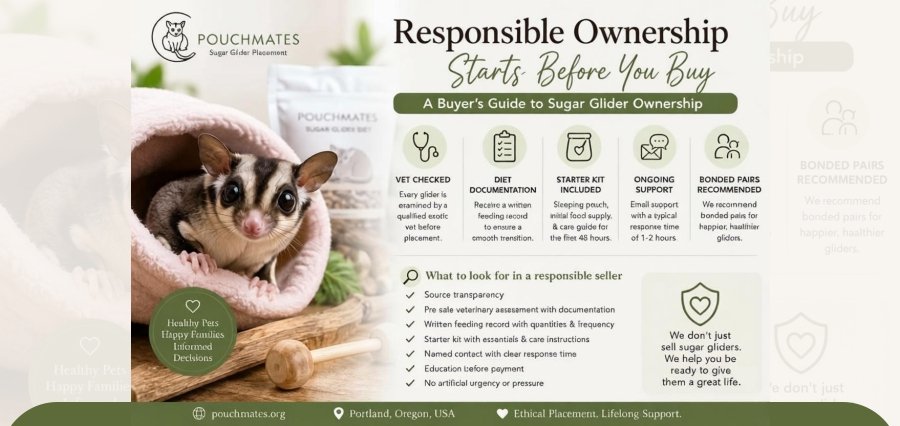
What prospective sugar glider owners should know before making a commitment, and how one Atlanta, Georgia-based provider is helping educate buyers before bringing a sugar glider home.
Sugar Glider ownership is growing. The welfare conversation is catching up.
Interest in sugar gliders as companion animals have increased steadily across the United States over the past decade. Sugar gliders, small marsupials are native to Australia and Southeast Asia. The awareness of sugar gliders has grown tremendously over the last few years.
The American Association of Exotic Mammal Practitioners (AAEMP) have published care guidance for the species. Most people research the animal only after it arrives.
The gap between consumer interest and consumer preparedness is where most sugar glider pet welfare problems begin.
Pouchmates, a sugar glider placement company based in Atlanta, GA, is one example. The company has published a comprehensive ownership guide and states it will not process a purchase before confirming the buyer understands the long-term care requirements.
This article draws on that guide, on published guidance from veterinary organisations, and on accepted species care practice to help prospective owners understand what responsible sugar glider ownership involves.
Why Pouchmates puts education before the sale?
Since 2019, PouchMates has been helping families welcome sugar gliders into their homes, backed by over 25 years of combined experience in sugar glider care, nutrition, and owner education.
The company has a network of in house, and external breeders it has vetted and evaluated over the years, working with Sugar Gliders.. According to the company, all gliders go through a health and wellness, pre-placement process, including examination by a dedicated veterinarian before any adoptions.
The company emphasises several practices it describes as non-negotiable in its placement process:
- Every animal is examined by a veterinarian before placement
- Every sugar glider placed in a home is fully weaned and consistently eating a healthy, balanced diet before being adopted.
- Every purchase includes a starter kit with, initial food supply, written feeding instructions, and a 30-day education and care guide
- Bonded pairs are offered as a standard option and recommended as the default for first-time owners
What sugar gliders are, and what ownership actually involves
Sugar gliders (Petaurus breviceps) are small marsupials, not rodents.
In the wild, sugar gliders live in tree canopies in groups of 10 to 15 individuals, glide between branches using a patagium (a membrane stretching from wrist to ankle), and forage nocturnally for nectar, sap, pollen, and insects.
Baseline facts every prospective owner should have:
- Adult weight: 4-5.3 ounces (113-150 grams)
- Body length: 5-6 inches, with an equally long tail
- Nocturnal: most active between dusk and dawn
- Lifespan: 10-15 years in captivity with appropriate care
- Social structure: colony animals that develop welfare problems when isolated
Diet is where most captive sugar gliders develop preventable problems
The Merck Veterinary Manual identifies metabolic bone disease caused by calcium-phosphorus imbalance as one of the most common preventable conditions in captive sugar gliders.
In the wild, sugar gliders consume a seasonally varied diet including insect protein, tree sap, nectar, and pollen.
To help simplify the process, PouchMates has developed a three-part feeding system designed to provide a balanced nutritional foundation.
The two feeding mistakes that cause most problems
Overfeeding fruit. Sugar gliders prefer sweet food. A fruit-heavy diet creates a calcium-to-phosphorus ratio the body cannot manage.
Pellet-only feeding. They require supplementation with protein sources such as calcium, protein, vegetables and controlled fruit portions.
3 widely referenced captive diet formulations, High Protein Wombaroo (HPW), Bourbon’s Modified Leadbeater’s (BML) and the TPG diet, are endorsed by breeders. Pouchmates recommends the HPW diet, with a mixture of pellets and fresh fruit/veggies.
Veterinary care.
A vet who sees primarily domesticated animals will often acknowledge they are not equipped to treat a sugar glider.
The (AAEMP) maintains a searchable directory of member veterinarians at aaemp.org.
Pouchmates states that every animal is examined by a dedicated veterinarian before placement.
Questions to ask before buying from any seller
- Where was this specific animal born? In-house or from an external breeder?
- Has a veterinarian examined this animal before sale? When, and what was the outcome?
- What has this animal been eating?
- What is included with the purchase? List the physical items.
- What post-purchase support do you offer?
Preparing your home before the animal arrives
Cage setup, vet identification, and food supply should all be in place first.
Pre-arrival checklist:
- Cage assembled, cleaned, and positioned in a draft-free room with regular human activity
- Sleeping pouch attached at mid-height inside the cage
- Branches, ropes, or climbing structures installed
- Water source (bottle preferred over bowl) secured
- Initial food supply purchased and portioned per the feeding plan
- Vet identified; contact saved
- Dogs, cats, and other pets physically separated from the glider’s room
- Ceiling fans, open toilet seats, and gaps behind appliances addressed
About Pouchmates
Is Pouchmates a legitimate company?
Pouchmates has been operating from Atlanta, Georgia since 2019. The company sources animals from in-house breeding and a vetted breeder network, provides pre-sale veterinary assessment, and includes a documented feeding record.
Does Pouchmates sell bonded pairs?
Yes, as a standard option. The company recommends bonded pairs for first-time owners and states it raises this recommendation before purchase rather than after.
How do I contact Pouchmates?
By email via pouchmates.org. The company states its typical response time is 1-2 hours during business hours.
Pouchmates is one available resource for prospective owners. Its ownership guide, seller checklist, and pre-sale consultation process are available at pouchmates.org.
About buying responsibly
What should I ask any sugar glider seller before buying?
Ask where the animal was born, whether a vet examined it before sale, what it has been eating (and request the written record), what is included with the purchase, what post-purchase support looks like.
Where can I find an exotic-animal vet?
AAEMP maintains a searchable directory at aaemp.org. The Association of Sugar Glider Veterinarians (ASGV) maintains a species-specific practitioner directory at asgv.org. Both are searchable by location.
Questions before you buy? Email Pouchmates via info@pouchmates.org.