




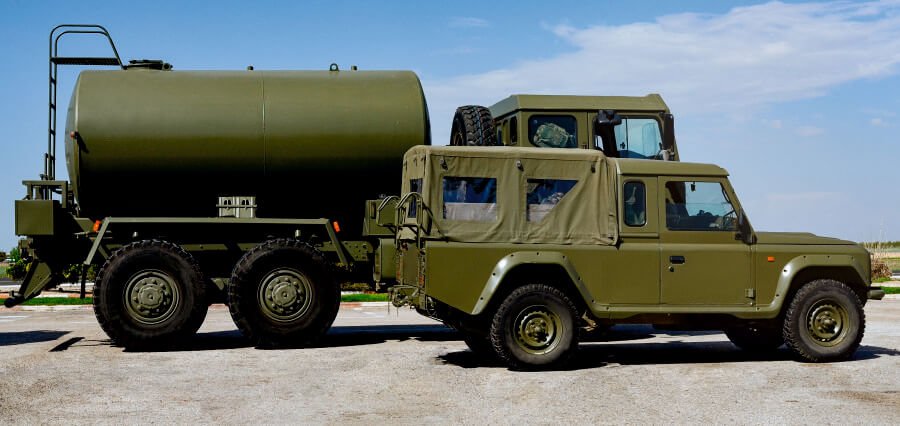
Transporting bulk liquids across agricultural and industrial environments requires careful attention to load stability and container design. Terrain conditions such as uneven farmland, sloped mining areas, or confined industrial yards influence how liquids behave during movement. When the tank shape matches the terrain it travels across, the load remains more stable and predictable, helping reduce liquid surge, maintain vehicle balance, and improve transport safety.
Cylindrical Tanks For Uneven Rural Terrain
Cylindrical tank designs are widely used in off-road environments because their curved structure distributes pressure evenly while allowing liquids to move more smoothly during travel. In agricultural operations and remote industrial areas where vehicles frequently pass through paddocks, gravel tracks, and ungraded access routes, cylindrical tanks help reduce abrupt shifts in liquid weight as the vehicle encounters bumps or uneven ground.
Specialised containers, including TTI tanks for industrial and agricultural liquid transport, are commonly designed with cylindrical profiles to support safer transport across these conditions. The rounded structure allows the liquid mass to stabilise more gradually when the vehicle tilts or vibrates, helping maintain better load control during movement.
Low-Profile Tanks For Sloped Mining Sites
Mining environments present unique terrain challenges due to steep haul roads, uneven platforms, and constantly changing ground conditions. In these situations, tank height can significantly influence vehicle stability. Low-profile tanks are engineered with a broader base and reduced height, keeping the liquid load closer to the vehicle’s centre of gravity.
Maintaining a lower centre of gravity reduces the likelihood of tipping when vehicles operate on inclined surfaces. By distributing the liquid weight more horizontally, these tank shapes help improve stability while transporting water, chemicals, or fuel across sloped mining terrain.
Elliptical Tanks For Road Transport Stability
When bulk liquids are transported between facilities via service roads or highways, elliptical tanks can provide additional stability. Their flattened oval shape lowers the centre of gravity while still allowing efficient storage capacity. This configuration supports safer transport when vehicles travel at higher speeds or cover longer distances.
Elliptical tanks also help reduce the impact of dynamic load transfer, a condition where liquid shifts rapidly during braking or acceleration. By limiting vertical movement inside the tank, the design allows for smoother vehicle handling and improved control during road transport.
Rectangular Tanks For Tight Industrial Access Areas
Facilities such as wineries, breweries, and chemical processing plants often have compact loading zones and restricted vehicle access points. Rectangular tanks can be useful in these environments because their shape allows them to fit efficiently within tight spaces or onto transport frames designed for confined industrial settings.
While rectangular tanks are generally better suited for controlled transport environments rather than rough terrain, they remain practical where manoeuvrability and space efficiency are important. When paired with internal stabilising structures such as slosh baffles, these tanks can help manage liquid movement during short-distance industrial transfers.
Tank Shape And Liquid Behaviour During Movement
The movement of liquid inside a tank is governed by principles associated with fluid dynamics, where the behaviour of liquids changes in response to motion, gravity, and container shape. As vehicles accelerate, brake, or navigate uneven ground, the liquid load shifts according to these forces.
Tank geometry influences how these forces interact with the container. Rounded shapes typically allow smoother redistribution of liquid, while wider and lower designs help reduce vertical movement of the load. Understanding how terrain and tank structure interact helps operators choose designs that maintain better stability during transport.
Why Tank Geometry Matters For Transport Safety
Matching tank shape to terrain conditions is an important consideration when planning safe liquid transport operations. Different environments place different demands on containers, and selecting a tank profile suited to those conditions helps manage liquid movement, maintain vehicle balance, and reduce operational risks. By aligning tank design with terrain challenges, industries that rely on bulk liquid transport can improve stability, safety, and reliability during daily operations.