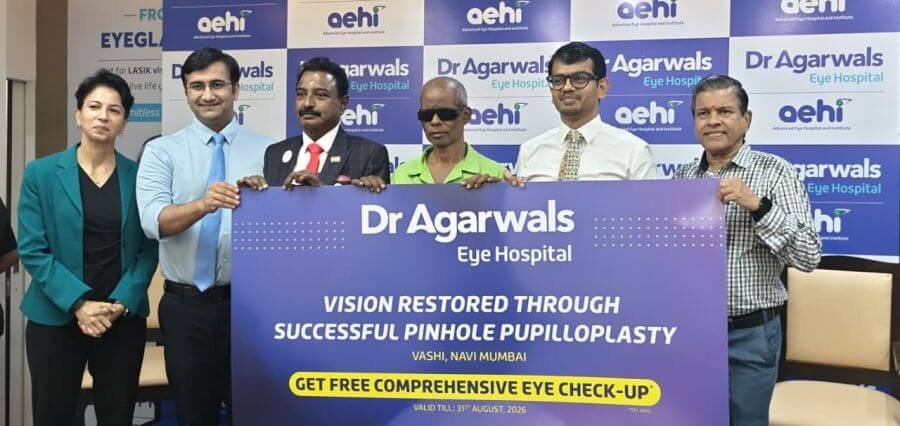
Navi Mumbai, July 28, 2026: Dr Agarwals Eye Hospital has successfully restored the vision of a 62-year-old Navi Mumbai resident through a rare and highly specialized dual surgical procedure combining cataract surgery with Pinhole Pupilloplasty (PPP). The procedure enabled the patient, who had been living with a mature cataract and a dense corneal scar in his left eye, to regain functional vision without requiring a corneal transplant.
Mr. Subhash Vishnu Chache, a resident of Vashi, had experienced progressive vision loss over several years due to two complex eye conditions occurring simultaneously. A dense corneal scar significantly obstructed the passage of light through his left eye, while a mature cataract had rendered the natural lens completely opaque. His right eye was also severely affected, making routine activities such as reading, recognizing faces, walking independently, and performing everyday tasks increasingly difficult.
Seeking a solution after consulting multiple healthcare providers, Mr. Chache visited Dr Agarwals Eye Hospital in Vashi, where he underwent a comprehensive clinical evaluation. Following assessments by Dr. Pratik Yeshwant Gogri and Dr. Vandana Jain, he was referred to the hospital’s specialist surgical team at its Wadala facility for advanced treatment.
The surgery was performed by Dr. Smit M. Bavariya, Cataract Surgeon, Dr Agarwals Eye Hospital, Wadala, who explained that both conditions needed to be addressed simultaneously to achieve meaningful visual improvement.
“The patient presented with two independent factors affecting vision. While the mature cataract prevented light from reaching the retina, the dense corneal scar distorted the light that entered the eye. Cataract surgery alone would not have delivered the desired outcome. By combining cataract extraction with Pinhole Pupilloplasty, we were able to reshape and centralize the pupil, allowing clearer and more focused light to reach the retina despite the corneal scarring. This approach helped restore vision while avoiding the need for a corneal transplant,” said Dr. Smit M. Bavariya.
Dr. Pratik Yeshwant Gogri, Consultant Ophthalmologist at Dr. Agarwals Eye Hospital, Vashi, said the patient’s condition required detailed clinical evaluation before determining the most appropriate treatment approach.
“Mr. Chache had already sought multiple opinions before visiting us. Our examination focused on assessing the extent of corneal scarring, evaluating the cataract and determining whether Pinhole Pupilloplasty would provide meaningful visual improvement. Careful planning and patient selection were critical to achieving the successful outcome.”
Highlighting the importance of multidisciplinary collaboration, Dr. Vandana Jain, Chief Strategy Officer and Head – Clinical Services, Dr. Agarwal’s Eye Hospital, Vashi, said:
“Managing coexisting corneal and lens pathology requires meticulous planning and close coordination between multiple specialists. Cases such as this demonstrate the importance of combining clinical expertise with advanced surgical technologies to deliver personalized treatment. Our continued investments in specialized ophthalmic care, including advanced robotic cataract surgery capabilities, strengthen our ability to manage complex eye conditions with precision.”
Padmashri Dr. S. Natarajan, Chief Clinical Services, Aditya Jyot Eye Hospital, a unit of Dr Agarwal’s Eye Hospital, Wadala, noted that such procedures require specialized expertise and comprehensive clinical infrastructure.
“Performing cataract surgery together with Pinhole Pupilloplasty demands extensive surgical experience, advanced technology, and rigorous clinical protocols. Every patient undergoes a detailed evaluation to determine suitability for this approach. Our objective is to provide patients with evidence-based treatment options that maximize visual outcomes while maintaining the highest standards of safety.”
Pinhole Pupilloplasty was pioneered by Dr. Amar Agarwal, Chairman of Dr Agarwal’s Eye Hospital, as an innovative surgical technique for carefully selected patients with irregular corneas and corneal scarring. By creating a precisely sized pinhole-shaped pupil, the procedure limits distorted peripheral light rays while allowing focused central light to reach the retina, thereby improving visual quality.
Clinical studies involving 257 patients have demonstrated significant improvements in visual acuity following the procedure, with average vision improving from 20/125 before surgery to 20/32 after treatment. Approximately 85 percent of eligible patients achieved driving-quality vision, while the technique has contributed to a reduction of nearly 15–25 percent in the need for corneal transplantation in suitable cases.
Mr. Chache’s surgery lasted approximately one hour, reflecting the complexity of simultaneously addressing both the cataract and corneal pathology. By combining both procedures into a single operation, the surgical team minimized recovery time and avoided the risks and challenges associated with corneal transplantation.
Following surgery, Mr. Chache’s distance vision improved to 6/9, while his near vision improved to N8, allowing him to independently perform daily activities, including reading standard print, recognizing faces, watching television and moving confidently without assistance. His post-operative recovery has been smooth, supported by prescribed medications, scheduled follow-up visits, and routine recovery precautions.
Reflecting on his recovery, Mr. Subhash Vishnu Chache said:
“Losing my vision gradually affected every aspect of my daily life. Even simple tasks became difficult. The doctors at Dr. Agarwal’s Eye Hospital carefully explained my condition and gave me confidence that treatment was possible. Today, I can see clearly again, recognize people and live independently. I am sincerely grateful to the entire medical team for restoring my vision.”
The successful procedure highlights the growing role of advanced ophthalmic innovations in managing complex vision disorders and underscores how specialized surgical techniques can help eligible patients achieve significant visual recovery while reducing the need for more invasive interventions.
About Dr Agarwals Eye Hospital
Dr Agarwals Eye Hospital is one of India’s leading ophthalmology networks, recognised globally for advancing eye care through clinical innovation, research and specialised surgical techniques. Its team has pioneered several internationally adopted ophthalmic procedures, including Glued Intraocular Lens (Glued IOL) surgery, Pre-Descemet’s Endothelial Keratoplasty (PDEK), Single-Pass Four-Throw (SFT) Pupilloplasty, Pinhole Pupilloplasty (PPP) and Corneal Allogenic Intrastromal Ring Segments (CAIRS). Through a combination of advanced technology, clinical expertise and patient-centred care, the hospital continues to deliver comprehensive ophthalmic services across a wide spectrum of eye conditions.