




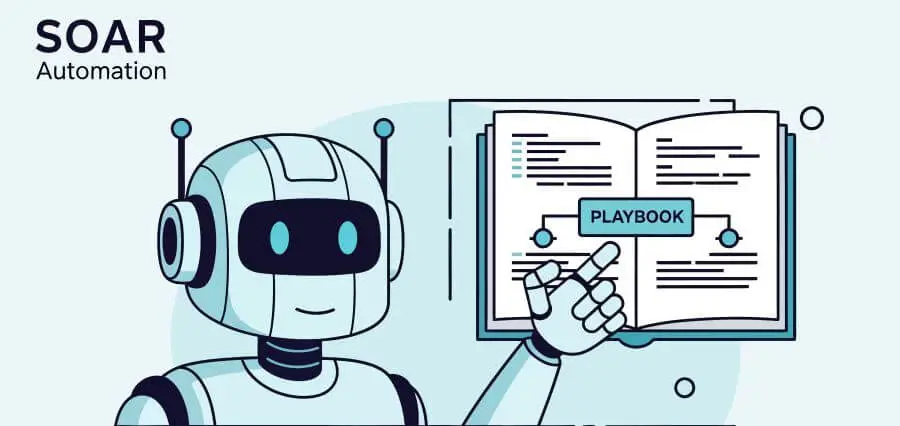
A security team drowning in alerts rarely has a detection problem. Most modern environments generate more than enough signal to catch a real threat; the harder problem is that a human analyst can only investigate so many of those alerts in an eight-hour shift, and the ones that matter most often sit buried under a much larger pile of routine, low-risk noise. That mismatch between alert volume and available analyst hours is exactly the gap SOAR automation in security operations is built to close, taking over the repetitive investigative steps that consume the bulk of a typical shift so analysts can focus on the alerts that genuinely need human judgment.
SOAR often provides the most obvious value in specific use cases that have one thing in common: they usually consist of a series, or sequence, of clearly defined steps (manual activity) executed by a person repeatedly with limited variations between runs.
Phishing Triage: the Standard Beginning
Security operations teams that use SOAR typically start with phishing, and for good reason: it’s a high-volume problem that’s well-understood and amenable to clear, repeatable steps. For example, if an employee submits a report about a suspicious email, the playbook can automatically parse that message and extract relevant indicators such as sender domain and embedded URLs from the original mail, run these indicators through threat intelligence feeds for references against known malware. The case closes itself if the results are clean. The playbook can also query any other mailboxes for the same message, and if it looks malicious, quarantine it globally without needing an analyst to manually intervene.
Coverage of security automation and playbooks makes an important point about why this particular use case tends to succeed where others stumble: it works because the underlying process is already mature and well-documented before automation gets layered on top. Applying automation to a process that isn’t yet consistent and well-understood tends to amplify existing problems rather than solve them.
Threat Intelligence Enrichment
However, before an analyst can determine whether or not any given alert is worth taking action against, they usually need context: has this IP address been involved in malicious activity previously, does this file hash match known malware, was this domain freshly generated in a way that suggests it may be used as disposable infrastructure? This manual gathering of context could entail a process is a mechanical one – sourcing through several threat intelligence sources, individually, this takes time. The moment an alert fires, you can make a query associated with all of those sources simultaneously by using a SOAR playbook which attaches the results to the case before an analyst has opened it.
Automated Containment for Confirmed Threats
When an incident goes from suspected to confirmed, the need for speed generally becomes paramount and this is where some of SOAR’s most immediate value is delivered. For instance, a playbook can take seconds to remove a compromised endpoint from the network, to mash cut off or disable a suspicious user account, or block a malicious IP address on the firewall after confirmed detection that otherwise had required an analyst to log in multiple separate systems and push each step by hand. And, every minute a compromised device is on the network gives an attacker time to laterally move or reach sensitive data.
In contrast, containment automation is riskier than investigative automation because making a decision on a system, rather than just being an indication of the activity running on that asset can interrupt business continuity if the underlying detection logic is inaccurate. Most organizations deploy automated containment incrementally, with an initial human-in-the-loop approval step rather than fully autonomous action on high-confidence detections. A false positive that collects only additional information costs some time; a false positive that further separates a production server can bring down a service on which customers rely.
Vulnerability and Patch Orchestration
SOAR can also go beyond active incident response to the more regular work of vulnerability management. For example, when a scanner detects a new critical vulnerability, the playbook finds out what assets are impacted, verifies if they are on the public internet or exposed to sensitive data and creates tickets for those systems carrying the highest level of risk. Your team does prioritization work (at least, it tries to), but that manual process has slowed down as new vulnerabilities pile up faster than a team can go through them by hand.
What Distinguishes Successful from Unsuccessful Use Cases
One common denominator of all the applications is that automation is simply normalizing a process that was already there under it. Once a manual process is fast, reliable and well-documented, it becomes susceptible to automation. Instead, a fuzzy process becomes fast but unreliable – running process elements at machine speed, but executing the wrong ones rather than the right ones. This is why most successful SOAR deployments begin narrowly, only finding an initial use case that you are already mature enough at implementing before trying to move a whole security operation into automation in one go.
Government agencies have published detailed guidance for organizations navigating this technology from procurement through implementation. Guidance for SIEM and SOAR implementation, developed by CISA in collaboration with international cybersecurity partners, includes separate resources for executives evaluating whether to invest and practitioners responsible for building out the actual playbooks, reflecting how differently these decisions get made depending on where someone sits in an organization.
Frequently Asked Questions
Does SOAR reduce the need for an SIEM?
No, SOAR and SIEM are not generally substitutes for each other; instead, they complement one another: SIEM aggregates and correlates log data to generate alerts, while SOAR takes action on those alerts once they have been generated.
What is the threshold of technical knowledge that an organization needs to reach before being able to implement SOAR?
A meaningful amount. Since automating an undocumented or inconsistent process only creates new issues instead of solving existing ones, it is vital to have a clear and mature view on security processes in order to build consolidated playbooks.
Can SOAR playbooks make mistakes that can actually harm?
For sure, especially with poorly tested logic and containment actions against immature. The risk behind that is why most organizations deploy automation in a phased approach, and typically start with a human approval step before removing it for high-confidence, well-tested playbooks.