




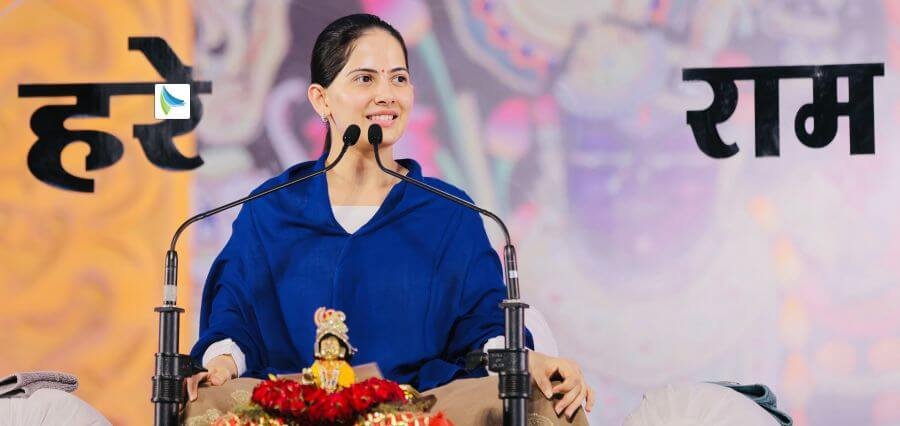
The present age, which consists of loudness and rapid movement and an endless drive for accomplishment, has produced a steady and peaceful voice that impacts the lives of numerous people throughout India and other regions. The voice of Jaya Kishori, who grew up in Kolkata, has dedicated her life to spiritual practices, showing both religious devotion and strong discipline, which created her exceptional ability to understand feelings deeply. The young girl who started singing bhajans at local events has developed into a national figure who creates powerful speeches and performs heartfelt music while expanding her digital reach.
Her strength remains because she can master scripture, yet her true power comes from her ability to explain ancient wisdom through modern times. She connects traditional values with current situations while delivering her message to people who face challenges in finding their life path and resolving their internal battles. As a Spiritual & Motivational Speaker today, she is leading a movement that changes spirituality into an accessible resource, which helps people build resilience, find connections, and discover their life purpose.
A Childhood Steeped in Devotion
Born on July 13, 1995, in Kolkata, West Bengal, Jaya Kishori grew up in a household where spirituality was not a Sunday ritual but a daily habit. Her grandparents filled her childhood with bhajans and stories of Lord Krishna. Her parents, Shiv Shankar Sharma and Sonia Sharma, nurtured that sensitivity rather than reducing it.
At just seven years old, she walked onto a makeshift stage at a local Satsang in Kolkata neighborhood and sang. The audience fell silent. Something in her voice carried a quality that audiences rarely encounter even in trained adults: sincerity. By the time she turned ten, she performed the Sundara Kanda alone in front of a large gathering. The applause that followed was not merely for her talent. It was for a child who made people feel something sacred.
Her earliest spiritual mentor, Pt. Govindram Mishra recognized the depth of her devotion early. In time, witnessing her unwavering commitment, he bestowed upon her the title ‘Kishori Ji’ and the name Jaya Kishori was born. She later trained under Pandit Vinod Kumar Ji Sahal, grounding her knowledge in Shrimat Bhagwat.
The Making of a Modern Spiritual Orator
By her early teens, Jaya Kishori was already traveling across India, giving spiritual talks in towns and cities beyond Kolkata. What set her apart was not just her knowledge of scripture, but her ability to explain it in a simple, modern way. She didn’t just speak to people, she connected with them.
Her signature discourses on the seven-day ‘Katha Srimad Bhagwat’ and the three-day ‘Katha Nani Bai Ro Mairo’ became events that communities planned months in advance. Till date, she has delivered more than 350 such discourses across the country. Remarkably, the charity collections from many of her spiritual sessions find their way to charitable trusts. “I do not separate service from spirituality, for me, they are the same act,” she expresses.
Her discourses rest on four foundational pillars: the Hindu scriptures, her own life experiences, the teachings passed down through her family, and the wisdom she continues to assemble from diverse sources across traditions. This synthesis is what gives her addresses the distinctive texture they feel, simultaneously rooted in tradition and strikingly contemporary.
A Digital Revolution in Devotion
In 2013, Jaya Kishori launched her YouTube channel at a time when the idea of a spiritual orator building an audience online felt almost counterintuitive. The platform, many assumed, belonged to entertainment and lifestyle content. She proved otherwise. Within a few years, millions of subscribers were tuning in not just for her katha sessions but for her motivational talks and bhajans. A type of content that helped people navigate grief, anxiety, relationship fractures, and the quiet despair that modern life tends to deposit.
Her bhajans, including beloved compositions such as Awadh me Ram aaye hai,’ Sao dukh Kaisa pave,’ and ‘Aigiri Nandani’, and many more, have accumulated millions of views and counting. She has lent her voice to more than 20 music albums, each one a testament to her range as a devotional artist.
The scale of the response she generates offline is equally remarkable. In 2018, a mass community event organized around her recitation of the Srimad Bhagwat Katha, where 1,11,000 sarees were presented to women by going door-to-door, entered the World Book of Records. It stands as a testament to the kind of mobilization her name alone inspires.
Extending Her Message Through Writing
Beyond her speeches and bhajans, Jaya Kishori has also reached audiences through her writing, most notably with It’s Okay. The book reflects her core philosophy that emotional struggles, self-doubt, and moments of vulnerability are natural aspects of life rather than weaknesses to conceal.
Through simple yet profound insights, she encourages readers to embrace their imperfections, practice self-acceptance, and move forward with faith and inner strength. Much like her speeches, the book offers comfort and clarity, especially to those navigating the pressures of modern living, reinforcing her belief that healing and growth begin with acknowledging one’s true emotions.
Faith, Family, and the Architecture of Her Message
She speaks about the importance of faith not as an abstract theological concept but as a practical tool, a way of withstanding failure, of sustaining hope when logic offers none. Her speeches are specifically calibrated to reach people who feel unmoored: those who have lost confidence in themselves, those who struggle to find meaning in their routines, those who are caught between the demands of the modern world and the pull of their inner lives.
She also speaks about spirituality as a lifestyle rather than a ceremonial observance. She advocates for mental peace and inner stability as outcomes that spirituality actively produces, not as passive by-products of religious adherence. This framing has drawn a younger demographic to her events, an audience that might ordinarily have little patience for traditional religious discourse.
Recognition at the Highest Levels
On March 8, 2024, International Women’s Day, Jaya Kishori received the National Creator Award for the title of ‘Best Creator for Social Change’ from the Prime Minister of India. The recognition placed her among a select cohort of content creators whose work the country’s leadership acknowledged as genuinely transformative.
That award, however, is only the most recent chapter of an honors story that began years earlier. In January 2016, at the 6th Bhartiya Chattra Sansad Award Ceremony held in Pune, Maharashtra, Shri Mohan Bhagwat, Chief of the Rashtriya Swayam Sewak Sangh, presented her with the ‘Adarsh Yuwa Adhyatmik Guru Puruskar,’ recognizing her as an exemplary young spiritual guru. The setting of a youth parliament underscored the particular significance of her influence on India’s younger generation.
Narayan Seva Sansthan in Udaipur honored her with the ‘Samaj Ratan Award,’ acknowledging the deep commitment she demonstrates to charitable causes. Sanskar Channel, Mumbai, named her the ‘Sanskar Artist of the Year 2013–2014’ at the Sanskar Sandhya event. Fame India Magazine celebrated her as the ‘Youth Spiritual Icon.’ The Women Era Award recognized her as a leading motivational speaker and spiritual orator. Pencil Dotcom placed her among the most inspiring women globally.
More recently, the Iconic Gold Awards 2021 named her the ‘Iconic Woman Motivational Speaker of the Year,’ Lokmat’s Digital Influencer Awards 2021 recognized her as the ‘Best Spiritual Influencer,’ and the World Digital Detox Day presented her with the ‘Best Motivational Speaker 2021’ award. In May 2022, the Global Excellence Awards honored her with the ‘Most Inspiring Woman of the Year Spiritual’ title. Each award adds a layer to a portrait of influence that extends well beyond any single tradition, region, or platform.
The Person Behind the Podium
What strikes those who meet Jaya Kishori off-stage is the absence of any of the affectation one might expect from someone of her stature. She completed her schooling from Mahadevi Birla World Academy and Shri Bhawanipur College in Kolkata, and later earned her Bachelor of Commerce degree. She reads voraciously, practices meditation, and draws a clear line between the public persona that millions follow and the private person she continues to nurture.
She holds an abiding, personal faith in Khatu Shyam Ji and speaks openly about how that personal devotion informs everything she does professionally. Her younger sister, Chetna Sharma, remains close to her, and the family continues to provide the grounding that she herself so often prescribes to others. There is no detachment between the life she advocates from the stage and the life she leads at home, and her audiences sense that alignment keenly.
She is known for a generosity that extends beyond her words. “A substantial portion of my income from katha events flows directly to charitable organizations, particularly to charitable and educational organizations. serves as the foundational backbone of a thriving society, fostering growth, resilience, and long-term progress,” she expresses.
A Movement, Not Just a Ministry
Jaya Kishori, merely a ‘spiritual speaker,’ is to misread the phenomenon she represents. She is, at her core, a social force. Someone who uses the language of devotion to address problems that are profoundly contemporary: loneliness, purposelessness, broken family structures, the crisis of confidence afflicting young Indians navigating a fast-changing world. She addresses these challenges not with self-help jargon but with the enduring vocabulary of scripture, delivered in the warm, immediate register of a trusted elder.
She often says, “Nothing in her life is truly planned; everything was destined.” There is something quietly radical about that conviction in an age defined by relentless personal optimization. It tells people that their worth is not contingent on their productivity. That peace is not a reward one earns after sufficient achievement. That the journey itself is uncertain, imperfect, and occasionally humbling is the point.
As the crowd outside the venue finally fills in and takes its seats, the anticipation in the hall is almost tangible. A hush falls. And then Jaya Kishori walks out, composed, unhurried, radiating the particular calm of someone who has found what she was looking for and has spent the better part of two decades helping others find it too. She begins to speak. Within minutes, people in the front rows are nodding. Somewhere in the middle of the hall, someone wipes a quiet tear.
This, quite simply, is what Jaya Kishori does. She reminds people in a language older than anxiety and louder than doubt that they are not alone.