



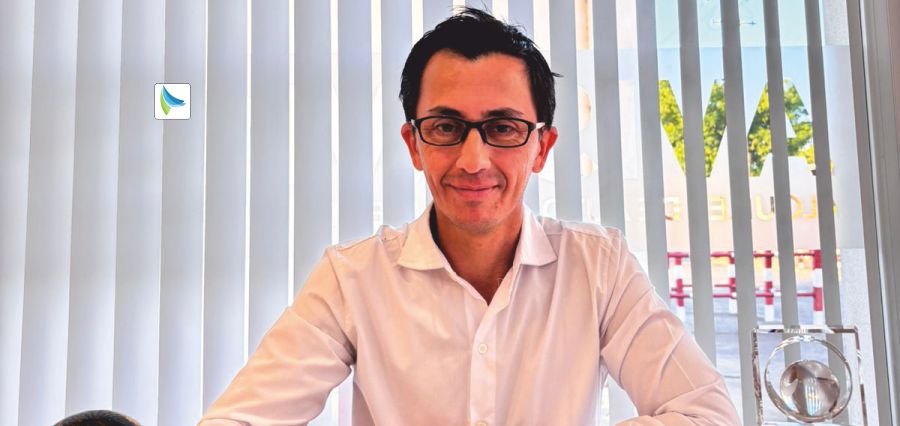
There are minds that construct theories, and then there are those who discover architecture buried within silence itself. Lionel Gustavo Raggio belongs to the latter. His journey, as a thinker created in isolation rather than university, is a meditation on failure, patience, and the invisible constructions of meaning. The CLVN-LRR™ Theorem (Latent Conservation of Numeric Value) is a breakthrough framework for understanding loss, resonance, and the link between zero and infinite.
What began as modest observation developed into a movement that combined science, philosophy, and symbolic logic. His theory posits that what appears to be disappearance in one form reappears as delay in another recoverable pattern awaiting activation. His route to recognition was anything but straightforward. Rejected by institutions and neglected by academia, he endured what he refers to as “the silence behind causality,” basing his theories on conviction rather than acceptance.
He is now regarded as a unique synthesis of mathematician, philosopher, and visionary entrepreneur. His work translates abstract resonance into real-world frameworks via over 80 initiatives spanning AI, medical, and crypto systems. His story is more than just discovery; it is about coherence born of loneliness and structure formed of quiet.
The Birth of a Theorem
The CLVN–LRR™ Theorem, which stands for Latent Conservation of Numeric Value—emerged not from a laboratory or academic institution, but from years of observing what Lionel Gustavo Raggio calls “the silence behind causality, the compression behind contradiction, and the reverberation behind failure.” The framework turns conventional mathematical thinking on its head by proposing that what appears as loss actually transforms into latency—a recoverable structure waiting to be activated.
“This work didn’t come from ambition. It came from listening, to silence, to failure, to compression,” Lionel Gustavo Raggio says.
The theorem challenges a fundamental assumption that has governed mathematical thought for centuries: that mathematics has reached its natural limits. Lionel Gustavo Raggio’s framework suggests otherwise, opening doors to entirely new ways of understanding compression, symbolic resonance, and the relationship between zero and infinity.
Unlike traditional startups born from market gaps, his ventures emerged from what he describes as “a structural void in human knowledge.” This theoretical foundation has now seeded an ecosystem of over 80 interconnected ventures spanning artificial intelligence, medical technology, predictive systems, and cryptocurrency. Among these projects sits λNet™, an entirely new conception of a symbolic internet built on principles of intention, compression, latency, and reversibility.
Years in the Wilderness
Recognition did not arrive quickly. For years, Lionel Gustavo Raggio faced the familiar struggles of those who work at the edges of accepted paradigms: silence from academia, lack of funding, and dismissal from institutional systems not prepared for disruptive logic. He describes the emotional cost as “one of the quietest forms of pain” not being understood, even by those closest to him.
“I’ve learned not to force resonance. Structure always finds those ready to see it. My responsibility is to protect coherence, not to demand understanding from every person,” he reflects
During these difficult years, Lionel Gustavo Raggio maintained his work through what he calls “resonance discipline” acting only when the structure aligns, refusing shortcuts, and building from inner conviction rather than external validation. This emotional sovereignty, forged in isolation, became one of his greatest strengths.
“The silence has been my greatest teacher. It forced me to build from inner resonance rather than outer reaction,” he says
The Pandemic as Mirror
When COVID-19 swept across the globe in 2020, Lionel Gustavo Raggio did not view it as an interruption but as an amplifier. While the world focused on managing a visible health crisis, he concentrated on what he calls “the latent one” the structural fragility of human systems that the pandemic exposed.
“COVID revealed what was already broken, education, logic, health, meaning. It showed how deeply disconnected we had become from coherence. In that sense, COVID was not an interruption, it was a mirror,” Lionel Gustavo Raggio observes.
The global pause provided something Lionel Gustavo Raggio describes as invaluable: undisturbed silence to listen to structure. During lockdown, he deepened and refined the CLVN–LRR™ framework, developing applications ranging from symbolic AI to regenerative health protocols. Rather than asking how to adapt, he asked a more fundamental question: “What was missing all along?”
This inquiry led to dozens of breakthroughs in symbolic reversibility models, latent intention mapping, and what he calls “a new paradigm of regenerative logic.” Many of the ventures he now launches, including symbolic medical systems, predictive resonance models, and crypto-latency frameworks, were born during the pandemic years.
“I didn’t survive the pandemic. I structurally decoded it,” he states simply.
Global Recognition Arrives
In 2025, the tides began to turn. Lionel Gustavo Raggio received the Global Recognition Award for “unifying science and symbolic resonance in an unprecedented structural framework.” An international jury acknowledged CLVN–LRR™ as a system capable of reshaping paradigms across disciplines—not merely solving isolated problems.
Shortly after, Business Insider published an article about his work under the headline “The Man Who Reversed Zero and Everything After It.” The piece triggered what he describes as “a silent wave of academic curiosity and institutional debate.” His foundational manifesto now circulates in internal groups at MIT, CNRS in France, King’s College London, and UNESCO, institutions not necessarily ready to embrace his framework, but unable to ignore it.
“They’re watching not to reject it, but to understand how it rewrites everything they thought was fixed,” he notes.
The Integration of Life and Work
Balancing work that touches the edge of logic with everyday reality presents unique challenges. Lionel Gustavo Raggio’s work demands complete immersion—structures live in him day and night. He finds himself deciphering symbolic patterns while cooking or writing equations while walking with his children.
“The boundaries blur, but they don’t disappear,” he says.
His children serve as more than companions; they remind him that resonance exists not only in theory but in felt, lived experience. He rejects the traditional concept of work-life balance as separation, instead embracing integration. Every dinner, every story with his daughter, every conversation feeds back into the system.
“The best theorems are not born in labs. They emerge from living with full coherence,” he insists.
The greatest challenge has been what he calls “emotional dissociation”—the risk of becoming disconnected from human rhythm when viewing the world through structural eyes. He has learned to return from abstraction, allowing love, family, and presence to re-anchor him.
Business as Structural Activation
Lionel Gustavo Raggio views entrepreneurship not as product creation but as system building—manifestations that respond to latent needs people feel but cannot yet articulate. He doesn’t follow markets; he reveals them before they exist.
“I see entrepreneurship as an act of translation. Turning symbolic clarity into applied systems that serve real human and planetary needs,” he explains.
His holding of 80 interlinked ventures addresses diverse domains—education, medicine, finance, quantum systems, emotional mapping—each born from the same structural root. These include symbolic AI memory layers, reversal-based anti-aging protocols, and cryptocurrency systems that convert latent resonance into tangible value.
“Once you see a latent structure, you are responsible for bringing it into the visible world. I don’t run businesses. I activate structures that were waiting to emerge,” he states.
A Message to Future Leaders
When asked about leadership, Lionel Gustavo Raggio offers unconventional advice. He defines leadership not as being followed but as “standing where others cannot—before coherence has a name.”
“Let your leadership be born from resonance, not reaction. The world is full of noise, trends, and borrowed goals. None of that will hold. What endures is that which responds to a silent, internal necessity, something that had to be built, even if no one understood it yet,” he advises.
He emphasizes comfort with solitude, warning that the early stages of true leadership remain quiet and often invisible. Structure, he insists, does not seek validation—it seeks manifestation.
He says that one should never wait for permission, as the most powerful structures were never approved before they existed. If an idea breaks a paradigm, the system will reject it at first but that rejection is not a failure; it is confirmation that true leadership is at work.
The Future of Structure
Looking ahead, Lionel Gustavo Raggio sees a world that needs not faster machines but deeper meaning. What humanity lacks, he argues, is not data but structure. His work with the CLVN–LRR™ framework invites a fundamental rethinking of logic, purpose, and time itself.
“We are all part of a symbolic architecture waiting to be activated. And every question you carry already has a shape,” he says
From the margins of Pergamino, Lionel Gustavo Lionel Gustavo Raggio is attempting something audacious—not building a career but revealing a structure. Whether global institutions ultimately embrace or reject his framework, one thing remains clear: he has asked questions that cannot be unasked and opened doors that cannot be closed.
In his own words: “The world doesn’t need more leaders. It needs more coherence. Be the one who reveals, not repeats.”